What is the Boom-and-Bust Cycle?
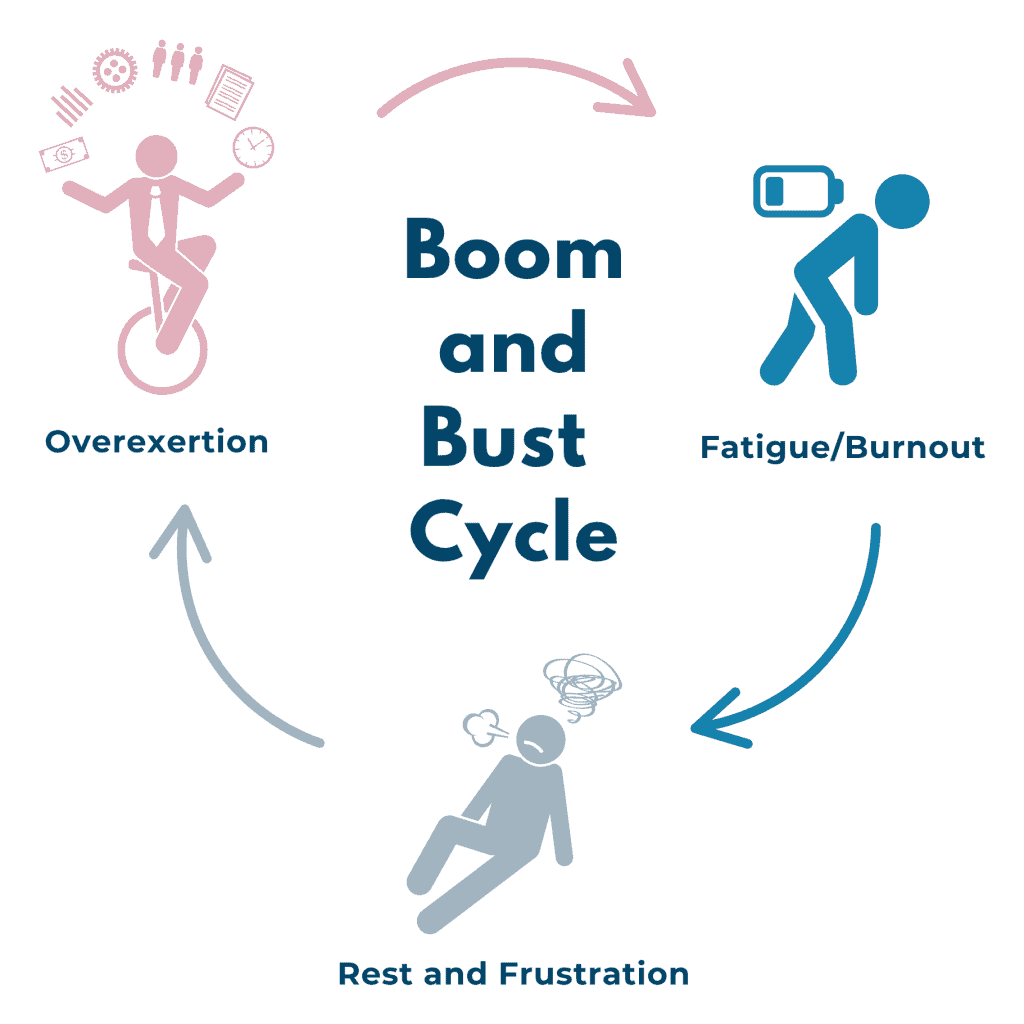
Everyone falls into the boom-and-bust cycle sometimes. The boom-and-bust cycle happens when we overextend ourselves on good days, then need time to recover the following day. For healthy people, this isn’t usually a big deal, as they can typically bounce back pretty easily.
For people living with a chronic health condition, fatigue, pain, or disability, the boom-and-bust cycle is a very common experience. On good energy days, it can feel so good to accomplish things we might feel as if we’re making up for lost time. So we overdo it and push past our body’s signals.
As ADHDers and Autistic people, many of us learned to push through. Inevitably, we crash (aka burnout), then the cycle starts all over again. Rinse and repeat. And each time we whirl through this cycle, we sink ourselves deeper and deeper into burnout.
The Downward Spiral
The trouble starts when the cycle becomes a way of life.
1) For many of us, each crash takes a little longer to recover from, and the burnout gets deeper.
2) It tends to send our mood on a rollercoaster. We tend to feel upbeat, positive, and accomplished on our “good” days, followed by a collapsing depression, disappointment, and melancholy on our “recovery days.”
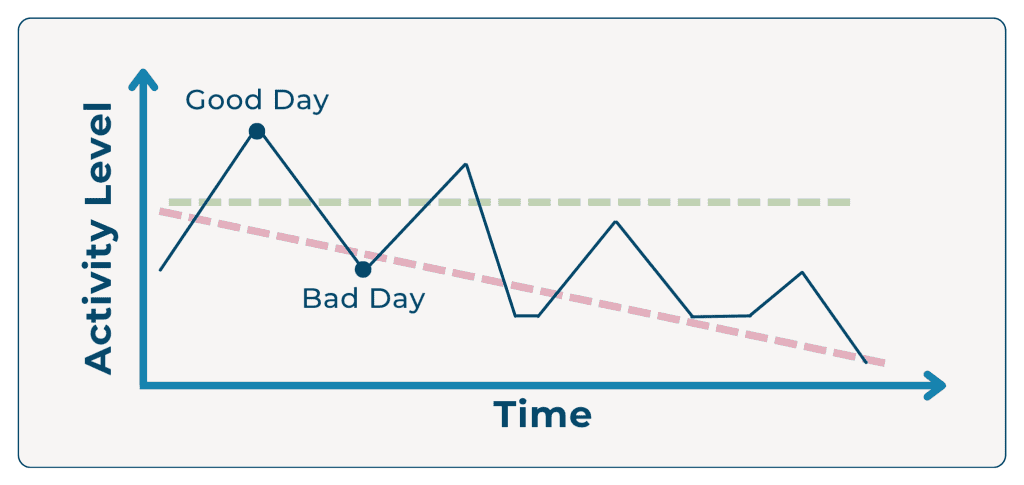
The following graph illustrates the boom-and-bust cycle. Notice that as the rest time between each cycle extends, it can take longer and longer for a person to return to their baseline. The pink line illustrates the downward fatigue spiral that occurs. The green line represents a steady energy expenditure that is more sustainable and enduring. Pacing systems are one of the things that can help a person get out of the boom-and-bust cycle and to move toward a more sustainable energy rhythm.
Intro to Pacing Systems
Several practices can help us get off the boom-and-bust rollercoaster:

addressing internalized ableism

practicing good boundaries

prioritizing healthy sleep habits, and more
I have found pacing systems to be a helpful tool for breaking the boom-and-bust cycle. Pacing systems help us spread our energy more evenly across the day, so we’re not constantly swinging between overdoing it and total collapse.
I first learned about pacing systems when working as a therapist in an oncology clinic. Many of my patients were navigating treatment-related fatigue, chronic pain, and other energy-draining challenges. Pacing their activities was vital for managing their day-to-day lives and ability to function.
Pacing strategies are widely used in medical settings to support people with chronic pain, fatigue, and other disabilities. They provide a useful framework for exploring sustainable ways to monitor and manage energy levels.
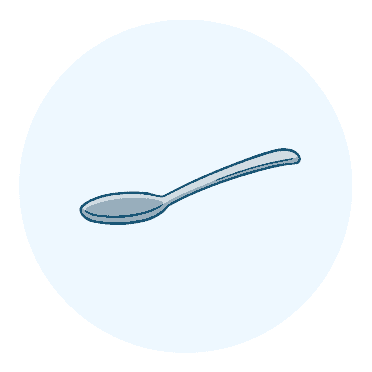
There are a variety of pacing system approaches, but the Spoon Theory pacing system is one of my personal favorites. Spoons give us a simple, visual way to explain our energy to ourselves and to other people.
What is Spoon Theory?
Spoon Theory comes from a 2003 essay by Christine Miserandino, who has lupus. She was in a diner late one night with her best friend, who asked what it actually felt like to be sick. Christine grabbed every spoon on the table, then spoons from other tables, and handed them over.
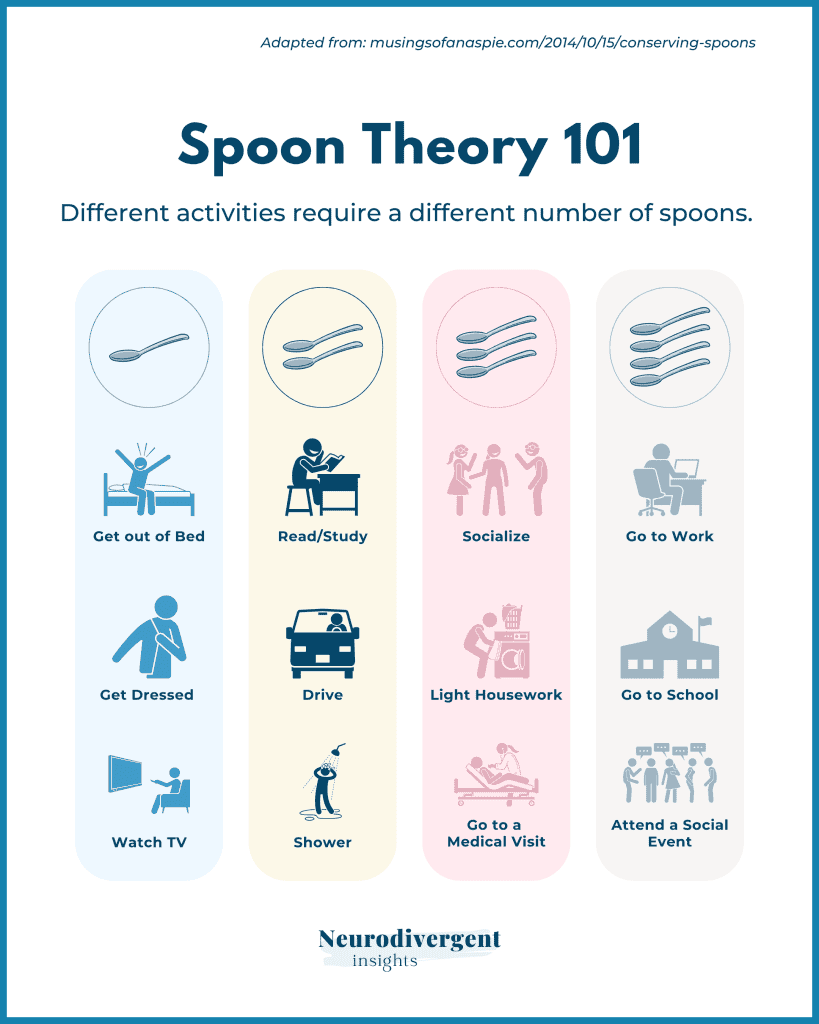
She asked her friend to count the spoons. There were 12. When you’re healthy, she explained, you expect a never-ending supply. When you’re sick, you have to know exactly how many you’re starting with. Then she asked her friend to list the tasks of a typical day. For each activity (waking up, showering, getting dressed), Christine took a spoon away.
Christine used this metaphor to explain that when she wakes up, she has a limited number of spoons. She must be meticulous about every choice she makes. Living with a chronic illness means she has to keep track of how much energy she has and what she’ll spend her spoons on each day.
Christine has since used this theory in the context of disability advocacy, and it’s now widely used by disabled and chronically ill people to describe living with limited energy.
Read about the experience in her own words in her blog post.
An Adapted Spoon Theory for Autism and ADHD
Spoons are a helpful idea, but for many of us one pile of spoons is too simple. Energy isn’t distributed equally across all activities for everyone. For example, you might have plenty of physical energy one day but struggle with tasks that need high focus, or vice versa. This can lead to conflicting needs, like wanting to socialize but being limited by sensory overload.
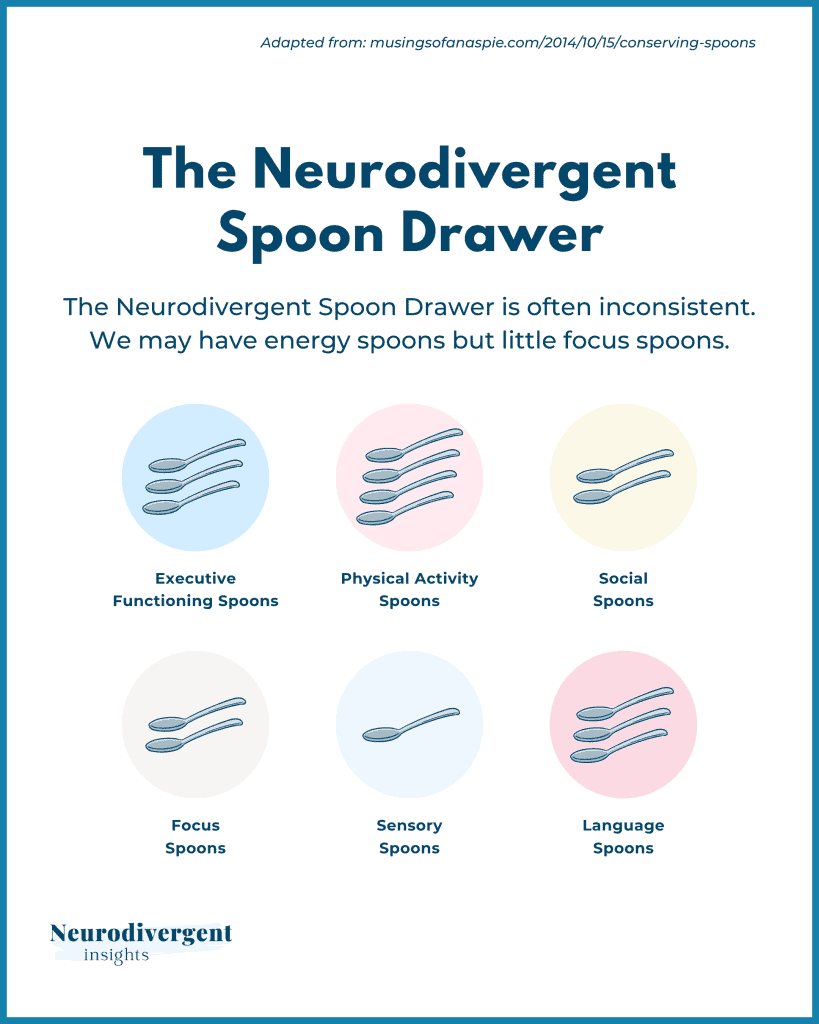
In a 2014 post, Autistic writer Cynthia Kim (Musings of an Aspie) suggested we have different kinds of spoons: social, language, physical activity, and more. Each one can run low on its own.
The Neurodivergent Spoon Drawer is often inconsistent. We might have plenty of energy spoons but only a few focus spoons, or lots of social spoons but limited sensory spoons. Our spoons can live in conflict and create tension for us.
Here’s how this usually shows up for me:
🥄 I have lots of mental spoons and very low social spoons, sensory spoons, and physical energy spoons.
🥄 I could write a workbook a month, create IG content, etc., with ease. But send me to a child’s birthday party or the grocery store and I will need serious recovery time.
Because our energy levels can be so unpredictable and frequently dip or spike, this can often lead to others misinterpreting our actions. For example, someone might say, “If you have the energy to see your friends, you certainly have the energy to do your homework!” These kinds of comments reflect a common misunderstanding of how uneven our energy spoons truly are, which can be a source of frustration for ourselves and for those around us.
Our “spiky” spoon drawer might be interpreted as being selfish, lazy, or a matter of poor prioritizing. People might even assume we are choosing fun over responsibility (“you have time for the things you want to do, but not the things you need to do,” and so on). But for Autistic and ADHD people, it’s rarely a simple choice. Our energy is limited, and it’s also uneven across different parts of life. This important distinction is why it’s helpful for us to go beyond thinking about our global spoons and consider how many spoons we have in each specific area of our lives: executive functioning, sensory, social, focus, language, and so on.
Being able to articulate our own Neurodivergent Spoon Drawer can help us communicate our experiences and needs more effectively, including when we ask for accommodations. For example, if you’re running low on sensory spoons but need something at the grocery store, you might use noise-canceling earbuds while shopping, or maybe you would be able to place an order for grocery delivery and avoid the store completely.
Being aware of our specific spoons can also help motivate us to do certain tasks. For example, I might pair an activity that requires a high level of spoons (cleaning the bathroom) with something that recharges my energy (listening to a podcast on a special interest topic).
If you want to map your own spoon drawer, the Spoon Theory Workbook walks through it step by step.

 Stay in the Neurodivergent Loop