What Is Sensory Regulation? How It Connects to Emotional Regulation
When our nervous system is on high alert, every sensory input gets louder. Even a small touch or sound can push us into overwhelm. To an outsider, it can look like an emotional outburst or a tantrum. Underneath, it’s often a sensory system in overload.
I’ve lived through a lot of sensory dysregulation and overload, and I know how much it affects emotions, focus, and the ability to self-regulate. It can feel disorienting and isolating. Once I started looking at those experiences through a sensory lens, I could trace a lot of them back to overload.
In my experience, sensory regulation comes first, and emotional regulation, attention, and behavior all sit on top of it.
Once I understood that, I started putting my sensory needs first.
Table of Contents
What Is Sensory Regulation?
Sensory regulation is how our nervous system takes in sensory input and adjusts to it, so our arousal (energy level) stays in a range we can work with. It shapes how we respond to the sounds, textures, lights, and movement around us.
When we’re sensory regulated, our inner energy roughly matches what’s happening around us, and we can filter out what doesn’t matter. When we’re dysregulated, that match breaks down, and input gets harder to process.
What Sensory Regulation Looks Like
When we’re sensory regulated, everyday things run more smoothly. Some signs:
Focused attention. We can stay with a task or a conversation without getting pulled away by every sound or movement.
Proportional responses. A sudden noise might startle us without derailing us, and textures are tolerable.
Smoother transitions. We can move between places and activities without getting overwhelmed.
Comfortable sensory engagement. We might seek out a hug, swinging, rocking, or textures we like.
More emotional balance. We can respond to sensory input without getting agitated or shutting down.
Enjoying sensory experiences. The taste of a favorite food, or the sights and sounds around us, can bring pleasure.
What Is Sensory Dysregulation?
Sensory dysregulation happens when our sensory system struggles to manage and respond to input. We might be more sensitive to input, less sensitive, or both in different senses. That can mean being easily overwhelmed by sounds, textures, or busy places, or having a hard time focusing somewhere visually busy.
Sensory dysregulation is more common for neurodivergent people, because our brains often process sensory input differently.
Sensory Regulation in ADHD
Many ADHDers struggle to filter out background sound, visual clutter, or too much information at once. A 2025 meta-analysis of 30 studies found more sensory differences in people with ADHD than in control groups, across sensitivity, avoiding, seeking, and registering input. I go deeper on this in ADHD and Sensory Overload.
Sensory Regulation in Autism
Sensory differences are common enough in autism that they’re part of the diagnostic criteria. One study found that 94% of Autistic adults reported extreme sensory processing patterns in at least one area. Overload can come from sounds, textures, lights, or several at once.
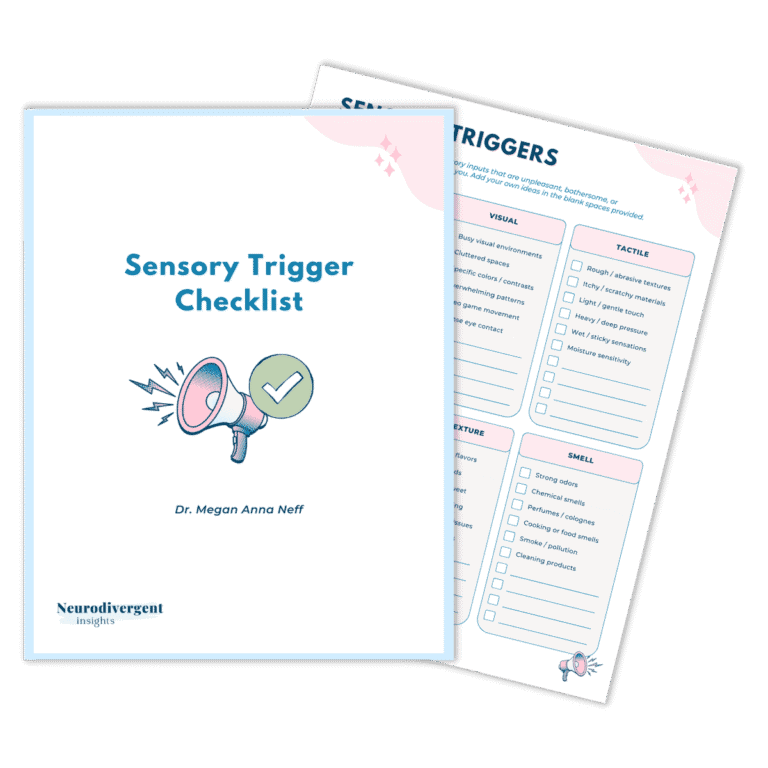
Free Sensory Trigger Checklist
Not sure what sets off your overload? Our free Sensory Trigger Checklist walks you through common triggers across each sense so you can start mapping your own.
Self-regulation is our ability to manage attention, emotions, and actions in response to what’s happening around us. It includes noticing what we feel and need, and managing impulses as things change.
In my experience, sensory regulation is the base the other kinds of regulation sit on. When the sensory system is dysregulated or overloaded, regulating emotions, attention, and behavior all get harder. It also works the other way: as other self-regulation skills grow, overload gets easier to manage.
Sensory Regulation and Emotions
Sensory overload can quickly turn into frustration, anxiety, or a meltdown. When sensory input is manageable, emotions tend to be easier to manage too. More on this in Sensory Overload and Emotions.
Sensory Regulation and Behavior
Sensory overload can set off a stress response, putting us into fight, flight, or freeze. In that state, changing what we’re doing gets much harder.
Sensory Regulation and Executive Function
Executive function covers planning, organizing, focusing attention, managing impulses, and flexible thinking. Sensory overload pulls from the same limited capacity, so concentrating and filtering out what doesn’t matter get harder. Supporting sensory regulation often makes focus easier.
Putting Sensory Regulation First
Compliance-based systems and many traditional therapy approaches focus on emotions or behavior without looking at the sensory system. Trying to build emotion or behavior skills on top of a dysregulated sensory system is like building a house on wobbly ground.
Supporting sensory regulation first can mean accommodations, sensory breaks, sensory-oriented therapies, or a more sensory-friendly environment.
For ADHD and Autistic Adults
When irritability, anger, fatigue, or anxiety show up, a sensory self-check-in can help:
Am I sensory dysregulated?
Is there something I can do to self-soothe until I can get to sensory safety?
What is one thing that could move me toward sensory safety?
For Parents and Teachers
Before addressing “bad” behavior, emotional outbursts, or inattention directly, it can help to ask:
Is this person sensory regulated?
How can I support their sensory regulation?
How do I help this child get back to sensory safety?
For Therapists and Caregivers
When someone starts to look stressed, anxious, or agitated, these questions can guide the next step:
How can I reduce sensory input (dim the lights, lower the noise, give them space)?
Are there sensory supports I can offer?
How can I reduce demands until they’re back to sensory safety?
Strategies for Sensory Regulation
What helps depends on the person, and it usually takes some experimenting. A few starting points for each group:
Neurodivergent adults
A sensory safety plan: calming input, sensory tools, and an exit plan for busy places
A sensory-friendly space: softer lighting, less noise, visual supports
Relaxation practices, sensory breaks somewhere quiet, or time to pace out extra energy
Parents and teachers
Spaces with fewer distractions, visual schedules, fidgets or cushions, and seating that allows movement
Scheduled sensory breaks: movement breaks, calming corners, sensory bins
Visual supports and predictable routines
Therapists and caregivers
Learning the person’s sensory preferences and sensitivities
Building strategies together, and inviting them to explore what feels good
A calm space, and respect for their need for breaks
⟳ Loading template...
A Few Closing Thoughts
For many neurodivergent people, sensory regulation is the part nobody asked about.
The check-in questions above are one way in, the next time irritability or overwhelm shows up.
Sensory Regulation FAQs
What is sensory regulation?
Sensory regulation is how the nervous system takes in sensory input and adjusts to it, so our energy level stays in a range we can work with. When we’re regulated, we can filter out what doesn’t matter and respond in proportion.
What does sensory dysregulation look like?
It can look like being easily overwhelmed by sounds, textures, or busy places, trouble focusing, irritability, meltdowns, or shutting down. Some people are more sensitive to input, some less, and many are both in different senses.
How is sensory regulation related to emotional regulation?
When the sensory system is overloaded, emotions get harder to manage. In my experience, meeting sensory needs first makes emotional regulation easier.
What are some sensory regulation strategies?
Common strategies include sensory breaks, a sensory-friendly space, deep pressure or movement, calming sounds, and a sensory safety plan for busy places.
For ongoing insights and updates, subscribe to the Neurodivergent Insights Newsletter. Each Sunday, I send out fresh thoughts and a roundup of the newest resources on topics related to neurodivergence, mental health, and wellness. My most personal writing is reserved for my newsletter, and subscribers also get access to the newsletter vault (12+ PDFs) when they join.
References
Crane, L., Goddard, L., & Pring, L. (2009). Sensory processing in adults with autism spectrum disorders. Autism, 13(3), 215–228. https://europepmc.org/article/MED/19369385
Jurek, L., et al. (2025). Sensory processing in individuals with attention-deficit/hyperactivity disorder compared with control populations: A systematic review and meta-analysis. Journal of the American Academy of Child & Adolescent Psychiatry, 64(10), 1132–1147. https://pubmed.ncbi.nlm.nih.gov/40250555/
Welcome!
Created by Dr. Megan Anna Neff, the Neurodivergent Insights Blog explores mental health and wellness through a neurodivergent lens, blending lived experience with clinical insight.
Dr. Megan Anna Neff (she/they) is an AuDHD clinical psychologist, as well as the author of Self-Care for Autistic People, The Autistic Burnout Workbook, and the forthcoming AuDHD Unlocked (Fall 2027).
She is the founder of Neurodivergent Insights, the business behind her education, training, clinical writing, and the NDI YouTube channel. Grounded in the blend of clinical insight, research, and lived AuDHD experience, NDI translates complex neurodivergent experiences into accessible, compassionate, and affirming resources for adults, clinicians and helping professionals worldwide.
To provide the best experiences, we use technologies like cookies to store and/or access device information. Consenting to these technologies will allow us to process data such as browsing behavior or unique IDs on this site. Not consenting or withdrawing consent, may adversely affect certain features and functions.
Functional
Always active
The technical storage or access is strictly necessary for the legitimate purpose of enabling the use of a specific service explicitly requested by the subscriber or user, or for the sole purpose of carrying out the transmission of a communication over an electronic communications network.
Preferences
The technical storage or access is necessary for the legitimate purpose of storing preferences that are not requested by the subscriber or user.
Statistics
The technical storage or access that is used exclusively for statistical purposes.The technical storage or access that is used exclusively for anonymous statistical purposes. Without a subpoena, voluntary compliance on the part of your Internet Service Provider, or additional records from a third party, information stored or retrieved for this purpose alone cannot usually be used to identify you.
Marketing
The technical storage or access is required to create user profiles to send advertising, or to track the user on a website or across several websites for similar marketing purposes.







 Stay in the Neurodivergent Loop