As an Autistic person, understanding the inner workings of emotions has been key for learning how to work with them.
Where emotions come from is one of the oldest questions in psychology, and there’s still no single answer. Here are the main theories, two famous studies, and a newer way of thinking about feelings that I find especially helpful.
Emotions: Body, Mind, or Both?
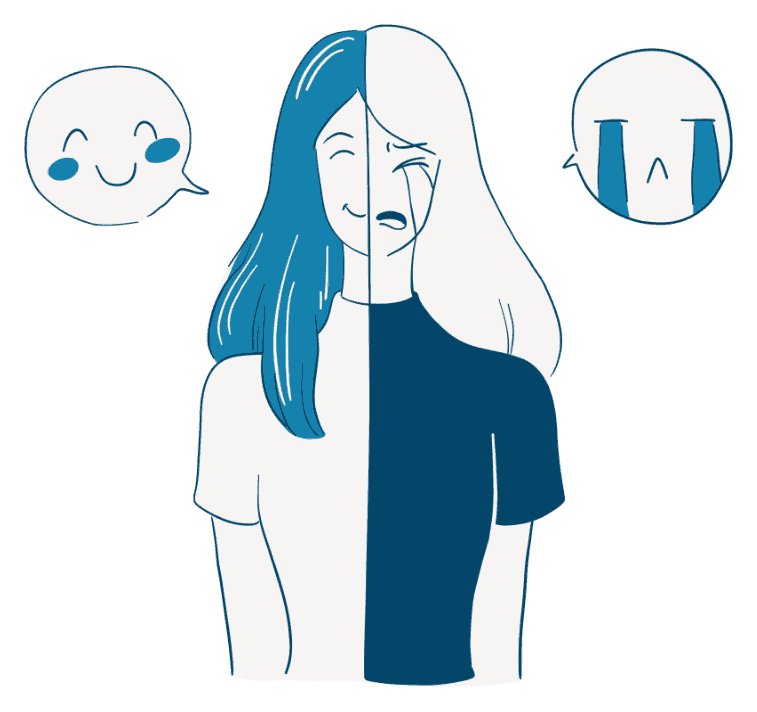
One way many researchers now think about emotions is as a blend of body sensations and the meaning our brain makes of them. Body sensations act as signals about what’s happening inside and around us. How we read those signals shapes the specific emotion we feel.
For example, a racing heart and sweaty palms tell us our body is activated. Whether that becomes fear, excitement, or anxiety depends on the context and on what we’ve lived through before. If a situation reminds us of something painful, our mind may read the same signals as fear or sadness. If we read it more positively, it may land as excitement or joy.
Neuroscientist Antonio Damasio’s somatic marker hypothesis adds to this. He proposed that the body’s reactions get linked, often outside our awareness, to past emotional experiences, and that those links shape our decisions. Other researchers put more weight on appraisal: how we interpret what’s happening. Most now agree it isn’t one or the other. Body, mind, and context all play a part.
Where Do Emotions Come From?
Emotions draw on a mix of sources, from biology to the world around us. A few of the main ones:
The brain. Many brain areas are involved, including the amygdala, insula, and prefrontal cortex. There’s no single “emotion center.”
Brain chemistry. Chemical messengers like serotonin, dopamine, and norepinephrine influence mood, motivation, and arousal. The idea that one chemical equals one emotion (serotonin as “happiness”) is a myth.
Genetics. Our genes shape how strongly we tend to react and how quickly we settle.
Past experiences. Memories and learning shape what we expect, and what we expect shapes what we feel.
Culture and environment. Family, culture, and circumstances shape which emotions we feel and how we show them.
Hormones. Stress hormones like cortisol, and hormonal shifts during puberty, pregnancy, and menopause, can all change our emotional experience.
Five Theories of Emotion
Over the last 140 years, researchers have offered different answers to one question: which comes first, the body or the feeling? Here’s a quick map before we go through each one.
Body first
James-Lange
Body reacts → we feel the emotion
Both at once
Cannon-Bard
Body and feeling arrive together
Mind first
Lazarus
We appraise the situation → body + feeling
Body + label
Schachter-Singer
Body reacts → we label it from context
Prediction
Barrett, Seth
Brain predicts → body + feeling → checked against what happens
James-Lange: Body First
In the 1880s, William James and Carl Lange each proposed, separately, a similar idea: emotions are how we experience changes in the body. First the body reacts, with a racing heart or sweating palms, and then we feel that reaction as an emotion. In James’s famous example, we don’t run from a bear because we’re afraid. We feel afraid because we run.
Cannon-Bard: Both at Once
Physiologist Walter Cannon challenged the James-Lange theory in 1927. He pointed out that bodily changes are often too slow to explain how fast we feel things, and that they look much the same across different emotions. Think of a hard workout: your heart pounds and you sweat, but you don’t feel afraid. Cannon and Philip Bard proposed instead that the body’s reaction and the feeling happen at the same time.
Lazarus: Mind First
Psychologist Richard Lazarus put the mind first. In his view, it’s not just what happens to us, but how we interpret it. We appraise a situation, often in a split second, and that appraisal sets off both the emotion and the body’s response. The same event can feel very different depending on the meaning we give it.
Schachter-Singer: Body Plus a Label
Stanley Schachter and Jerome Singer’s two-factor theory brings body and mind together. First the body reacts. Then we look to the situation to explain that reaction, and the label we give it shapes the emotion we feel. More on the study behind it below.
Prediction: The Brain’s Best Guess
The newest of these theories flips the order the older ones assume. For a long time, we pictured the brain waiting for information to arrive and then working out what it meant. Over the last twenty years, neuroscience has moved toward a different picture. The brain is constantly predicting what comes next, and it adjusts when a prediction turns out to be wrong. As autism researcher Peter Vermeulen puts it in Autism and the Predictive Brain, “the brain does not receive the world; the brain predicts the world.”
Many of us have felt this. Pick up a carton we think is full, find it nearly empty, and our arm flies up before we can stop it. Nothing touched us. The brain had already braced for a weight that wasn’t there.
Lisa Feldman Barrett’s theory of constructed emotion brings this to feelings. Rather than a fixed program firing, an emotion is the brain’s best guess about what’s happening, built from two things: signals from the body and predictions shaped by past experience. Neuroscientist Anil Seth makes a related point: even our sense of what’s happening inside the body is partly a prediction.
In this view, emotions aren’t just reactions after the fact. They’re part of how the brain gets us ready for what it thinks is coming.
Why this matters for neurodivergent people. For many of us, body signals come in noisy or barely at all (more on interoception here). When the signal is muddy, the brain’s guess leans harder on past experience, and it’s easier to land on the wrong feeling, or not know what we’re feeling at all. Some researchers also think Autistic brains give more weight to prediction errors, the jolt when the world doesn’t match the guess, which may be part of why surprise and change can feel so big. This research is still young, so I hold it as a useful lens rather than settled science.
Which One Is Right?
No single theory wins. Each one captures part of the picture, and newer research suggests emotions come from body, mind, context, and prediction working together.
The story we tell ourselves is important!
Two famous studies show how much that story matters, and how easily the body’s signals can be read in more than one way.
Two Famous Studies
The Adrenaline Study
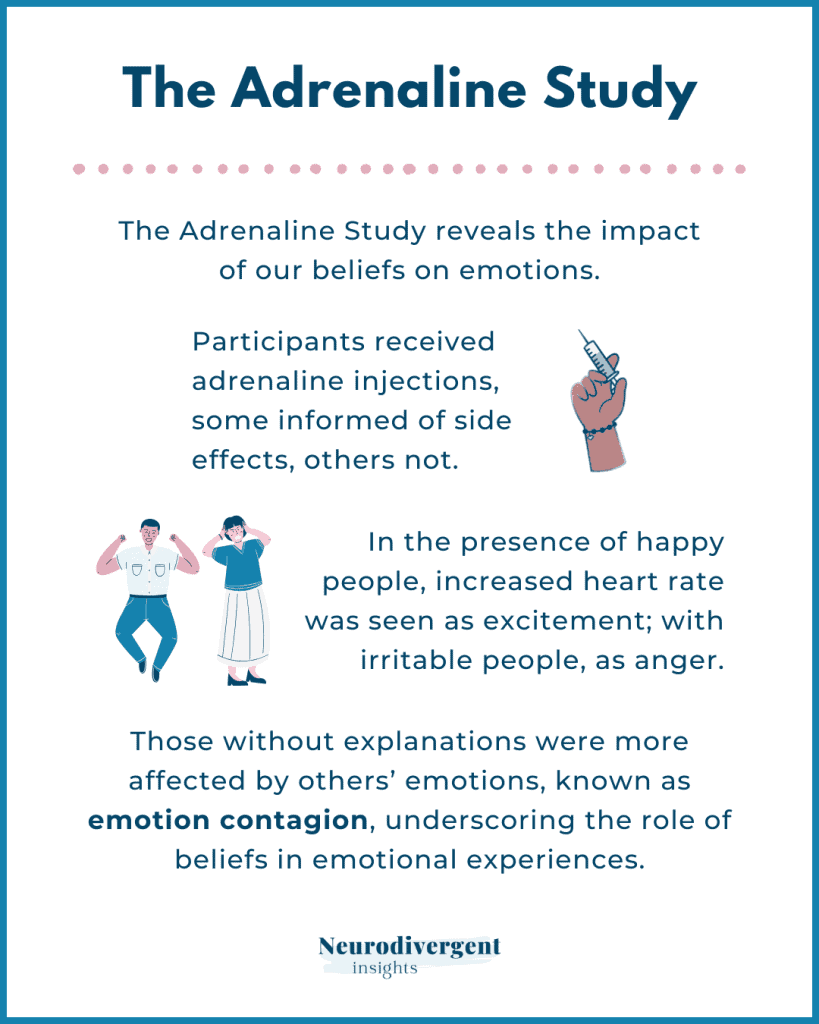
In Schachter and Singer’s 1962 study, male college students were told they were getting a vitamin compound to test their vision. Most actually got an injection of epinephrine (adrenaline). Some were told about the side effects to expect, like a racing heart and shaky hands. Others weren’t.
Each student then waited with another “participant” who was secretly part of the study and acted either euphoric or irritated. The students who had no explanation for their racing hearts were more likely to take on the mood in the room.
When we don’t have an explanation for what our body is doing, we look around us for one.
Later studies, by Marshall and Zimbardo and by Maslach in 1979, didn’t always find the same thing. In their work, unexplained arousal tended to feel unpleasant rather than taking on the mood of the room. So the adrenaline study is best read as an early, influential idea rather than settled science.
The Capilano Suspension Bridge Study
In Dutton and Aron’s 1974 study, men crossed either a sturdy, low bridge or the wobbly Capilano Suspension Bridge in British Columbia. A woman working with the researchers approached them on the bridge, asked them to fill out a short questionnaire, and gave them her phone number in case they had questions.
Men on the shaky bridge were more likely to call her later. The researchers read this as misattribution of arousal: some of the men may have read the jitters from the bridge as attraction.
A Few Closing Thoughts
We may never have one neat answer to where emotions come from. What we do know is that they come from body sensations, the meaning we make of them, and the predictions our brain is always running.
For neurodivergent people, this matters. When body signals are hard to read, as with alexithymia or interoception differences, we may be more open to misreading arousal, or to taking on the emotions around us. Getting to know our body’s signals can help. The arousal-valence model is a gentle place to start, and Feelings Are Not Facts is a good next read.
Our senses play a part too. For how overload turns up the volume on emotions, see Sensory Overload and Emotions.
Where Emotions Come From FAQs
Additional Resources
For ongoing insights and updates, subscribe to the Neurodivergent Insights Newsletter. Each Sunday, I send out fresh thoughts and a roundup of the newest resources on topics related to neurodivergence, mental health, and wellness. My most personal writing is reserved for my newsletter, and subscribers also get access to the newsletter vault (12+ PDFs) when they join.
References
Barrett, L. F. (2017). The theory of constructed emotion: An active inference account of interoception and categorization. Social Cognitive and Affective Neuroscience, 12(1), 1–23. Link
Cannon, W. B. (1927). The James-Lange theory of emotions: A critical examination and an alternative theory. The American Journal of Psychology, 39(1/4), 106–124. Link
Dutton, D. G., & Aron, A. P. (1974). Some evidence for heightened sexual attraction under conditions of high anxiety. Journal of Personality and Social Psychology, 30(4), 510–517. Link
Marshall, G. D., & Zimbardo, P. G. (1979). Affective consequences of inadequately explained physiological arousal. Journal of Personality and Social Psychology, 37(6), 970–988. Link
Maslach, C. (1979). Negative emotional biasing of unexplained arousal. Journal of Personality and Social Psychology, 37(6), 953–969. Link
Schachter, S., & Singer, J. (1962). Cognitive, social, and physiological determinants of emotional state. Psychological Review, 69(5), 379–399. Link
Seth, A. K. (2013). Interoceptive inference, emotion, and the embodied self. Trends in Cognitive Sciences, 17(11), 565–573. Link
Vermeulen, P. (2022). Autism and the predictive brain: Absolute thinking in a relative world. Routledge.






 Stay in the Neurodivergent Loop