Many neurodivergent people need regular nervous system resets to help the body regulate. This post gives a short overview of how the nervous system responds to stress, then 13 ways to reset. For a deeper dive, see The Neurodivergent Nervous System.
Table of Contents
Before a Nervous System Reset
It helps to understand what’s going on in the body first. Here’s a quick look at the parts of the nervous system that handle stress and rest.
The Autonomic Nervous System
The autonomic nervous system (ANS) is responsible for moderating our bodies’ response to external and internal stressors. The ANS is made up of two branches:
- the Sympathetic Nervous System (“Fight-or-Flight”)
- the Parasympathetic Nervous System (“Rest-and-Digest”)
The sympathetic nervous system is responsible for arousing and mobilizing our body for action. This system is what activates our “fight-or-flight” response.
The parasympathetic nervous system calms our bodies and aids the “rest and digest” process.
These two systems control the same organs; however, they work in opposite directions. Think of the sympathetic mode as the gas pedal and the parasympathetic mode as the brake pedal. When the two branches work in harmony, like a driver easing between the gas and the brake, they keep the body in balance.
Sympathetic Nervous System
When we experience a threat, our bodies may become sympathetic dominant, commonly referred to as the “fight-or-flight” response.
When our sympathetic nervous system kicks into gear, several things happen: we get a surge of adrenaline (epinephrine), and our stress hormone, cortisol, increases.
These hormones are designed to give us the energy to fight off the threat. Other physical responses to the fight or flight process include:
- Pupils dilate so that we can take in more information
- Heart rate increases
- Breathing speeds up
- Blood diverts from our digestive tract to our muscles
These physical responses are helpful and lifesaving on the rare occasion we are out in the woods and run into a dangerous animal. However, it’s not so helpful when sitting in a classroom, and our fight-or-flight response gets tripped. We then have excessive energy with limited outlets to release it.

The Parasympathetic Nervous System
The parasympathetic nervous system (the brake pedal) slows down specific responses within the body and helps the body get into a state of calmness. When in the parasympathetic branch of the nervous system, we can slow down, calm the body, rest, relax, and sleep. It supports digestion, repair, and sleep.
When our body is in the parasympathetic nervous system, it experiences the following:
- Reduced heart rate
- Slower (deeper) breathing
- Soft eye focus
- More digestive activity (including enzymes and bile)
Our ability to activate the relaxation response and down-regulate our body is directly connected to our vagal tone. Some studies have found lower heart rate variability, a rough marker of vagal tone, in Autistic people at rest. This may be one reason it can take longer for some of us to come back down after stress.

Freeze and Shutdown
Fight-or-flight isn’t the only stress response. When stress feels overwhelming, or there’s no way out, the body can shift into freeze, or shutdown, instead.
Shutdown can feel foggy, heavy, and disconnected. It can be hard to move, speak, or think clearly, and some people describe it as watching life from a distance. I write more about this in Autism, ADHD, and Dissociation: Why We Fog Out.
Significance for ADHD and Autistic Nervous Systems
For the neurodivergent person, a loud sound, unexpected change to plans, or unexpected touch can trip our fight-or-flight response. And then, it can take longer to get back to baseline. For this reason, many of us spend a lot of time in fight-or-flight mode.
To Summarize: when we are stressed, emotionally taxed, tired, or sensory overloaded, our nervous system is dysregulated. This is the body’s natural response. In these moments, our nervous system needs a “reset” to get back to baseline.
Many ADHD and Autistic people have more sensitive nervous systems, meaning we are more easily shifted into a stressed state.
13 Strategies for a Nervous System Reset
Because ADHDers and Autistic people have more sensitive nervous systems, we benefit from more daily resets. Here are 13 practices that can help reset the nervous system:

Chew on Ice
Chewing on ice is grounding and can also help with sensory overload. Chewable fidgets can function similarly.
Three Deep Breaths
Deep breathing helps to trigger the relaxation response and move us out of our fight-or-flight response.
Stim Through It
Stimming helps to move the excess energy through. You may need to move the extra energy through before being able to engage in down-regulating and relaxing practices (like breathwork and progressive muscle relaxation).
Try a Vagus Nerve Toning Device
My personal favorite is the Sensate, which uses gentle vibration and sound on the chest to help the body shift into rest mode. Research on devices like this is still limited, but I find it really calming. Use code NeuroInsights to get 10% off.
Tapping
Many people find tapping grounding, and studies of tapping (often called EFT) have found it can ease anxiety.
Put on Music and Dance
Music you love can trigger dopamine release and works as a great mood reset. Dancing helps move the energy through and can provide grounding.
Hum, Chant, or Sing
Humming, chanting, and singing slow your exhale and create vibration in the throat, where branches of the vagus nerve run. Both can help nudge the body toward rest mode.
Spend Time with Your Pet
Pets can help co-regulate and down-regulate our nervous system. If you are playing with or petting your pet, this serves as an extra sensory grounding strategy.

Use a Weighted Blanket
Many people find the deep pressure of weighted blankets calming (alternatively, you may consider a weighted lap pad).
Go on a Walk
Walks are grounding, increase dopamine, and help to move excess energy through. If done outside, the fresh air is a bonus.

Hold a Fan in Front of Your Face
The cool air is both grounding and helps to down-regulate the body.
Progressive Muscle Relaxation
This is one of my favorite strategies for calming the nervous system. It eases muscle tension and helps the body shift into rest mode. A 2024 systematic review found it helped adults with stress and anxiety. Dartmouth has a recording you can listen to that will walk you through a progressive muscle relaxation exercise.

Use Aromatherapy
Many people find scents like lavender calming. One review found lavender may ease anxiety and lower cortisol, although this is early research. As a bonus, the more you do this, your brain will start to pair the smell with relaxation, which will further support relaxation.
Nervous System Reset FAQs
What does it mean to reset your nervous system?
When we are stressed, emotionally taxed, tired, or sensory overloaded, our nervous system is dysregulated. This is the body’s natural response. In these moments, our nervous system needs a “reset” to get back to baseline.
Why do Autistic and ADHD people need more nervous system resets?
Many ADHD and Autistic people have more sensitive nervous systems, meaning we are more easily shifted into a stressed state. A loud sound, unexpected change to plans, or unexpected touch can trip our fight-or-flight response, and then it can take longer to get back to baseline. Because of this, we benefit from more daily resets.
What is the difference between the sympathetic and parasympathetic nervous system?
The sympathetic nervous system is responsible for arousing and mobilizing our body for action. This system is what activates our “fight-or-flight” response. The parasympathetic nervous system calms our bodies and aids the “rest and digest” process. Think of the sympathetic mode as the gas pedal and the parasympathetic mode as the brake pedal.
Can stimming help calm the nervous system?
Stimming helps to move the excess energy through. Stimming also provides predictable input, which can be grounding for many Autistic people. We may need to move the extra energy through before being able to engage in down-regulating and relaxing practices (like breathwork and progressive muscle relaxation).
Visual Guide
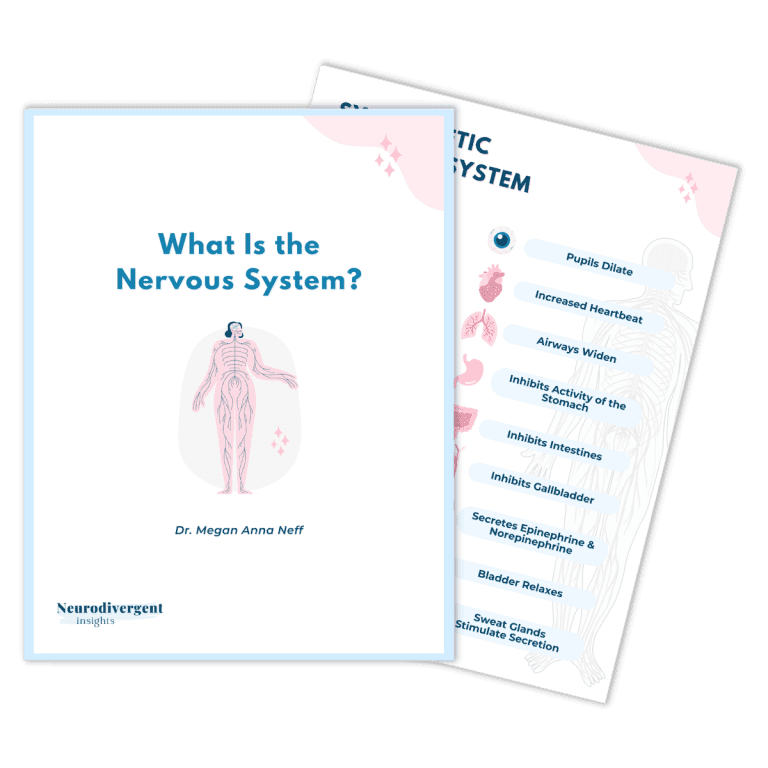
Prefer to engage or share this information visually? Our free NDI Visual Guides are abbreviated, visual-forward highlights of our longer articles. This one, What Is the Nervous System?, walks through the basics.
Additional Resources
This post contains affiliate links. If you buy through them, we may earn a small commission at no extra cost to you. We only link to things we use or trust.

Vagus Nerve Devices: Some people, including me, find the Sensate calming. The research on how it works is limited. Use code NeuroInsights to get 10% off.

Workbook: For more of a deep dive on the nervous system you can check out the Neurodivergent Nervous System digital workbook here.

Free Blog Posts: I have several free blog posts up on nervous system regulation practices and strategies.
 Stay in the Neurodivergent Loop
For ongoing insights and updates, subscribe to the Neurodivergent Insights Newsletter. Each Sunday, I send out fresh thoughts and a roundup of the newest resources on topics related to neurodivergence, mental health, and wellness. My most personal writing is reserved for my newsletter, and subscribers also get access to the newsletter vault (12+ PDFs) when they join.
References
Cheng, Y.-C., Huang, Y.-C., & Huang, W.-L. (2020). Heart rate variability in individuals with autism spectrum disorders: A meta-analysis. Neuroscience & Biobehavioral Reviews, 118, 463–471. https://doi.org/10.1016/j.neubiorev.2020.08.007
Clond, M. (2016). Emotional Freedom Techniques for anxiety: A systematic review with meta-analysis. Journal of Nervous and Mental Disease, 204(5), 388–395. https://doi.org/10.1097/NMD.0000000000000483
Kang, H., Nam, E. S., Lee, Y., & Kim, M. (2019). How strong is the evidence for the anxiolytic efficacy of lavender? Systematic review and meta-analysis of randomized controlled trials. Asian Nursing Research, 13(5), 295–305. https://doi.org/10.1016/j.anr.2019.11.003
Muhammad Khir, S., Wan Mohd Yunus, W. M. A., Mahmud, N., Wang, R., Panatik, S. A., Mohd Sukor, M. S., & Nordin, N. A. (2024). Efficacy of progressive muscle relaxation in adults for stress, anxiety, and depression: A systematic review. Psychology Research and Behavior Management, 17, 345–365. https://doi.org/10.2147/PRBM.S437277
Salimpoor, V. N., Benovoy, M., Larcher, K., Dagher, A., & Zatorre, R. J. (2011). Anatomically distinct dopamine release during anticipation and experience of peak emotion to music. Nature Neuroscience, 14(2), 257–262. https://doi.org/10.1038/nn.2726