
The Attention Series, Part Two
Stop me if you’ve heard this one before. I sat down to write today’s essay — but got sidetracked.
I accidentally looked at the Neurodivergent Insights inbox and saw an email come in. It was one of those emails that lights up the OCD part of my brain. It was a complaint about language use in an article. The emailer took issue with some particular terminology and then mischaracterized intent based on that wording. I couldn’t simply ignore this email, even though I knew that particular phrasing was chosen carefully to stay close to the research — not because of a character-based reason as implied in the email.
Still, my brain couldn’t let it go. Maybe there’s new research I missed that means I should change that wording. So off I went — down the rabbit hole. I looked at the research again. I found new research and read that so that I could provide a more informed response. After all this, I drafted a response to the reader, but then paused to wonder if this was a genuine concern or someone trolling me. The political climate makes that hard to tell sometimes. So I edited my reply to make my response as protected as possible, just in case.
So here I am, an hour later, back to the newsletter finally and realizing that I’m supposed to be writing about regulating our attention. Whoops. Apparently this is going to be one of those ones where it’s a “do what I say, not what I do” thing, since I clearly cannot lead by example at this, as I’m suddenly aware that I’ve just spent my limited writing window following a thread that didn’t need to be tugged. I know better. I have systems and boundaries in place precisely because I know how vulnerable my attention is — especially when something activates the “you did something wrong” or “you are a bad person” circuit in my brain.
That’s the tricky dance of having both ADHD and OCD. When something triggers that anxious itch, my attention easily side-quests. It gets locked onto things that feel threatening but aren’t necessarily the things that matter most. My mind won’t rest until it has resolved the discomfort and can settle into that monotropic or hyperfocused state that’s far more conducive to creativity.
ADHD has a way of turning even our best intentions into detours. One moment, I’m supposed to be working on a deadline; the next, an idea — or in this case, a perceived mistake — brushes against my awareness like a branch, and suddenly I’m deep in the woods following it.
Some might call this distraction. I’ve come to think of it as an attention side-quest.
The ADHD brain isn’t short on attention. It’s full of it — sparked, scattered, flooded, sometimes fused into a single, immovable point. The challenge isn’t whether we can pay attention, but whether we can direct it, sustain it, or summon it on command.
October happens to be both ADHD Awareness Month and OCD Awareness Month, which feels fitting. This essay will mostly focus on ADHD attention. I’ll write another soon on OCD attention — but the truth is, for many of us, these things intersect in complex, inseparable ways.
Table of Contents
The Myth of “On-Demand Attention”
Dr. William Dodson, a psychiatrist who has worked extensively with ADHD, uses a phrase I find helpful when describing the ADHD struggle with attention. He discusses how we struggle with accessing “on-demand attention.” Most people can usher up focus when they need it — when a task is important, a deadline looms, or someone is depending on them. But for those of us with ADHD, attention doesn’t appear on cue in the same way.
Instead, it seems to have a mind of its own, it can come in waves — powerful, erratic, and often tied to emotional drivers like interest, novelty, or urgency. This inconsistency in the ability to access our attention can make it hard to trust our own minds.
If I pause this project, will I remember (or be able) to pick it back up later? → Don’t trust my attention to re-engage. Stay up until 2 a.m. to finish it.
If I don’t follow this ping right now, will it vanish? → Probably. So I follow all the pings… all day long. Get little substantive work done.
I’m interested in this thing right now. If I don’t respond while the interest is hot, it might be weeks before I circle back. And at that point it’s become a demand with friction. → Act now or lose the window.
ADHD often feels like living with an unreliable engine — one that can go from zero to sixty without warning but sometimes won’t even start. This lack of trust in my mind — in my attention and my ability to get myself engaged — creates much of the chaos in my life. It’s hard to tell the things I have motivation for to wait when I don’t trust the motivation will come back.
This inconsistency can create a lot of internal angst — and strain for the people in our lives who struggle to understand how our attention and motivation show up in such erratic ways. Understanding the why behind that — through what Dr. William Dodson calls an interest-based nervous system — has been one of the most helpful frameworks for me.
An Interest-Based Nervous System
Dodson coined another phrase that has shaped how I think about ADHD: the interest-based nervous system.
For most people — the “importance-based” crowd — motivation is more easily guided by significance: what’s important, what’s due, what matters to others, what leads to reward or prevents consequence. They can more easily harness attention when something should be done (aka on demand attention).
For the ADHD mind, that system doesn’t always click into place. We may understand importance conceptually, but it doesn’t translate into motion. What drives us and gets our neurons going is different — our engines ignite through interest, novelty, challenge, play, or urgency.
It’s not that we don’t care about important things. We do. But the “importance” signal doesn’t reliably reach the ignition switch.
That’s why we might forget to pay bills or delay appointments, yet stay up all night reorganizing a closet or researching an obscure historical fact. Our minds aren’t disobedient — they’re wired to follow the spark.
Neuroscience Side-Quest
Dopamine is a neurotransmitter that also acts as a neuromodulator — it not only carries messages between neurons but also influences how those neurons communicate with one another. Think of dopamine as adjusting the “volume” or “signal strength” between brain cells, helping them coordinate more efficiently.
Research shows that ADHD involves differences in how dopamine is regulated and transported, particularly in pathways connecting the prefrontal cortex and striatum (the brain’s “motivation and reward” network). When dopamine levels are low, those communication pathways slow down, and getting the brain to engage in a task can feel like trying to start an engine in negative-30-degree weather.
This is why so many ADHD strategies focus on warming up the engine — through things like habit stacking, “dopa-menus,” body movement, music, or novelty. These activities increase dopamine availability and help us get the gears turning.
(Simplified, of course. Dopamine research is evolving, and my OCD will likely have me revisiting this paragraph in three years when a reader emails me with the latest findings.)
The PINCH Framework
For me, starting an uninteresting but important task feels like moving through molasses. My brain knows it’s important, but my neurons haven’t gotten the memo. Everything in me slows, like I’m trying to wade forward with weights pulling me down.
So how do we de-molasses?
Dodson has another line I really appreciate: ADHD attention is inconsistent… but in a very consistent way. Meaning, our struggle to consistently access attention shows up most when things don’t tap into our core motivators — interest, novelty, urgency or challenge.
Enter PINCH.
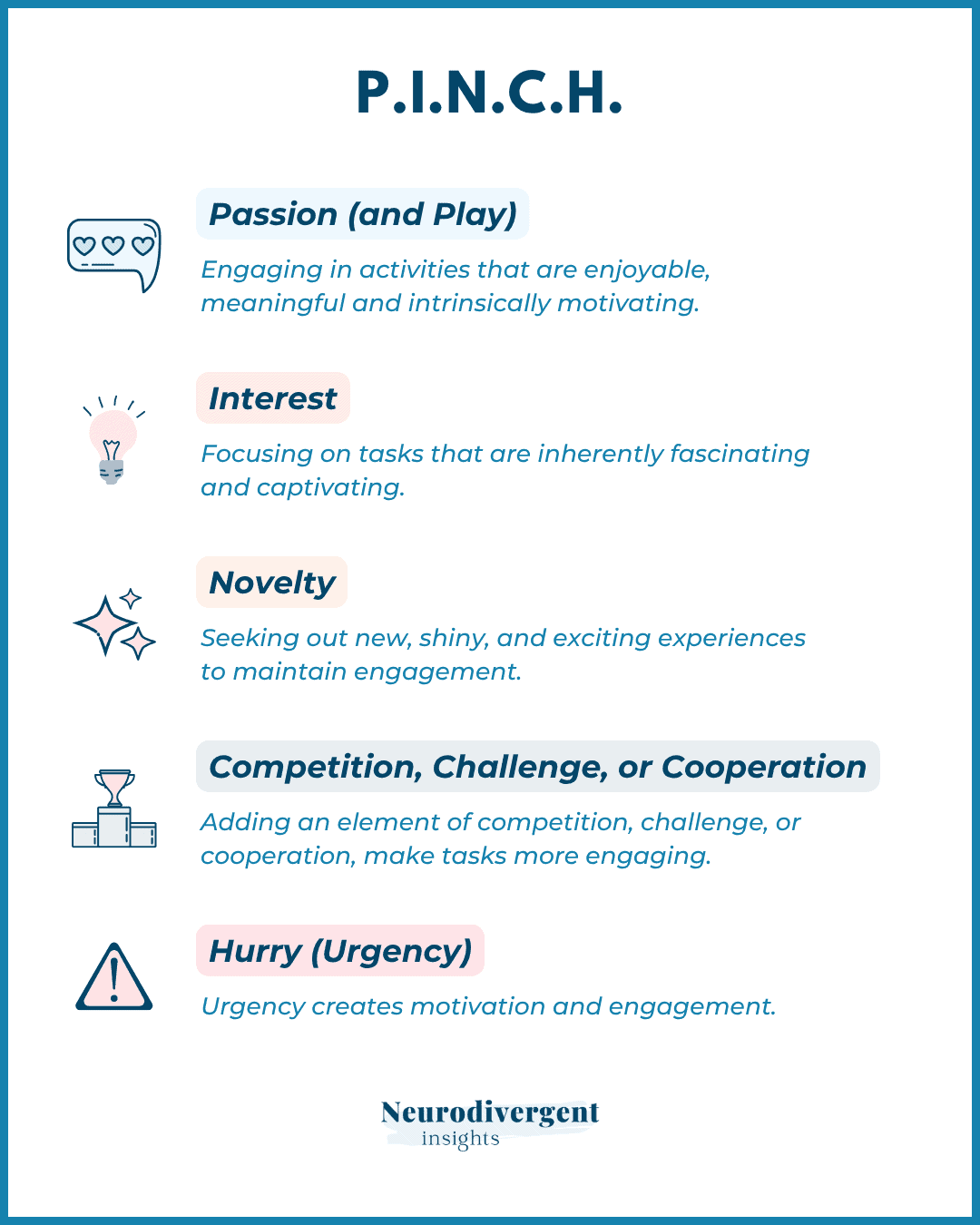
Dodson first used the acronym ICNU (Interest, Challenge, Novelty, Urgency), later adapted by the ADHD community into PINCH — a more memorable way to describe what lights up the ADHD brain:
P – Passion (or Play): When we’re lit up by something we love, focus feels effortless.
I – Interest: Tasks that fascinate us pull focus like gravity.
N – Novelty: Newness, change, or discovery recharges engagement.
C – Challenge (or Cooperation): Turning something into a game, race, or shared pursuit activates energy.
H – Hurry: Urgency or looming deadlines trigger that last-minute surge of focus.
Many of us (myself included) end up over-relying on Hurry. Hello, urgency. There’s a reason I don’t write this newsletter until Sunday day. Doing it ahead of time feels like… wading through concrete. But give me the pressure of an evening deadline, and suddenly my neurons are alive and buzzing.
The problem is that depending on Hurry often means depending on our stress response — using adrenaline as fuel. It works… until it doesn’t. Over time, that kind of focus can drain us, leaving our nervous system fried and foggy. It’s one of the quieter contributors to ADHD burnout.
The more we can build scaffolding for our activities around Passion, Play, Interest, Novelty, and Challenge (or Cooperation — hello, body-doubling), the less we have to rely on the urgency circuit to get us going.
Frameworks like PINCH help us work with our attention, not against it. It’s not about forcing motivation through willpower but about learning what naturally fuels us, and designing our lives around that. (1)
Hyperfocus and the Pendulum of Attention
So far, we’ve mostly focused on the ADHD struggle of getting started. But on the flip side, stopping our attention can be just as challenging. (Which is why ADHD isn’t actually a deficit of attention, but a difficulty regulating it.)
For every ADHD struggle with starting, there’s also the experience of struggling to stop once we’re locked in. This state — hyperfocus — can feel both magical and menacing. It’s when the world fades, time dissolves, and we become wholly absorbed in what’s in front of us. I call this state the vortex.
Six months ago, I was deep in my writing vortex. My puppy was on my lap (on top of my blanket). Two hours later, when I finally stood up, I found a rather large wet area on the blanket — he had peed on me and I hadn’t noticed. That’s hyperfocus in a nutshell: when your dog can pee on you and you still don’t break concentration.
Hyperfocus can be a powerful source of creativity and productivity, but it’s also a pendulum swing. The same intensity that allows us to tunnel into a project can make it hard to disengage. Meals are skipped. Messages ignored. Bodies forgotten. Sleep… ahem… delayed.
Hyperfocus isn’t something we can always choose to enter or exit. We can set up the conditions for it, maybe even invite it in — but it’s not an on-demand button we push. For me, it feels more like a rip current: it can propel us forward, offering a creative, restorative flow, but it can pull us under before we realize how far we’ve drifted.
Attention, Trust, and Agency
One of the hardest parts of living with ADHD is learning to trust a mind that doesn’t always show up when you call it. There’s grief in that — grief for the projects started and abandoned, for the rhythms that never seem to hold, for the energy that arrives like a lightning bolt one day and disappears the next. Sometimes, I can’t even trust what I’ll feel interested in tomorrow.
And that uncertainty can make it hard to trust myself.
One truth I’m working to lean into is that trust doesn’t have to mean control. I’ve spent much of my life trying to create rules and rigid systems to strong-arm my mind — to force it into predictability. But maybe it’s less about commanding attention and more about partnering with it — creating containers where it can thrive, instead of cages it will inevitably resist.
I’ve been experimenting with what that partnership looks like — building scaffolding around my natural rhythms, creating rituals that honor both my roaming and my resting. When I stop fighting my attention and start working within its natural flow, it begins to feel less like something to tame and more like a river I’m learning to move with. Still unpredictable, yes — but the more I settle into its rhythm, the more I find ways to come into alignment with it.
That, to me, is where agency begins — not in domination, but in collaboration and the small, steady shifts toward alignment.
Working With Attention: PINCH + Permission
Here are a few ways I’ve been practicing this collaboration:
Scaffolding with PINCH. When I’m struggling to begin, I ask: Which of the PINCH drivers could I infuse here? Could I turn this task into a challenge, or infuse it with novelty? Could I pair it with alerting music I love, make it playful, or co-work with someone?
Building attention-roaming days. These are days where I take the corset off my mind and let it tree-branch freely. I follow curiosity wherever it leads — sometimes into research, sometimes into writing, sometimes into website projects. At NDI, we call these tree-branch projects — intentional side quests that allow our attention to stretch and breathe.
Practicing on the go mindfulness. When people hear the word mindfulness, they often picture someone sitting cross-legged, eyes closed, trying to empty their mind for ten quiet minutes — imagery that feels, well, very not ADHD-friendly. That’s not what I mean here.
I practice a lot of what I call mindfulness on the go.
For me, mindfulness isn’t about stillness — it’s about how I relate to my thoughts. It’s the practice of bringing in a curious observer who can notice and name where our attention has gone.
Sometimes I narrate it: “Ah, my attention just wandered to that idea again.” Or, “My attention has gotten pulled into this thing — do I want to stay here or try to pivot out?” Or, “My attention is ruminating on that conversation.”
That moment of noticing creates a small pause — just enough space to ask, Here’s where my attention is… what do I want to do about it?
Designing external memory systems.
Instead of relying on my brain to hold everything, I am working to offload more — notes, lists, voice memos, reminders. This helps reduce the anxiety of “What if I forget?” so I can focus on what’s alive in the moment. If I’m feeling particularly pingy I’ll do a brain dump of all the pings pulling at my attention with urgency. Having them captured somewhere tells my brain it’s okay to hold onto them with a bit less hypervigilance.
Reframing “Distractibility” as Responsiveness
The longer I live with and study ADHD, the less I see my distractibility as a flaw and the more I see it as responsiveness — to the world, to ideas, to people, to possibility. My attention moves because it’s alive and curious.
What if, instead of pathologizing that movement, we started honoring it? What if the goal isn’t to build tighter walls around our attention, but to give it both structure and space — to let it flow like a river, with room for all its bends and meanders?
That doesn’t mean it’s easy. My struggle with on-demand attention still brings plenty of friction into daily life. There are moments when I wish I could just make my brain show up. But even in those moments, I can feel the aliveness in it — the part of me that’s reaching, sensing, searching for connection.
Learning to trust this kind of mind isn’t about perfecting focus and ADHD hacks. It’s about building a relationship with attention that’s flexible, kind, and radically honest.
There will be days when my mind refuses to show up on time, and nights when it wakes up just as the world goes quiet. Projects will get left midstream; new ones will start in the margins. But maybe that’s part of how this brain of mine was made — attention that moves like water, sometimes rushing, sometimes still, always stretching to find its way.
So maybe the question isn’t How do I control my attention? Maybe it’s How do I listen to it? How do I learn its rhythm, offer it boundaries wide enough to breathe, and make it feel safe enough to play?
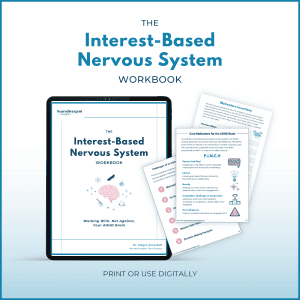
P.S if you’re interested in learning more about working with the Interest-Based Nervous System you can check out our workbook here, or our parent workshop here (which includes our workbook).
Additional Resources
🗞️ Stay in the Neurodivergent Loop
For ongoing insights and updates, subscribe to the Neurodivergent Insights Newsletter. Each Sunday, I send out fresh thoughts and a roundup of the newest resources on topics related to neurodivergence, mental health, and wellness. My most personal writing is reserved for my newsletter, and subscribers also get access to the newsletter vault (12+ PDFs) when they join.
References
- A reader, Kristen Pressner, recently sent me a TEDx talk she gave earlier this year, and I found it to be one of the clearest, most compassionate explanations of the Interest-Based Nervous System I’ve seen — told from the perspective of a neurotypical parent shifting from character-based labels to a deeper understanding of the ADHD brain. It’s a wonderful resource for parents and neurotypical allies wanting to better understand ADHD attention, motivation, and the interest-based nervous system.
More Like This...


Lorem ipsum dolor sit amet, consectetur adipiscing elit. Ut elit tellus, luctus nec ullamcorper mattis, pulvinar dapibus leo.