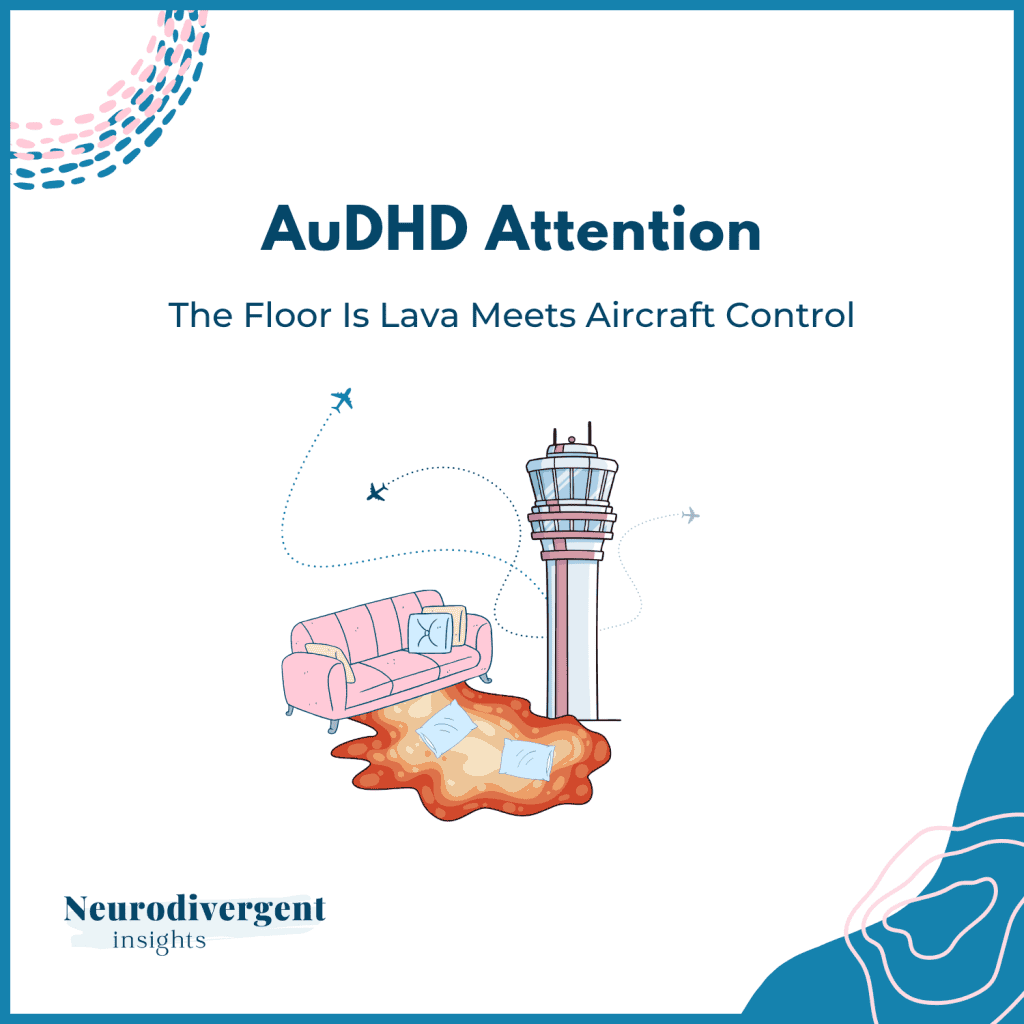

The Attention Series, Part Four
It’s been hard to focus lately on the things I want to focus on, which is probably why I’ve been writing this mini-series about attention. This essay is part four in that series. You can find the others here: Special Interests vs. Hyperfixated Interests, ADHD Attention, and Spontaneous vs. Deliberate Mind Wandering.
How much has your mind wandered today? This past week? Maybe even in this moment, perhaps to a conversation replay, a to-do list, or a sudden flash of curiosity.
That’s the thing about wandering minds: they don’t wait for permission.
Last week, we explored why the ADHD brain tends to wander: how the Default Mode Network can pull focus away from the present, and how deliberate “drift time” can actually help restore balance. We also looked at how not all wandering is the same: deliberate mind-wandering often feels restorative, while spontaneous mind-wandering can create more stress and friction.
This week, I want to look at what happens when that wandering turns heavy.
Because sometimes, our minds don’t just wander … they spiral. They get caught in rumination loops, revisiting pain points and emotional static: the worries, regrets, and what-ifs that refuse to quiet.
This is the piece I’ve been thinking through lately: when we have a mind that’s both more prone to wander and more drawn toward what’s emotionally charged, it makes sense that the ADHD brain might drift until it finds something that lights it up, whether that’s excitement, novelty, or threat and pain.
And that’s where things can get tangled. Difficulty regulating attention meets a brain wired to seek emotional charge. The result can be a loop that’s hard to escape, one with real implications for our mental health.
That’s what I want to explore today.
Table of Contents
When Wandering Turns Heavy
If you have ADHD, you probably know the heavier side of mind-wandering. Our minds don’t just wander, they loop. They can get caught on emotionally charged or arousing thoughts, worries, regrets, to-do lists, that conversation replay.
When attention regulation is low, the brain naturally hooks onto whatever feels most emotionally loud. ADHD brains are wired to respond to emotional charge. Sometimes that means being drawn to the new, the exciting, the shiny thing (which makes for much more enjoyable mind-wandering). But threat also feels emotionally salient. So when we’re mindlessly, or spontaneously, wandering, the ADHD brain might get hooked on the loudest threads: the unfinished tasks, the interpersonal tension, the fears of failure.
And this is where wandering can tip into rumination, the kind of sticky thinking that amplifies anxiety or drains mood. For many of us with ADHD, it’s a bit of a double bind: we wander because our control networks are weaker, and then our minds drift, almost magnetically, toward whatever feels most charged.
For example, my mind often wanders until it lands on a memory that stirs shame. Then, like a metal detector picking up a strong signal, it starts digging. I’ll find myself replaying an awkward conversation from fifteen years ago, suddenly flooded with the same embarrassment I felt then. And because regulating attention already takes effort, pulling myself out of that loop can feel especially hard.
No wonder ADHD so often overlaps with anxiety and depression. It’s not just distractibility; it’s a brain tuned to emotional intensity, drawn toward whatever hums the loudest. And that pull can make it harder to shift our attention away from the sticky points: the thoughts or memories that leave us feeling worse the longer we stay there.
For this kind of spontaneous mind-wandering that turns into rumination, practices that build meta-awareness, awareness of our own thoughts, can help. Mindfulness, naming thoughts as they arise, or recognizing familiar “mind stories” can turn the unaware, spontaneous roaming into something held. By naming it, we give it a container and can gently start to unhook from it.
The Case for Intentional Drift
So mind-wandering can contribute to stress, making focusing on the things we want to focus on harder and lead to rumination spirals. But not all wandering is unhelpful, and we can, with intention, cultivate the more adaptive kind (and when we do this, it may also help with the unhelpful kind of mind wandering).
Studies on creativity show that deliberate mind-wandering, when the brain is given permission to meander during low-demand tasks, can enhance problem-solving. In one experiment, participants were asked to come up with unusual uses for common objects (like a brick or a spoon). Those who took a short “mind-wandering break” between attempts performed better than those who stayed on task. Their minds had incubated new ideas while idling.
In other words: stepping away can open up the mental aperture.
The challenge for ADHD isn’t that we wander, but when and how. Our goal isn’t to suppress wandering altogether but to regulate it, to create boundaries around when the Default Mode Network gets to play. If we never give our brains downtime, they’ll steal it.
Just like a sleep-deprived brain will “microsleep” during the day, a focus-deprived brain will “microwander” when you need it most.
So perhaps the practice isn’t fighting the wandering but scheduling it. Letting your mind roam intentionally, on a walk, in the shower, while doodling, folding laundry, or staring out the window, giving it space to breathe, integrate, create, and replenish.
The Attention-Agency Link
If our attention is like a pup (or ten) dragging us around all day, every which way, without us realizing it until we’re halfway down the block in our undergarments, then it’s no wonder agency can feel hard to find.
When mind-wandering becomes chronic and spontaneous, it can chip away at our sense of agency. It can start to feel like our thoughts are something that happens to us rather than something we actively participate in. Over time, that loss of agency can shape self-perception: Why can’t I focus like other people? Why can’t I stay present?
Rebuilding a sense of agency often starts with gentle (and curious) awareness. Mindfulness practices, not in the “clear your mind” sense, but in the noticing-where-your-mind-is sense, can help us catch the moment of drift, without judgment. That micro-moment of awareness is already a shift from being in the thought to observing it.
For me, learning ACT (Acceptance and Commitment Therapy, a mindfulness-based approach) was one of the best things I’ve ever done for my mental health. As someone with an anxious brain prone to ruminate, learning how to become more aware of where my attention goes, and to gently contain or redirect it, has been one of the most helpful practices I’ve found.
I’ve never responded well to therapy models that tried to control or correct my thoughts. The approaches that helped were the ones that invited me to notice and lean in with curiosity. That’s what’s given me a sense of agency again, even inside my wandering, splintery, anxious-filled mind.
When I notice my mind has wandered, my responses vary. Sometimes it’s “Oops… there she goes again.” Sometimes it’s “Oh, that’s interesting … where did you go, and why?” Sometimes the wandering reveals what’s preoccupying me and needs attention; sometimes it’s simply my brain craving rest or novelty.
By bringing awareness to why my mind wanders, I begin to participate in it differently — not steering so much as walking alongside it, leash in hand, curious about where it wants to go next.
Practices for a Wandering Mind
Here are a few small, grounded ways to work with your wandering mind rather than against it:
Schedule mind-wandering time. Give your brain a few intentional “idle” windows each day: a walk, a cup of tea without screens, a few minutes of staring out the window. Let your mind drift there, on purpose. Movement (walking, shooting hoops, dribbling a soccer ball) can be an especially powerful catalyst for deliberate, generative mind-wandering. The rhythm of motion gives the mind space to roam while the body stays anchored in the present.
Notice the tone of your wandering. Is it creative, reflective, problem-solving, or anxious, self-critical, looping? Naming the tone helps you recognize when wandering is restorative and when it’s tipping toward rumination.
Name the wandering. Catch it when spontaneous wandering has taken hold, not punitively, but to bring awareness to it. Pause and check in: Is this where I want my mind to be right now? A small check-in with yourself invites a moment of choice.
Use gentle anchors. When spontaneous wandering pulls you off task, try light cues to re-orient, like a deep breath, a stretch, or quietly naming what you’re doing (“I’m writing now”). It’s about re-grounding, not reprimanding the wandering; it’s going to happen.
Practice body wandering. Sometimes letting attention wander through the body by noticing your breath, the texture of your clothes, or the weight of your feet, can meet that need for internal movement without mental overstimulation. This is a form of intentional body wandering: tuning into sensations and interoceptive cues that help ground attention and steady emotion.
Create transitions between focus and rest. Rather than slamming from deep work to social media, building small rituals can give your mind space to reset, like heating up a cup of tea, stepping outside, changing environments. These moments become bridges, helping our attention switch modes with a bit more ease.
Closing Reflections
If you are an ADHDer, you likely have a mind that wanders, sometimes wildly, sometimes wisely. The same brain that pulls you off course is often the one that helps you connect ideas, sense nuance, and imagine what doesn’t yet exist.
The work isn’t to rein it in completely, but to build a trusting relationship with it. To recognize when wandering is an act of replenishment and when it’s depleting you.
When the Default Mode Network has space to roam intentionally, it nurtures creativity and rest. When it takes the lead uninvited, it can pull us into distraction or worry. Learning to notice the difference helps our minds feel a little less like something to manage, and a little more like something we can meet with curiosity.
Additional Resources
🔗 Further Learning
Motivating ADHD Kids With PINCH
Help your child thrive by working with their brain, not against it. In this short, parent-friendly video, Dr. Megan Anna Neff explains the PINCH model: Play, Interest, Novelty, Challenge, and Hurry, and how to use it in everyday family life. You’ll get real-world examples, practical tips, and compassionate guidance to support your child’s ADHD motivation, without the overwhelm. Check out the training here.
🗞️ Stay in the Neurodivergent Loop
For ongoing insights and updates, subscribe to the Neurodivergent Insights Newsletter. Each Sunday, I send out fresh thoughts and a roundup of the newest resources on topics related to neurodivergence, mental health, and wellness. My most personal writing is reserved for my newsletter, and subscribers also get access to the newsletter vault (12+ PDFs) when they join.
References
Baird, B., Smallwood, J., Mrazek, M. D., Kam, J. W. Y., Franklin, M. S., & Schooler, J. W. (2012). Inspired by Distraction: Mind Wandering Facilitates Creative Incubation: Mind Wandering Facilitates Creative Incubation. Psychological Science, 23(10), 1117-1122. https://doi.org/10.1177/0956797612446024
Bozhilova N. S., Michelini G., Kuntsi J., & Asherson P. (2018). Mind-wandering perspective on attention-deficit/hyperactivity disorder. Neuroscience & Biobehavioral Reviews, 92, 464–476.
Deng, YQ., Li, S. & Tang, YY. The Relationship Between Wandering Mind, Depression and Mindfulness. Mindfulness 5, 124–128 (2014). https://doi.org/10.1007/s12671-012-0157-7
Mowlem F. D. et al. (2019). Validation of the Mind Excessively Wandering Scale and the Relationship of Mind Wandering to Impairment in Adult ADHD. Journal of Attention Disorders, 23(6), 624–634.
Seli, P., Risko, E. F., Smilek, D., & Schacter, D. L. (2016). Mind-Wandering With and Without Intention. Trends in cognitive sciences, 20(8), 605–617. https://doi.org/10.1016/j.tics.2016.05.010
Smallwood J., Schooler J.W. The science of mind wandering: empirically navigating the stream of consciousness. Ann. Rev. Psychol. 2015;66:487–518. doi: 10.1146/annurev-psych-010814-015331.https://doi.org/10.1146/annurev-psych-010814-015331