The Attention Series, Part Five
My Attention Landscape
How much has your mind wandered today? This past week? Maybe even in this moment, perhaps to a conversation replay, a to-do list, or a sudden flash of curiosity.
That’s the thing about wandering minds: they don’t wait for permission.
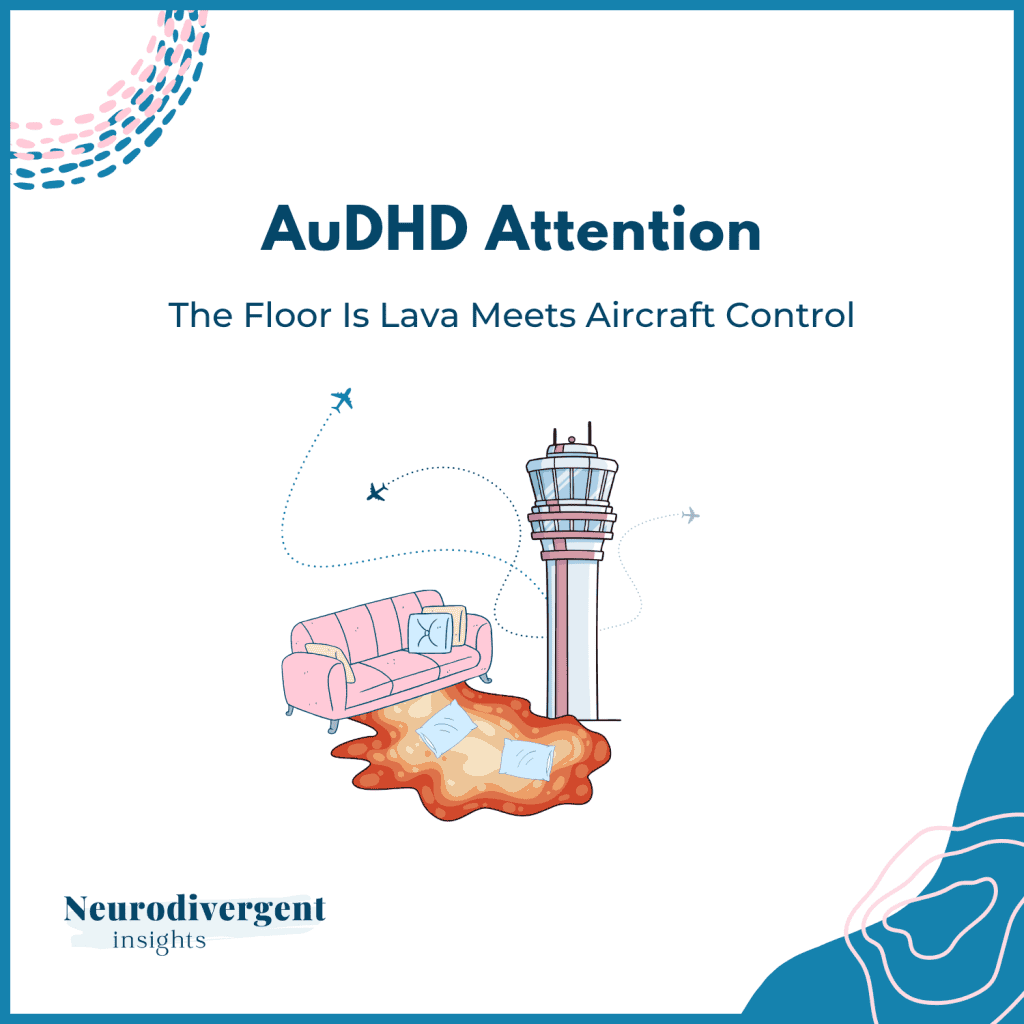
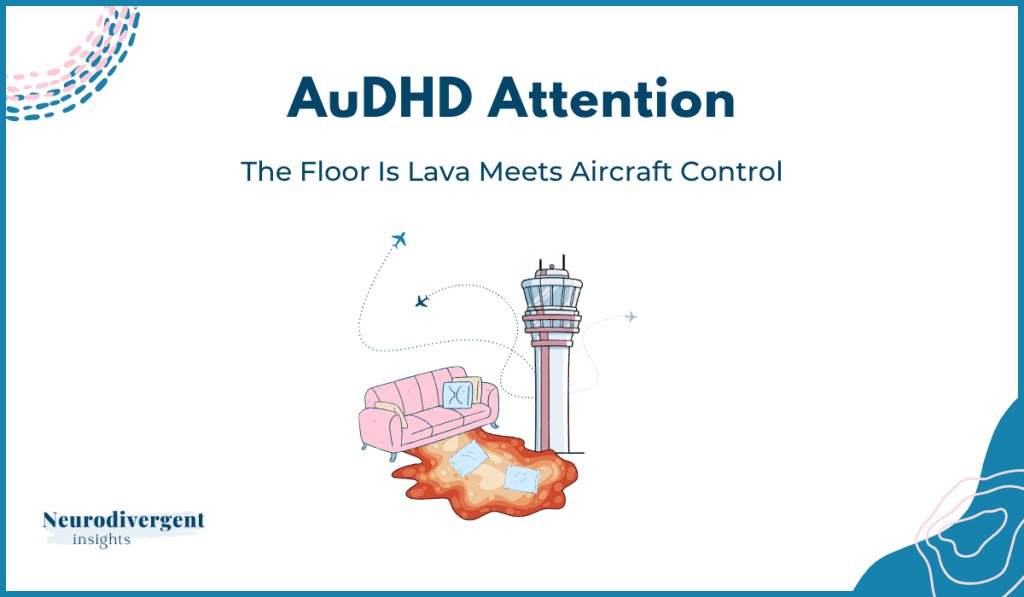
As a child I remember playing a game with my sisters, “Lava.” We’d scatter pillows across the living room floor, each one a safety rock. The carpet beneath was the lava, filled with alligators and imagined danger. If we fell in, we were in trouble.
I remember the anxiety right before a big jump, the way my small body tensed, the mix of fear and thrill as I leapt. I was the youngest, so the spaces between the pillows always stretched just a bit too wide. But I also remember the rush of safety when I landed solidly on a cushion. For a moment, I was safe. Then came the next jump.
I thought of that game today while writing about AuDHD attention, an attention style that feels, for me, both singular and scattered. I move through the world the same way I once crossed that living room, hopping from one island of focus to the next, trying not to fall into the lava of overwhelm that bubbles beneath.
When I land on something that captures me completely, I feel anchored. Safe. The noise quiets. My mind and body settle. That’s the monotropic pull of Autistic attention, the deep, singular focus that feels like a warm cocoon. But when the cocoon breaks and focus slips, my mind scatters across too many inputs: emails, sounds, to-dos, thoughts. I fall back into the lava. My attention floods outward in a hundred directions, none of them able to quite stick.
I’ve come to call this defensive monotropic mode, when I dive deep not from joy or curiosity, but from the need to escape the chaos of scattered thoughts.
This week, I’ve been thinking about what’s actually happening in the brain when attention feels both deep and divergent, why AuDHD attention can feel like both a joy-filled refuge and a flood of overwhelm.
Table of Contents
The AuDHD Attention Paradox
Over the last few weeks, I’ve been exploring attention from different angles: Autistic attention, ADHD attention, and this week I find myself somewhere in the middle. Or maybe on the bridge between them… or perhaps not a bridge at all, but its own distinct rhythm of attention.
AuDHD attention is both pulled deep and pulled wide. It is both singular and scattered. It can be deeply soothing and deeply dysregulating. And many of us, I suspect, ground ourselves through finding small, stable islands of regulation, places where attention can slip into flow and the noise quiets for a while.
These seeming contradictions make sense when we look at the brain. The same systems that help us focus can also overwhelm us with too much input.
Research has shown that ADHD and autism each shape the brain in distinct ways. Emerging studies suggest that when they coexist, they may form something new altogether, an attentional pattern with its own neural fingerprint (Berg et al., 2023).
Pulled Both Deep and Wide (Flow State)
When I’m deep in focus (“the vortex”, as we call it in our house), it’s as if time is suspended. The edges of the world blur. I can chase a single stream of thought for hours. This chasing down has elements of both autism and ADHD, where it is deep and divergent at once.
Take this essay, for example. I started by jotting down thoughts about AuDHD attention. Then the Autistic part of me that needs to understand why pulled me into research papers. Before I knew it, I was buried in brain maps, reading about the caudate, amygdala, and all these networks that talk to each other in mysterious ways.
One minute I was reading about how the default mode network gets in the way of focus; the next, I was trying to figure out how other systems compete for control. What started as a simple deep dive turned into a kind of mental hopscotch, one question leading to the next, each one pulling me deeper in.
Suddenly I wasn’t just trying to understand attention, I was chasing it.
While going deep, my brain was also branching out, connecting regions, theories, and metaphors — building an inner web of understanding that felt both scattered and strangely coherent in its own pattern. It was creating an interconnected web, an ecosystem. Deep and divergent. It’s as if my brain wants to tunnel and wander at the same time. I suppose that means it wandels (wanders and tunnels), moving with focus and curiosity all at once. Do you have a brain that wandels?
That’s the depth of Autistic attention, sometimes called monotropism, a kind of steady, immersive focus that gathers the world into one clear thread. And it’s the strength of ADHD associative thinking, a style that sees connections others might miss and thinks in leaps. When you bring them together, you get deep, divergent thinking.
These are the rocks in the floor is lava game. The moments when our attention feels like a gift. But we live in a world that doesn’t always give deep, divergent thinkers room to thrive.
And when that world closes in, when the noise rises and the pace quickens, the same attention that once felt fluid can turn overwhelming. That’s when we need to navigate the lava.
Singular and Scattered (Struggle State)
My ADHD attention has an alive, restless, scanning quality that’s always searching for connection, one idea sparking another, one sound interrupting the last. That’s the ADHD current in me, tugging at the edges of my focus, opening more doors than I can walk through.
And my Autistic mind wants to move in the opposite direction. It seeks depth and precision. It wants to stay with one thread until it makes sense, to follow a single question down until it reaches something solid. Where my ADHD attention darts outward in curiosity, my Autistic attention anchors inward in clarity. It wants to build structure, to find coherence, to understand how all the pieces fit together.
This tug between breadth and depth reminds me of an air traffic control tower: the place where every plane in the sky is being tracked and coordinated.
The Air Traffic Control Tower
If the lava game explains how AuDHD attention feels, the air traffic control tower explains how it works. I told you I was knee-deep in neuroscience studies, here is my modest attempt to make it interesting (and understandable) through metaphor.
Imagine dozens of planes circling overhead, each one a thought, a sound, an emotion, a task. The control tower is trying to manage them, deciding which to land, which to delay, which to ignore. But in the AuDHD brain, there’s often too much incoming noise and not enough steady connection between tower and tarmac.
Researchers often describe three core systems that shape attention (Posner & Petersen, 1990; Petersen & Posner, 2012): the alerting, orienting, and executive control networks. Each plays a role in how we scan, select, and sustain focus, and each shows subtle differences in Autistic and ADHD brains.*
1. The Radar — Alerting System
This network keeps the brain on standby — alert, scanning, ready to respond. It involves the brainstem, thalamus, and right frontal cortex.
For many Autistic people, especially early in life, this radar can be hypersensitive, tuned to everything at once. Researchers like Sabag and Geva (2022) found early over-activation in the brainstem and thalamus, key areas that control arousal and alertness.
When the radar is constantly on high alert, the brain is flooded with signals before it even has time to sort out which ones matter. Over time, that flood can make it harder for the later-developing systems, the ones that filter and prioritize, to do their jobs smoothly.
Flight control translation: Too many planes in the air, all demanding attention at once. The radar never gets a chance to rest.
2. The Spotlight — Orienting System
If the radar keeps us alert, the orienting system decides where that alertness goes. It’s the spotlight that swings toward what seems important, ideally filtering out distractions so we can focus on what matters most.
In both autism and ADHD, this spotlight can be jumpy or slow to recalibrate, especially in sensory-rich environments.
In autism, research suggests the orienting system may be more strongly connected to sensory and perceptual processing regions, which can make it harder to ignore irrelevant input. This pattern can reflect attention being more easily pulled toward sensory detail and emotional salience, leaving less room for sustained, intentional focus.
A study by Fitzgerald and colleagues (2015) used an attention-orienting task to see how Autistic teens move their focus. They found stronger connectivity in the ventral attention network, the system that reacts to new or unexpected things, and weaker connectivity in the dorsal attention network, which helps us stay focused on what we want to pay attention to.
In plain terms, the reactive system was running hot, while the steady, goal-directed system was running low. The result is an attention style that’s quick to notice and respond, but harder to anchor.
In daily life, that might look like being pulled toward every flicker, sound, or movement in the room — a brain that orients to whatever feels loudest or most charged, rather than what’s most relevant to the task. When that happens, it leaves little bandwidth for sustained, intentional focus, especially in uncontrolled sensory environments.
From the ADHD side, a large analysis by Norman and colleagues (2024), using nearly ten thousand brain scans, found stronger resting connections between the brain’s reward and motivation centers (like the caudate and nucleus accumbens) and its attention-control regions. In simpler terms, attention tends to be guided less by external importance and more by what feels interesting or emotionally charged. It’s not that attention is weak; it’s that it follows curiosity. This helps explain why focusing on something dull can feel nearly impossible, yet a spark of fascination can pull us in completely.
When autism and ADHD co-occur, these attention patterns can intensify. Attention is more easily captured by irrelevant sensory details in the environment, while also being more influenced by motivation and emotional relevance rather than external importance. In other words, attention may be pulled by what stands out and what matters personally, even when those things don’t align with the task at hand. The result is an attention system that can feel both reactive and restless, quick to notice, quick to wander, and hard to rein back in.
To complicate our spotlight metaphor a bit …the spotlight doesn’t necessarily stay the same across time. Farrant and Uddin (2016) found that Autistic children showed overactivity within both top-down and bottom-up attention networks — brains constantly scanning and reacting. By adulthood, those same networks often quiet, perhaps from years of overload or adaptation. What was once hyper-reactive becomes hypo-responsive, and the spotlight that once darted wildly begins to dim.
The result is an attention system that can swing between over-on and under-on, a spotlight that sometimes burns too bright, then suddenly fades. Many Autistic and AuDHD adults describe this as a kind of cognitive fatigue, the long-term wear of a brain that has spent a lifetime trying to manage too much input.
Flight control translation: There are still too many planes in the air. While trying to manage the ones already circling, there’s also daydreaming about the plane you want to build. The spotlight is struggling to decide which planes need to land now, which can keep coasting, and which are just adding to the noise.
3. The Controller — Executive System
This is the air traffic controller of the brain. It manages priorities, filters distractions, and shifts attention as demands change, deciding which “plane” lands next. It draws on areas such as the prefrontal cortex, anterior cingulate cortex, and frontoparietal networks, which help us plan, focus, and transition between tasks.
For AuDHD brains, the controller faces a dual challenge: it’s overloaded with input and under-coordinated within itself.
A recent study by Lin and colleagues (2024) found that AuDHD people showed increased functional connectivity between the brain’s control regions and areas that process sensory and emotional input, compared to those with autism alone. In other words, the system that’s meant to regulate attention is tightly linked to the raw data it’s supposed to manage. It’s like an air traffic control tower receiving radio signals from every plane in the sky, all at once, all at full volume!
The result isn’t sharper awareness; it’s overload. The brain’s filter, designed to suppress distractions, becomes wired into the very noise it’s trying to quiet. Instead of greater control, the system becomes congested, with attention pulled toward every flicker, feeling, and signal. The spotlight becomes not only reactive but increasingly hard to steer.
At the same time, Yerys and colleagues (2019) found that Autistic children with ADHD showed reduced functional connectivity within and between their control networks, including the frontoparietal and salience systems. The salience system is what helps us decide what to pay attention to — what’s urgent, what can wait. When these internal control systems are less synchronized, it becomes harder to maintain focus or shift smoothly between tasks.
Flight control translation: The coordination between controllers has broken down. They’re struggling to communicate with each other while being bombarded by outside signals, some relevant, many not. Each controller is working hard, but together they can’t keep the airspace clear.
Summary
Together, these findings sketch a brain that’s both hyperconnected and fragmented, a control tower flooded with input, its controller overstimulated and trying to make sense of too many signals at once.
It’s not simply chaos; it’s congestion. And living inside that congestion shapes not only how we focus, but how we feel.
Next week, I’ll turn toward the emotional side of AuDHD attention, how it can both soothe and flood us, and the ways we find small islands of regulation amidst the noise.
Your Attention Signature
Every AuDHD brain has its own attention signature, its own rhythm of pulls and pauses. Maybe your focus leans toward depth, drawn into long, immersive stretches. Maybe it tilts toward breadth, scanning widely, connecting ideas others might miss. Or maybe, like many of us, you move between the two, deep one moment, scattered the next, always searching for stable ground.
This essay (and the thinking behind it) is part of the early work for my next book, AuDHD Unlocked, where I’m exploring how attention, emotion, and identity intersect in AuDHD lives. I want this project to grow from lived experience as much as from research.
If you recognize yourself in this landscape, I’d love for your voice to be part of it. My first AuDHD survey is now live, it explores the term “AuDHD,” intersectional identities and the experience of coming to understand yourself through that lens. Over the next nine months, there will be five surveys in total, and I’d be honored if you shared some of your attentional resources to contribute to our understanding of AuDHD.
*There’s a popular idea in Autistic pop culture that the Autistic brain is hyperconnected due to reduced synaptic pruning. While this theory stems from real research, it oversimplifies things. Studies show both hyperconnectivity and hypoconnectivity in Autistic brains, and they often appear in different regions or change across developmental stages. That’s why you’ll never catch a “pruning” infographic on my IG feed. It flattens something far more complex. What follows is a complex breakdown of some of the ways the hypoconnection and hyperconnection can show up, which of course gets even more complex for AuDHD brains.
Additional Resources
🔗 Further Learning
Motivating ADHD Kids With PINCH
Help your child thrive by working with their brain, not against it. In this short, parent-friendly video, Dr. Megan Anna Neff explains the PINCH model: Play, Interest, Novelty, Challenge, and Hurry, and how to use it in everyday family life. You’ll get real-world examples, practical tips, and compassionate guidance to support your child’s ADHD motivation, without the overwhelm. Check out the training here.
🗞️ Stay in the Neurodivergent Loop
For ongoing insights and updates, subscribe to the Neurodivergent Insights Newsletter. Each Sunday, I send out fresh thoughts and a roundup of the newest resources on topics related to neurodivergence, mental health, and wellness. My most personal writing is reserved for my newsletter, and subscribers also get access to the newsletter vault (12+ PDFs) when they join.
References
Berg, L. M., Gurr, C., Leyhausen, J., Seelemeyer, H., Bletsch, A., Schaefer, T., Pretzsch, C. M., Oakley, B., Loth, E., Floris, D. L., Buitelaar, J. K., Beckmann, C. F., Banaschewski, T., Charman, T., Jones, E. J. H., Tillmann, J., Chatham, C. H., Bourgeron, T., EU-AIMS LEAP Group, Murphy, D. G., … Ecker, C. (2023). The neuroanatomical substrates of autism and ADHD and their link to putative genomic underpinnings. Molecular autism, 14(1), 36. https://doi.org/10.1186/s13229-023-00568-z
Farrant, K., & Uddin, L. Q. (2016). Atypical developmental of dorsal and ventral attention networks in autism. Developmental science, 19(4), 550–563. https://doi.org/10.1111/desc.12359
Fitzgerald, J., Johnson, K., Kehoe, E., Bokde, A. L., Garavan, H., Gallagher, L., & McGrath, J. (2015). Disrupted functional connectivity in dorsal and ventral attention networks during attention orienting in autism spectrum disorders. Autism research : official journal of the International Society for Autism Research, 8(2), 136–152. https://doi.org/10.1002/aur.1430
Lin, Q., Shi, Y., Huang, H., Jiao, B., Kuang, C., Chen, J., Rao, Y., Zhu, Y., Liu, W., Huang, R., Lin, J., & Ma, L. (2024). Functional brain network alterations in the co-occurrence of autism spectrum disorder and attention deficit hyperactivity disorder. European child & adolescent psychiatry, 33(2), 369–380. https://doi.org/10.1007/s00787-023-02165-0
Norman, L. J., Sudre, G., Price, J., & Shaw, P. (2024). Subcortico-Cortical Dysconnectivity in ADHD: A Voxel-Wise Mega-Analysis Across Multiple Cohorts. American Journal of Psychiatry, 181(6), 553–562. https://doi.org/10.1176/appi.ajp.20230026
Posner, M. I., & Petersen, S. E. (1990). The attention system of the human brain. Annual Review of Neuroscience, 13, 25–42. https://doi.org/10.1146/annurev.ne.13.030190.000325
Petersen, S. E., & Posner, M. I. (2012). The attention system of the human brain: 20 years after. Annual Review of Neuroscience, 35, 73–89. https://doi.org/10.1146/annurev-neuro-062111-150525
Sabag, M., & Geva, R. (2022). Hyper and hypo attention networks activations affect social development in children with autism spectrum disorder. Frontiers in human neuroscience, 16, 902041. https://doi.org/10.3389/fnhum.2022.902041
Yerys, B. E., Tunç, B., Satterthwaite, T. D., Antezana, L., Mosner, M. G., Bertollo, J. R., Guy, L., Schultz, R. T., & Herrington, J. D. (2019). Functional Connectivity of Frontoparietal and Salience/Ventral Attention Networks Have Independent Associations With Co-occurring Attention-Deficit/Hyperactivity Disorder Symptoms in Children With Autism. Biological psychiatry. Cognitive neuroscience and neuroimaging, 4(4), 343–351. https://doi.org/10.1016/j.bpsc.2018.12.012