One reason ADHD gets missed so often is that it can look quite different from person to person. There are three types: inattentive (ADHD-I), hyperactive-impulsive (ADHD-H) and combined (ADHD-C). Hyperactive ADHD tends to be the most noticed in young children, while the inattentive type is the most common in adults.
As a psychologist who worked with neurodivergent adults, and someone diagnosed late with both ADHD and autism, I’ve seen how much confusion there is about these types. This article walks through each one, how they differ, and the diagnostic criteria.
Table of Contents
Overview of the ADHD Types
There are three types: ADHD Inattentive type (ADHD-I), ADHD Hyperactive and Impulsive type (ADHD-H), and ADHD Combined type (ADHD-C).
ADHD-I
Characterized by difficulties regulating attention.
ADHD-H
Characterized by impulsive and hyperactive behavior.
ADHD-C
Characterized by both inattention and hyperactivity/impulsivity.
The DSM-5 calls these presentations rather than subtypes, because how ADHD shows up can change over time.
ADHD Inattentive Type (ADHD-I)
ADHD-inattentive type (formerly known as ADD) is marked by:

Difficulty regulating attention
A tendency to make careless mistakes
Overlooking details, distractibility
Difficulty organizing and finishing tasks
Forgetfulness
Difficulty listening
Difficulty sequencing events or following detailed instructions
Difficulty with routine chores.
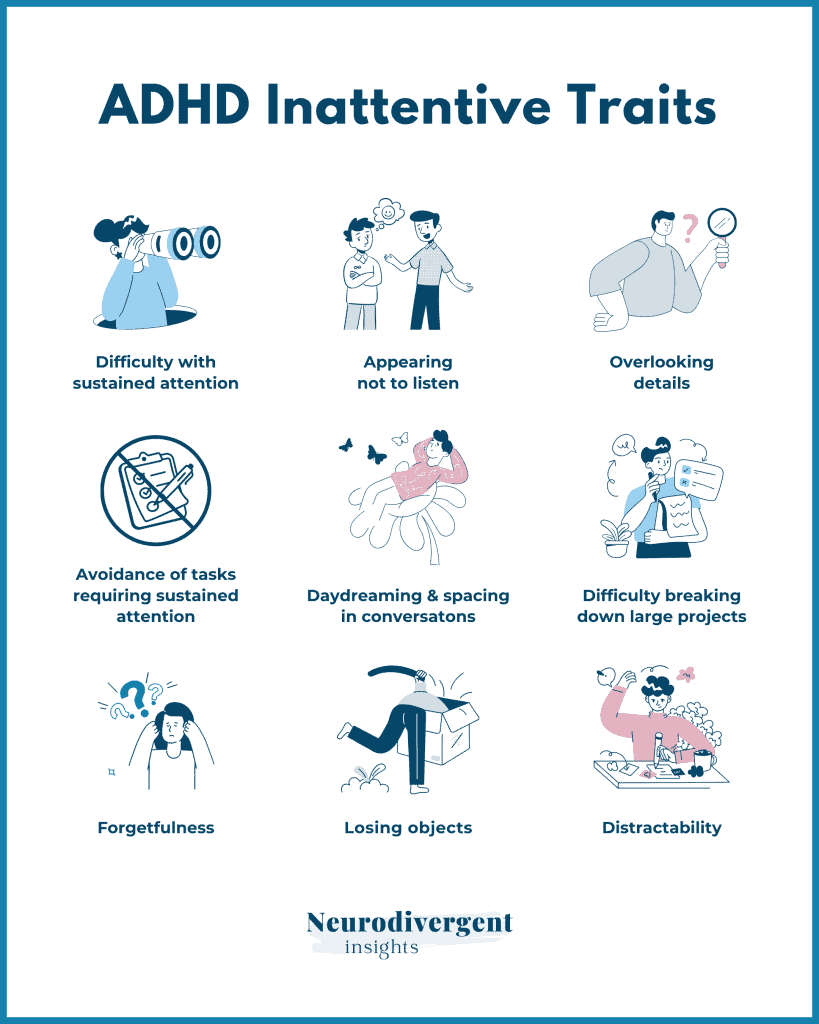
Working memory and processing speed are often impacted in the context of ADHD-inattentive type (processing speed may not become impacted until too many tasks are placed on the person). It’s the most common type in adults and among women and girls.
Inattentive ADHD does not look like the stereotypical presentation of ADHD. Most people think of a young child who is struggling to sit in their seat or running around tirelessly. However, ADHD-I can look like:
daydreaming quietly in class
feeling anxious or sad
difficulty listening
shyness
people-pleasing
trouble maintaining friendships
picking at cuticles or skin
being a perfectionist
People with ADHD-I are more likely to have Sluggish Cognitive Tempo (SCT). SCT was described by Russell Barkley, and is characterized by dreaminess, mental fogginess, slow working memory, hypoactivity (less activity), staring frequently, inconsistent alertness, and excessive daydreaming. It is estimated that 30-63% of people with inattentive type ADHD also have SCT (Fassbender et al., 2015)
Inattentive ADHD may be the most difficult to diagnose as it is often dismissed as the person being “spacey”, or “apathetic”, or experiences are attributed to anxiety or a mood disorder. Even when diagnosed, people with ADHD-I may be less likely to be offered medication. Willcutt, 2012 found that while ADHD-I was the most common type, people with ADHD-C were more likely to be referred for clinical services. This may mean people with ADHD-I have to push harder to get support.
ADHD Hyperactive and Impulsive Type (ADHD-H)
The hyperactive-impulsive type is the most common type in preschoolers. It is associated with behavioral difficulties in early childhood and co-occur with Oppositional Defiant Disorder (ODD) and Conduct Disorder (CD) at high rates (Bendiksen et al., 2017). ADHD-H is characterized by the need for constant movement. Such folks often fidget, squirm, and get up from their seat to walk around or stand. Children with ADHD-H are often described as if they are “driven by a motor” (running around excessively).
Hyperactivity may also show up as excessive talking, difficulty waiting their turn, and difficulty with self-control may lead to impulsive behaviors (blurting out answers, engaging in risky activities, and so forth). The hyperactive-impulsive type tends to be more visible in children, which may help explain why it often gets diagnosed sooner than the inattentive type. It is more commonly diagnosed among children and men.

ADHD Combined Type (ADHD-C)
ADHD-C is common in childhood and becomes less common in the teen and adult years (see the breakdown below).
Combined type is diagnosed when someone meets the criteria for both: at least six of nine symptoms in each area (at least five for people 17 and older). ADHD-C also co-occurs with externalizing disorders such as ODD and CD at high rates (Bendiksen et al., 2017). People with ADHD-C often have co-occurring internalizing disorders (anxiety and depression).
ADHD Screener: While we’re on the topic of the DSM and diagnosis, the ASRS is the most widely used screener for ADHD, and this instrument aligns closely with the DSM criteria.
DSM-5 Criteria for the ADHD Types
ADHD-I
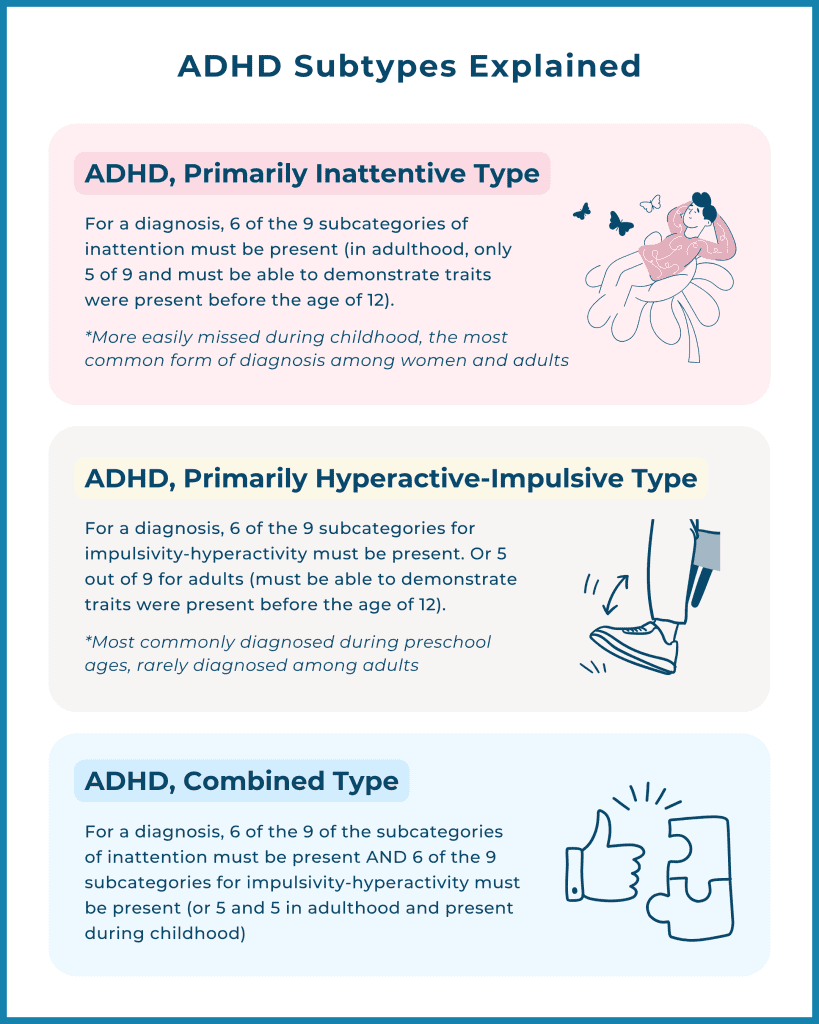
Here is how ADHD-I is diagnosed based on the DSM-5 criteria. For children and teens up to age 16, at least Six of the following nine symptoms of inattention need to be present for at least six months. For people 17 and older, at least five are needed:
1
Often fails to give close attention to details or makes careless mistakes in schoolwork, at work, or during other activities (e.g., overlooks or misses details, work is inaccurate).
2
Often has difficulty sustaining attention in tasks or play activities (e.g., has difficulty remaining focused during lectures, conversations, or lengthy reading).
3
Often does not seem to listen when spoken to directly (e.g., the mind seems elsewhere, even in the absence of any obvious distraction).
4
Often does not follow through on instructions and fails to finish schoolwork, chores, or duties in the workplace (e.g., starts tasks but quickly loses focus and is easily sidetracked).
5
Often has difficulty organizing tasks and activities (e.g., difficulty managing sequential tasks; difficulty keeping materials and belongings in order; messy, disorganized work; has poor time management; fails to meet deadlines).
6
Often avoids, dislikes, or is reluctant to engage in tasks that require sustained mental effort (e.g., schoolwork or homework; for older adolescence and adults, preparing reports, completing forms, reviewing lengthy papers).
7
Often loses things necessary for tasks or activities (e.g., school materials, pencils, books, tools, wallets, keys, paperwork, eyeglasses, mobile telephones).
8
Is often easily distracted by extraneous stimuli (for older adolescents and adults, may include unrelated thoughts).
9
Is often forgetful in daily activities (e.g., doing chores, running errands; for older adolescents and adults, returning calls, paying bills, keeping appointments)
ADHD-H
To meet the criteria of ADHD-H, children and teens up to age 16 need at least six of the following nine symptoms of hyperactivity-impulsivity for at least six months. For people 17 and older, at least five are needed:
1
Often fidgets with or taps hands or feet or squirms in seat.
2
Often leaves seat in situations when remaining seated is expected (e.g., leaves his or her place in the classroom, in the office or other workplace, or in other situations that require remaining in place).
3
Often runs about or climbs in situations where it is inappropriate. (Note: In adolescents or adults, may be limited to feeling restless.)
4
Often unable to play or engage in leisure activities quietly.
5
Is often “on the go,” acting as if “driven by a motor” (e.g., is unable to be or uncomfortable being still for an extended time, as in restaurants, meetings; may be experienced by others as being restless or difficult to keep up with).
6
Often talks excessively.
7
Often blurts out an answer before a question has been completed (e.g., completes people’s sentences; cannot wait for turn in conversation).
8
Often has difficulty waiting their turn (e.g., while waiting in line).
9
Often interrupts or intrudes on others (e.g., butts into conversations, games, or activities; may start using other people’s things without asking or receiving permission; for adolescents and adults, may intrude into or take over what others are doing).
ADHD-C
In order to be diagnosed with ADHD-C based on the DSM-5, one must meet at least six of the nine ADHD-I criteria and six of the nine ADHD-H criteria for the last six months (at least five in each area for people 17 and older).
The DSM-5 also requires that several symptoms were present before age 12, show up in two or more settings (such as home, school or work), and clearly interfere with daily life.
Prevalence of the ADHD Types
These types aren’t fixed. A young child might be diagnosed with ADHD-H, meet the criteria for ADHD-C in mid-childhood, and only meet the criteria for ADHD-I as an adult. How ADHD shows up shifts with age and setting, so it helps to hold these categories loosely.
Willcutt’s 2012 review of ADHD studies found that the share of each type changes with age:
ADHD-I
Preschool
23%
Elementary
45%
Adolescence
72%
Adulthood
47%
The most common type in adults
ADHD-H
Preschool
52%
Elementary
26%
Adolescence
14%
ADHD-C
Preschool
25%
Elementary
29%
Declined in samples of adolescents and adults
Share of people with ADHD who meet criteria for each type, by age.
Similarities and Differences Across ADHD Types
The types differ in some ways and overlap in others. Some researchers have suggested ADHD-I should be its own condition, but the overlap seems large enough that it isn’t usually treated that way. Research on the topics below (executive functioning, processing speed) is mixed, which reflects how varied ADHD is.
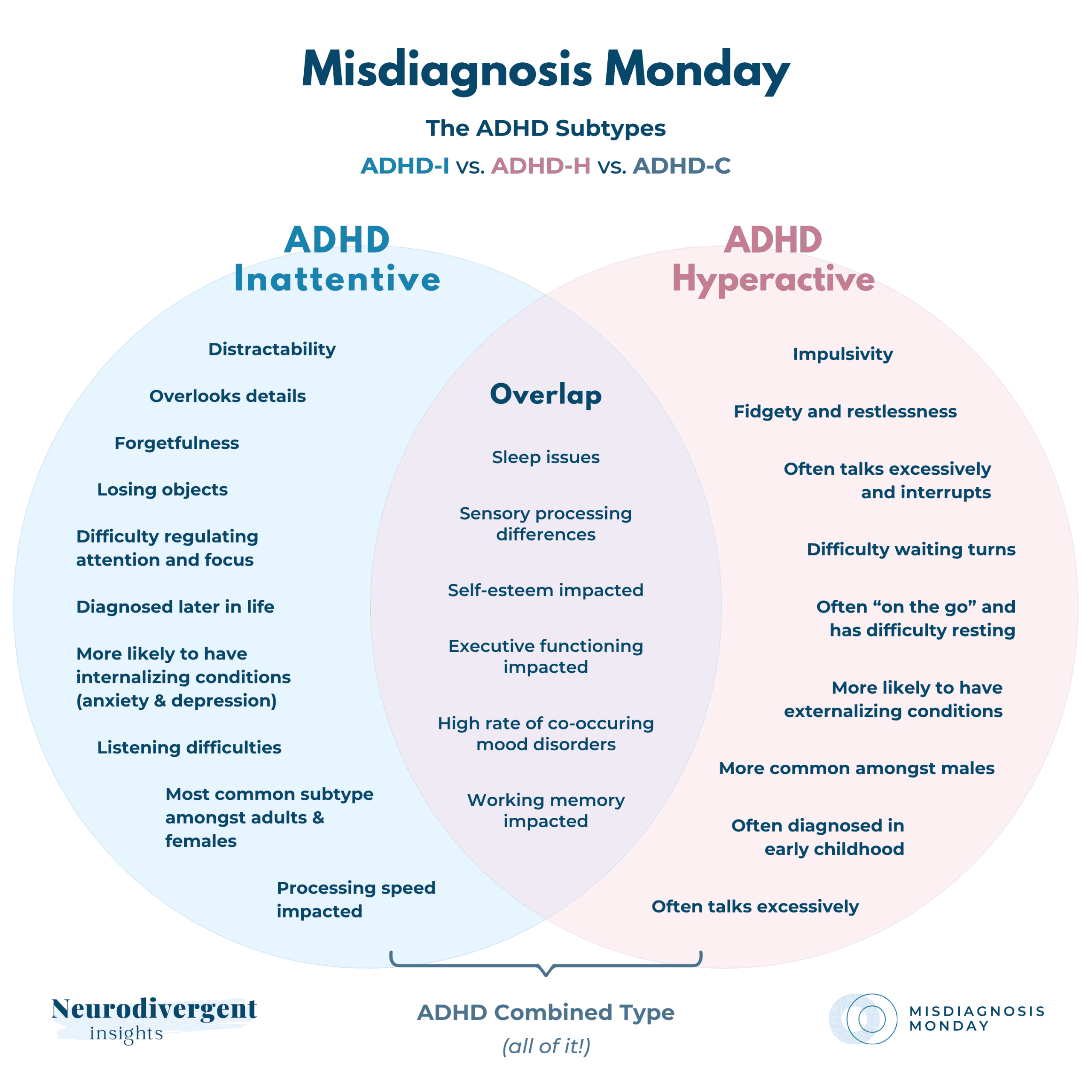
Similarities Across ADHD Types
Executive Functioning
The studies on executive functioning (EF) and ADHD types are inconsistent. In the late 1990s, Barkley (1997) hypothesized that ADHD-C and ADHD-H were associated with executive functioning deficits while ADHD-I was not (Geurts et al., 2005). Since then, a number of studies have found executive functioning challenges are similar across types.
- Geurts et al. (2005) studied a group of ADHD-C and ADHD-I children to see if they demonstrated differences in executive functioning and, thus, if they represented distinct disorders. Their findings suggest a similar impact on executive functioning, particularly impairment in inhibition, was noted in both groups.
- Bahçivan et al. (2015) found similar executive functioning between ADHD-I and ADHD-C on measures of inhibition, set-shifting, verbal fluency, cognitive flexibility, and planning; however, ADHD-I demonstrated significantly higher performances in verbal working memory and verbal category-shifting than children in the ADHD-C group. ADHD-I struggled more with indecision than ADHD-C.
- Nigg et al. (2002) compared executive functioning among ADHD-I and ADHD-C and found that the groups did not differ on most domains (ADHD-C struggled with planning more, and motor inhibition was elevated among boys with ADHD-C).
Studies are mixed, but most suggest that similar neuropsychological processes are at play within all types of ADHD, and all experience executive functioning difficulties. However, these will vary from person to person and will likely be influenced by other factors (gender, temperament, presence of co-occurring conditions).
Auditory Processing
Many ADHDers have auditory processing differences. One study of children and teens with ADHD found no difference in auditory processing between types (Ghanizadeh, 2009). Children with ADHD and co-occurring ODD had higher rates of auditory processing problems and were more likely to under-register sound (hyposensitive) (Ghanizadeh, 2009).
Sensory Processing
While sensory processing problems are not technically part of the DSM criteria, there is increasing awareness around the high co-occurrence of sensory processing problems and ADHD. A high percentage of children with ADHD also have sensory processing problems. In a systematic review, Ghanizadeh (2011) found a significant relationship between sensory processing problems and ADHD (both types).
- Children with ADHD have more difficulties in tactile processing (Hern & Hynd, 1992)
- Sensory over-responsivity in ADHD is associated with anxiety. Children with ADHD and sensory sensitivity (sensory over-responsivity) had higher anxiety levels than those without (Ghanizadeh, 2011).
- The level of touch sensitivity is higher in girls with ADHD than in boys with ADHD (Ghanizadeh, 2011). One study found that sensitivity to touch was higher in girls, but boys with ADHD were not different from control boys (Bröring et al., 2008).
- Balance control and vestibular systems: More than a third of children with ADHD experience poor balance and coordination, which is related to sensory inputs and integration and difficulty inhibiting movement (Ghanizadeh, 2011).
- Sensory processing problems can be useful for differentiating children with ADHD from children without ADHD. However, it doesn’t distinguish ADHD from other conditions (such as autism). (Ghanizadeh, 2011).
- Children with ADHD and sensory sensitivities typically have another co-occurring condition, such as anxiety. (Ghanizadeh, 2011).
- Children with ADHD and co-occurring ODD have higher rates of sensory processing differences (particularly auditory processing). Such children tend to be under-responsive to sounds and sensory input.
Differences Across ADHD Types
Processing Speed
Processing speed is associated with how quickly our brains can process and work with information and stimuli. ADHDers don’t necessarily have impaired speed overall, but processing speed slows when the tasks become more complex or more demands are clumped together (Kibby et al., 2019). While working memory difficulties occur in both types, it appears that processing speed is more consistently impacted in ADHD-I. As reported in Adalio et al., 2018, children with ADHD-I have been shown to have more processing speed deficits when compared to:
- typically developing children (e.g., Arnett, Pennington, Willcutt, DeFries, & Olson, 2015; Rossi et al., 2015)
- children with ADHD-H (e.g., Hellwig-Brida, Daseking, Petermann, & Goldbeck, 2010)
- children with ADHD-C (e.g., Mayes, Calhoun, Chase, Mink, & Stagg, 2009)
Similarly, adult ADHD with hyperactivity features is associated with faster processing speed (Nigg et al., 2005), while ADHD-inattentive type is associated with slower processing speed (Hunt et al., 2012; Nigg et al., 2005)
Age of Onset/Age of Diagnosis
Symptoms of ADHD-I may show up later in life and are more likely to be diagnosed later in life than ADHD-H and ADHD-C. Willcutt, 2012 found that approximately 10-25% of children with ADHD had an age of onset after seven years of age (the cutoff in the older DSM-IV; the DSM-5 raised it to 12), and that this occurred more frequently among children with ADHD-I. Complicating matters, ADHD-I may be attributed to anxiety or other mood disorders and thus may be diagnosed later in life.
Impairment Differences
First of all, I don’t love the use of the word “impairment,” and yet at the same time, assessing the impact of the symptoms/traits on a person’s functioning is an integral part of providing medical assessments. But it’s an important thing to understand here, and here is why:
To be diagnosed with ADHD, several symptoms need to show up in two or more settings, such as home, school or work, and there needs to be clear evidence they interfere with daily life. Some research, mostly using the older DSM-IV criteria, suggests this two-setting rule may cause some people with ADHD-I and ADHD-H to be missed. Impact on functioning also differs across the types. While ADHD-C often shows “impairment” in both school and home (or work and home), a subset of people with ADHD-I and ADHD-H only shows significant impairment in a single setting at a single point in time (Willcutt, 2012).
ADHD-I is most likely to show impairment in school because of the attention demands. At the same time, ADHD-H is more likely to show impairment at home due to behavioral difficulties, and people with ADHD-C are the most likely to show impairment in multiple contexts. Because the DSM-5 requires symptoms in more than one setting, people with ADHD-I and ADHD-H can get missed. As Willcutt, 2012 observes, these findings “suggest that the validity of the cross-setting impairment criterion should be systematically evaluated in future studies to clarify the costs and benefits of its inclusion as a diagnostic criterion in the DSM-5 or other future diagnostic systems.”
Summary: The ADHD Types
ADHD shows up in many ways, and how it looks can shift across a lifetime. If you have the inattentive type, you may need to advocate a bit more to get your symptoms recognized and treated.
Types of ADHD FAQs
What are the three types of ADHD?
There are three types: inattentive (ADHD-I), hyperactive-impulsive (ADHD-H) and combined (ADHD-C). ADHD-I is characterized by difficulties regulating attention, ADHD-H by impulsive and hyperactive behavior, and ADHD-C by both. The DSM-5 calls these presentations rather than subtypes.
Which type of ADHD is most common in adults?
Hyperactive ADHD tends to be the most noticed in young children, while the inattentive type is the most common in adults. It’s also the most common type among women and girls.
Can your ADHD type change over time?
These types aren’t fixed. A young child might be diagnosed with ADHD-H, meet the criteria for ADHD-C in mid-childhood, and only meet the criteria for ADHD-I as an adult. How ADHD shows up shifts with age and setting, so it helps to hold these categories loosely.
Why is inattentive ADHD often missed?
Inattentive ADHD does not look like the stereotypical presentation of ADHD. It may be the most difficult to diagnose, as it is often dismissed as the person being “spacey” or “apathetic,” or experiences are attributed to anxiety or a mood disorder.
Additional Resources



 Stay in the Neurodivergent Loop
For ongoing insights and updates, subscribe to the Neurodivergent Insights Newsletter. Each Sunday, I send out fresh thoughts and a roundup of the newest resources on topics related to neurodivergence, mental health, and wellness. My most personal writing is reserved for my newsletter, and subscribers also get access to the newsletter vault (12+ PDFs) when they join.
References
Adalio, C. J., Owens, E. B., McBurnett, K., Hinshaw, S. P., & Pfiffner, L. J. (2018). Processing Speed Predicts Behavioral Treatment Outcomes in Children with Attention-Deficit/Hyperactivity Disorder Predominantly Inattentive Type. Journal of abnormal child psychology, 46(4), 701–711. https://doi.org/10.1007/s10802-017-0336-z
Arnett AB, Pennington BF, Willcutt EG, DeFries JC, Olson RK. Sex differences in ADHD symptom severity. Journal of Child Psychology and Psychiatry. 2015;56:632–639. doi: 10.1111/jcpp.12337. [PubMed]
Alloway, T., Elliott, J., & Holmes, J. (2010). The prevalence of ADHD-like symptoms in a community sample. Journal of attention disorders, 14(1), 52–56. https://doi.org/10.1177/1087054709356197
Bahçivan Saydam, R., Ayvaşik, H. B., & Alyanak, B. (2015). Executive Functioning in Subtypes of Attention Deficit Hyperactivity Disorder. Noro psikiyatri arsivi, 52(4), 386–392. https://doi.org/10.5152/npa.2015.8712
Barkley, R. A. (1997). Behavioral inhibition, sustained attention, and executive functions: constructing a unifying theory of ADHD. Psychological bulletin, 121(1), 65-94. https://doi.apa.org/doiLanding?doi=10.1037%2F0033-2909.121.1.65
Barkley, R. A. (1997). ADHD and the nature of self-control. Guilford press. Google Scholar
Bianchini, R., Postorino, V., Grasso, R., Santoro, B., Migliore, S., Burlo, C., … & Mazzone, L. (2013). Prevalence of ADHD in a sample of Italian students: a population-based study. Research in developmental disabilities, 34(9), 2543-2550.
Bendiksen, B., Svensson, E., Aase, H., Reichborn-Kjennerud, T., Friis, S., Myhre, A. M., & Zeiner, P. (2017). Co-occurrence of ODD and CD in preschool children with symptoms of ADHD. Journal of attention disorders, 21(9), 741-752.
Bröring T, Rommelse N, Sergeant J, Scherder E. Sex differences in tactile defensiveness in children with ADHD and their siblings. Dev Med Child Neurol. 2008;50:129–133. [PubMed]
Fassbender, C., Krafft, C. E., & Schweitzer, J. B. (2015). Differentiating SCT and inattentive symptoms in ADHD using fMRI measures of cognitive control. NeuroImage. Clinical, 8, 390–397. https://doi.org/10.1016/j.nicl.2015.05.007
Geurts, H. M., Verté, S., Oosterlaan, J., Roeyers, H., & Sergeant, J. A. (2005). ADHD subtypes: Do they differ in their executive functioning profile? Archives of Clinical Neuropsychology, 20(4), 457–477. https://doi.org/10.1016/j.acn.2004.11.001
Ghanizadeh A. (2009). Screening signs of auditory processing problem: does it distinguish attention deficit hyperactivity disorder subtypes in a clinical sample of children?. International journal of pediatric otorhinolaryngology, 73(1), 81–87. https://doi.org/10.1016/j.ijporl.2008.09.020
Ghanizadeh A. (2011). Sensory processing problems in children with ADHD, a systematic review. Psychiatry investigation, 8(2), 89–94. https://doi.org/10.4306/pi.2011.8.2.89
Hellwig-Brida S, Daseking M, Petermann F, Goldbeck L. Intelligenz- und aufmerksamkeitsleistungen von jungen mit ADHS [Components of intelligence and attention in boys with ADHD] Zeitschrift Für Psychiatrie, Psychologie Und Psychotherapie. 2010;58:299–308. doi: 10.1024/1661-4747/a000040. [Google Scholar]
Hern KL, Hynd GW. Clinical differentiation of the attention deficit disorder subtypes: do sensorimotor deficits characterize children with ADD/WO? Arch Clin Neuropsychol. 1992;7:77–83. [PubMed]
Hunt MG, Bienstock SW, Qiang JK. Effects of diurnal variation on the Test of Variables of Attention performance in young adults with attention-deficit/hyperactivity disorder. Psychological Assessment. 2012;24:166–172. doi: 10.1037/a0025233. [PubMed]
Kibby, M. Y., Vadnais, S. A., & Jagger-Rickels, A. C. (2019). Which components of processing speed are affected in ADHD subtypes?. Child neuropsychology : a journal on normal and abnormal development in childhood and adolescence, 25(7), 964–979. https://doi.org/10.1080/09297049.2018.1556625
Nigg, J. T., Blaskey, L. G., Huang-Pollock, C. L., & Rappley, M. D. (2002). Neuropsychological executive functions and DSM-IV ADHD subtypes. Journal of the American Academy of Child & Adolescent Psychiatry, 41(1), 59-66.
Nigg JT, Stavro G, Ettenhofer M, Hambrick DZ, Miller T, Henderson JM. Executive functions and ADHD in adults: Evidence for selective effects on ADHD symptom domains. Journal of Abnormal Psychology. 2005;114:706–717. doi: 10.1037/0021-843X.114.3.706. [PubMed]
Mayes SD, Calhoun SL, Chase GA, Mink DM, Stagg RE. ADHD subtypes and co-occurring anxiety, depression, and oppositional-defiant disorder: Differences in Gordon Diagnostic System and Wechsler working memory and processing speed index scores. Journal of Attention Disorders. 2009;12:540–550. doi: 10.1177/1087054708320402. [PubMed]
Rossi ASU, de Moura LM, de Mello CB, de Souza AAL, Muszkat M, Bueno OFA. Attentional profiles and white matter correlates in attention-deficit/hyperactivity disorder predominantly inattentive type. Frontiers in Psychiatry. 2015;6:1–10. doi: 10.3389/fpsyt.2015.00122. [PubMed]
Turgay, A., & Ansari, R. (2006). Major Depression with ADHD: In Children and Adolescents. Psychiatry (Edgmont (Pa. : Township)), 3(4), 20–32. https://www.ncbi.nlm.nih.gov/pmc/articles/PMC2990565/#B4
Weiss, M., Worling, D., & Wasdell, M. (2003). A chart review study of the inattentive and combined types of ADHD. Journal of Attention Disorders, 7(1), 1-9.
Willcutt E. G. (2012). The prevalence of DSM-IV attention-deficit/hyperactivity disorder: a meta-analytic review. Neurotherapeutics : the journal of the American Society for Experimental NeuroTherapeutics, 9(3), 490–499. https://doi.org/10.1007/s13311-012-0135-8