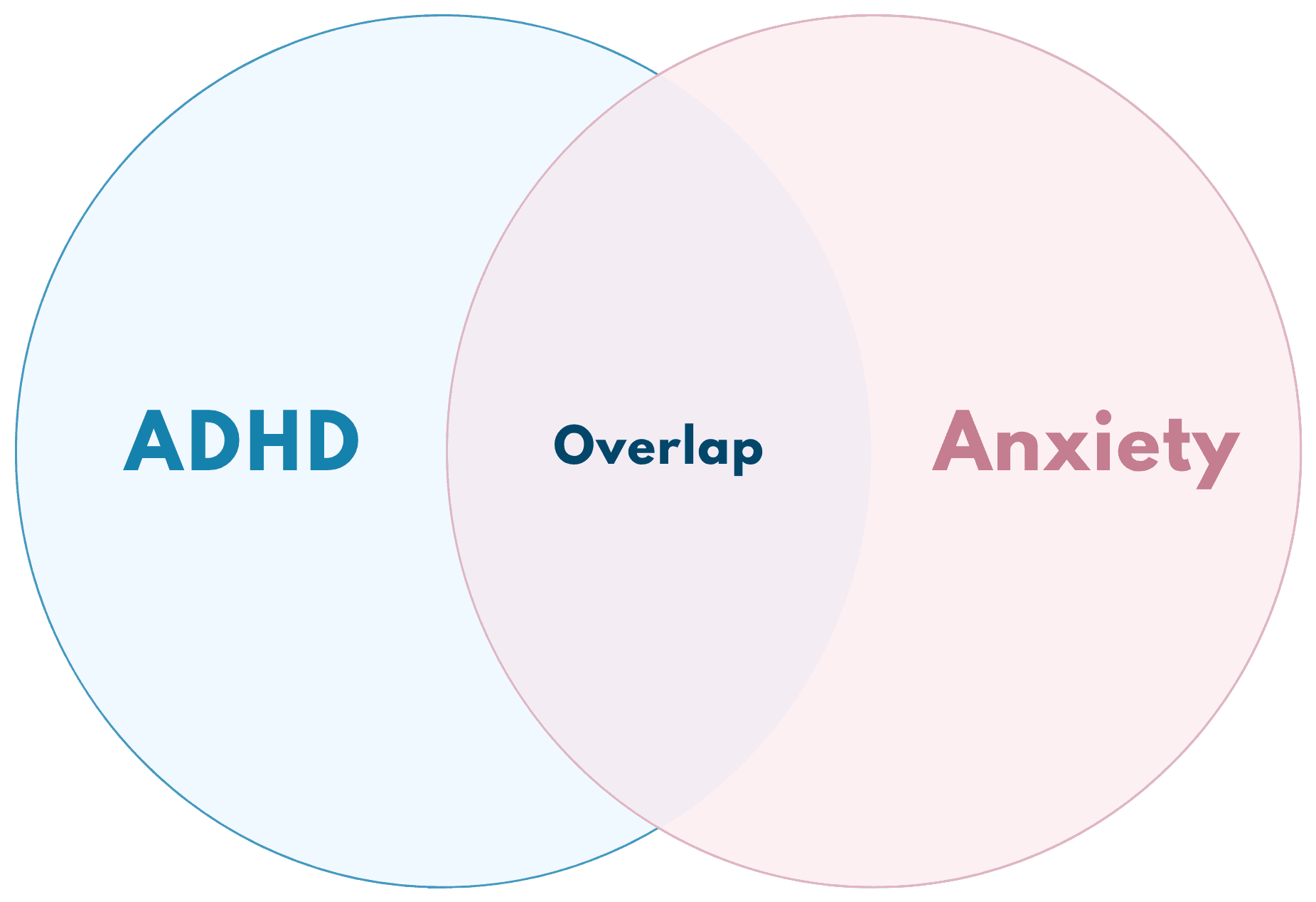
ADHD and anxiety share a complicated relationship. They often show up together, with rates approaching 50% of people with ADHD also experiencing an anxiety disorder. They also share similar traits, which can make them hard to tell apart.
Some research suggests anxiety is especially common alongside ADHD-inattentive presentation, which can make for a particularly complex picture. Without hyperactivity, it can be hard to tell whether trouble focusing comes from anxiety and worry or from difficulty regulating attention.
Another challenge is that ADHD often comes with secondary anxiety: worry tied to ADHD difficulties rather than generalized anxiety. ADHD worry is often connected to executive functioning tasks (finances, health, relationships, school and work), while generalized anxiety is more global and pervasive. Secondary ADHD anxiety might look like worry about missing details, deadlines, or keeping up with time and tasks (executive functioning).
Table of Contents
What Is ADHD?
ADHD is a neurodevelopmental condition, meaning it shows up during development (typically early childhood) and has a strong genetic component. It affects the parts of the brain that regulate attention, focus and emotion, and is characterized by persistent inattention and/or hyperactivity and impulsivity. The DSM-5-TR describes three presentations: predominantly inattentive, predominantly hyperactive-impulsive, and combined. Traits must interfere with daily life in at least two settings, such as home and school or work and home.
Some common ADHD traits include:

Difficulty focusing or staying on task
Trouble keeping track of things
Trouble following through on complex projects
Distractibility and forgetfulness
Seeming not to listen when spoken to
A need to be up and moving, or fidgeting
Impulsivity
Interrupting others or talking a lot
While ADHD is present from early development, it may not become apparent until demands exceed capacity, and many people build sophisticated ways to compensate, so some are only recognized later in life. ADHD has a worldwide prevalence of about 5.3% among children and adolescents, and about 7 million U.S. children (11.7%) have been diagnosed, making it one of the most commonly diagnosed developmental conditions in the U.S.
What Is Generalized Anxiety Disorder?
Generalized anxiety disorder (GAD) is marked by persistent, excessive and hard-to-control worry. The worry occurs more days than not for at least six months, about several events or activities (like work or school), and is out of proportion to the actual likelihood or impact of what is feared. What sets GAD apart from everyday worry is how excessive it is and how much it interferes with work, school and daily life.
Along with difficulty controlling worry, an adult with GAD experiences at least three of the following (one for children):
GAD symptoms in the DSM
Restlessness or feeling keyed up or on edge
Being easily fatigued
Difficulty concentrating or the mind going blank
Irritability
Muscle tension
Sleep disturbance (difficulty falling or staying asleep, or restless, unsatisfying sleep)
To meet criteria, the anxiety can’t be better explained by a substance, a medical condition, or another mental health condition. According to the DSM, the lifetime risk of GAD is about 9%, and in a given year it affects about 0.9% of adolescents and 2.9% of adults in the U.S. Risk peaks in middle age and declines later in life.
How Often Do ADHD and Anxiety Show Up Together?
ADHD and anxiety are distinct conditions, but they often co-occur. Estimates vary depending on the study:
- A review of the literature found anxiety disorder rates approaching 25% in many ADHD samples.
- A later review of adult ADHD describes rates approaching 50%.
- In one study of 134 children with ADHD, about 31% had an anxiety disorder, and more anxiety went along with more severe ADHD.
- People with ADHD who also have anxiety disorders tend to have more severe anxiety, an earlier onset of anxiety, and more additional mental health conditions and substance use.
When anxiety is also present, it can intensify ADHD struggles. People with both may notice more worry, feeling on edge, stress, fatigue, sleep issues, and more trouble with working memory.
How Anxiety Can Change the Picture
- One review suggests anxiety may partly repress impulsivity while making working memory harder. Because of this, ADHD may be noticed later, especially in children who are less likely to be disruptive in class.
- The same review notes that anxiety in ADHD may look different from the more phobic types of anxiety seen in people without ADHD.
- One early study found that methylphenidate improved working memory in children with ADHD who weren’t anxious, but not in those who were.
- In a large study of children with anxiety disorders, co-occurring ADHD mainly affected school functioning and increased the need for mental health treatment. Otherwise, anxiety looked much the same with or without ADHD.
Misdiagnosis: ADHD, Anxiety, or Both?
Misdiagnosis most often happens when one condition is missed, or when ADHD-inattentive presentation is mistaken for anxiety (or the other way around), since the two can look similar. Another common miss is diagnosing GAD when someone is actually experiencing secondary anxiety from ADHD. That kind of anxiety often comes from having to work much harder than others to keep up: worry about missing details, assignments or social missteps, which is different from primary anxiety.
Where ADHD and Anxiety Overlap
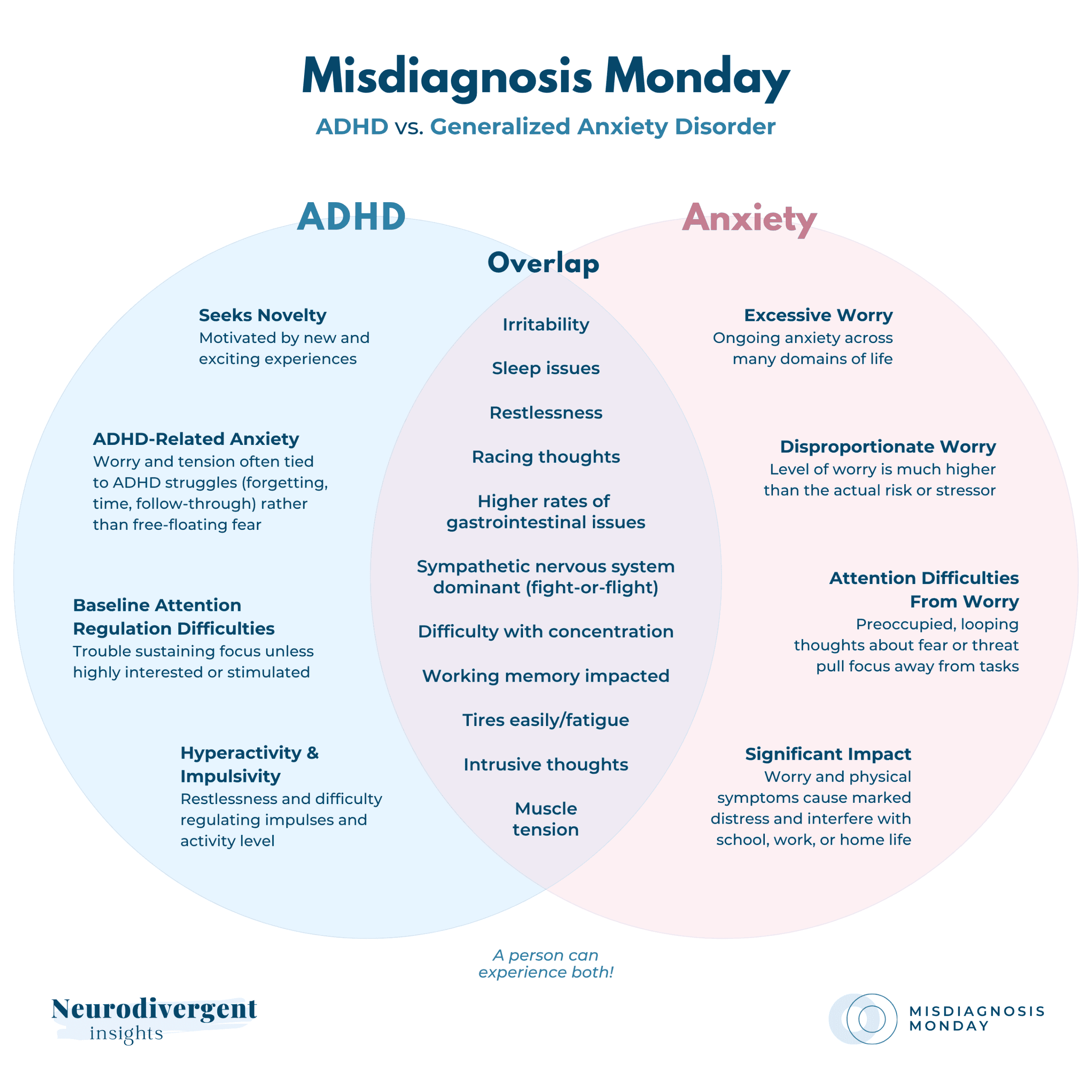
Many experiences show up in both, which can make one look like the other or cause one to be missed.
Inattention
Excessive worry can make it hard to focus, since the brain is tuned to possible threats and less available for everything else. Difficulty regulating attention is also a core part of ADHD.
Sleep Issues
Anxiety can interfere with sleep, and sleep problems like insomnia are common with GAD. Sleep issues are also common with ADHD: about 25 to 50% of people with ADHD have sleep problems such as circadian rhythm differences, insomnia, restless legs or sleep-disordered breathing.
Intrusive Thoughts
Intrusive thoughts are common in many anxiety disorders, and one study found unwanted intrusive and worrisome thoughts are also more common in adults with ADHD.
Digestive Issues
Digestive issues are more common among people with ADHD, and they are also common alongside anxiety and mood disorders.
Restlessness, Agitation, and Irritability
These show up in both conditions. Some research also points to GABA, the brain’s main calming neurotransmitter: one small study found lower GABA in children with ADHD, and GABA is also implicated in anxiety.
Difficulty Focusing and Concentrating
Both involve trouble concentrating, but the origin differs. Someone with anxiety may be so caught up in anxious thoughts that their executive functioning suffers and taking in new information is hard.
For the ADHD brain, even in a state of relative calm, attention and concentration are still hard.
How to Tell ADHD and Anxiety Apart
Teasing ADHD apart from anxiety takes some care. A few questions can help:
Is the anxiety primary or secondary?
If worry is tied specifically to executive functioning struggles (getting things done, being on time, remembering details), it may be secondary anxiety that comes with ADHD. If worry is broader and not tied to ADHD difficulties, it may be a co-occurring anxiety disorder. Because physical signs like restlessness and poor sleep show up in both, it helps to understand what triggers the worry and what the worry thoughts are like.
Is the worry in proportion to the stressor?
In GAD, worry is out of proportion to the actual risk. With ADHD, worry and stress often track actual difficulties with tasks, deadlines and appointments, so they tend to be more proportionate.
What is driving the inattention?
Is focus hard because the mind is consumed by worry, or is it hard even when there is nothing to worry about? Difficulty focusing in the absence of worry points more toward ADHD. A thorough history helps sort out primary anxiety, ADHD, or anxiety that comes with ADHD.
Screeners can be a starting point, though not a substitute for an evaluation: the ADAA GAD screener and the Adult ADHD Self-Report Scale (ASRS).
What Helps
Treatment usually works best when it supports executive functioning and eases anxiety at the same time. Treating both lightens the load on executive functioning.
- Medication: stimulants or non-stimulants for ADHD; antidepressants and other medications for anxiety. For some people, stimulants can increase anxiety; a prescriber may then suggest a non-stimulant option.
- Executive functioning coaching: practical support with planning, time and tasks.
- Therapy: cognitive behavioral therapy (CBT) and acceptance and commitment therapy (ACT) can both help with anxiety.
- Movement: regular exercise or other bodily movement.
- Mindfulness: Headspace is one of my favorite apps for learning mindfulness.
This post contains affiliate links. If you buy through them, we may earn a small commission at no extra cost to you. We only link to things we use or trust.
- Omega-3s: some studies show small benefits for ADHD; Nordic Naturals Ultimate Omega is one option (affiliate link).
Screening note for clinicians: when assessing anxiety, it’s worth screening for ADHD-inattentive presentation too, especially in girls, whose ADHD is more often missed when inattentive traits and anxiety show up together.
A Few Closing Thoughts
ADHD and anxiety overlap a lot: restlessness, sleep trouble, racing thoughts and difficulty concentrating can all come from either one. When worry is tied to executive functioning struggles, that’s a signal to look for ADHD, not just anxiety.
A person can also have both. Understanding where the worry comes from, and what is driving the inattention, helps point toward support that fits.
ADHD vs. Anxiety FAQs
Can you have ADHD and anxiety at the same time?
Yes. They are distinct conditions but often co-occur. Reviews describe anxiety disorder rates from about 25% to approaching 50% among people with ADHD.
Can ADHD cause anxiety?
ADHD often comes with secondary anxiety: worry tied to executive functioning struggles like deadlines, details and keeping up. A person can also have a separate anxiety disorder alongside ADHD.
How can I tell if it’s ADHD or anxiety?
Look at what drives the inattention and the worry. If focus is hard even when there is nothing to worry about, that points more toward ADHD. If worry is broad and out of proportion to the situation, that points more toward an anxiety disorder. An evaluation can help sort it out.
Do stimulants make anxiety worse?
For some people, stimulants can increase anxiety. Others find their anxiety eases once ADHD is treated. If anxiety goes up, a prescriber may adjust the dose or suggest a non-stimulant option.
Additional Resources
ADHD and Autistic Anxiety Why neurodivergent minds are more vulnerable to stress

Screeners: the ADAA GAD screener and the Adult ADHD Self-Report Scale

The Interest-Based Nervous System Workbook Working with ADHD motivation and focus
Books on anxiety (affiliate links): Things Might Go Terribly, Horribly Wrong by Kelly Wilson and Troy DuFrene; The Cognitive Behavioral Workbook for Anxiety by William Knaus; and The Mindfulness and Acceptance Workbook for Anxiety by John Forsyth and Georg Eifert

Stay in the Neurodivergent Loop

For ongoing insights and updates, subscribe to the Neurodivergent Insights Newsletter. Each Sunday, I send out fresh thoughts and a roundup of the newest resources on topics related to neurodivergence, mental health, and wellness. My most personal writing is reserved for my newsletter, and subscribers also get access to the newsletter vault (12+ PDFs) when they join.
References
Abramovitch, A., & Schweiger, A. (2009). Unwanted intrusive and worrisome thoughts in adults with attention deficit/hyperactivity disorder. Psychiatry Research, 168(3), 230–233.
American Psychiatric Association. (2022). Diagnostic and statistical manual of mental disorders (5th ed., text rev.). American Psychiatric Publishing.
Centers for Disease Control and Prevention. Data on ADHD in children.
Edden, R. A. E., Crocetti, D., Zhu, H., Gilbert, D. L., & Mostofsky, S. H. (2012). Reduced GABA concentration in attention-deficit/hyperactivity disorder. Archives of General Psychiatry, 69(7), 750–753.
Hammerness, P., Geller, D., Petty, C., et al. (2010). Does ADHD moderate the manifestation of anxiety disorders in children? European Child & Adolescent Psychiatry, 19, 107–112.
Katzman, M. A., Bilkey, T. S., Chokka, P. R., et al. (2017). Adult ADHD and comorbid disorders: Clinical implications of a dimensional approach. BMC Psychiatry, 17, 302.
Kedem, S., Yust-Katz, S., Carter, D., et al. (2020). Attention deficit hyperactivity disorder and gastrointestinal morbidity in a large cohort of young adults. World Journal of Gastroenterology, 26(42), 6626–6637.
Lydiard, R. B. (2003). The role of GABA in anxiety disorders. Journal of Clinical Psychiatry, 64(Suppl 3), 21–27.
Polanczyk, G., de Lima, M. S., Horta, B. L., Biederman, J., & Rohde, L. A. (2007). The worldwide prevalence of ADHD: A systematic review and metaregression analysis. American Journal of Psychiatry, 164(6), 942–948.
Schatz, D. B., & Rostain, A. L. (2006). ADHD with comorbid anxiety: A review of the current literature. Journal of Attention Disorders, 10(2), 141–149.
Shah, E., Rezaie, A., Riddle, M., & Pimentel, M. (2014). Psychological disorders in gastrointestinal disease: Epiphenomenon, cause or consequence? Annals of Gastroenterology, 27(3), 224–230.
Staner, L. (2003). Sleep and anxiety disorders. Dialogues in Clinical Neuroscience, 5(3), 249–258.
Tannock, R., Ickowicz, A., & Schachar, R. (1995). Differential effects of methylphenidate on working memory in ADHD children with and without comorbid anxiety. Journal of the American Academy of Child & Adolescent Psychiatry, 34(7), 886–896.
Tsang, T. W., Kohn, M. R., Efron, D., et al. (2015). Anxiety in young people with ADHD: Clinical and self-report outcomes. Journal of Attention Disorders, 19(1), 18–26.
Wajszilber, D., Santiseban, J. A., & Gruber, R. (2018). Sleep disorders in patients with ADHD: Impact and management challenges. Nature and Science of Sleep, 10, 453–480.