
The Connection Between ADHD and Alexithymia
Struggling with emotions is one of the most common — and most misunderstood — parts of living with ADHD. Many ADHDers feel things intensely but can’t always name or manage them. Do you ever find yourself overwhelmed by emotions, unsure what you’re feeling, or turning to food, drinking, or other quick fixes just to cope? You’re not alone.
Adding another layer of complexity, ADHD often overlaps with alexithymia — the difficulty identifying and describing emotions. This overlap makes emotional regulation harder and can intensify challenges such as anxiety, impulsivity, and depression.
As an ADHD Psychologist (and someone who also has alexithymia), I know this terrain personally. Learning to recognize and work with my emotions has been a journey of both training and lived experience. The tools I’ve used have given me a greater sense of agency over my body and mind, and it’s why I’m so passionate about sharing them with others.
In this article, we’ll explore what alexithymia is, how it overlaps with ADHD, and why it matters for emotional regulation, impulsivity, support needs, and mental health.
Table of Contents
What is Alexithymia?
Alexithymia comes from the Greek words meaning “without words for emotions.” Psychiatrist Peter Sifneos coined the term in 1972 to describe patients who struggled to notice and put language to their feelings.
Alexithymia is not a mental health disorder but rather a personality trait. It often co-occurs with other forms of neurodivergence, including ADHD, as well as with several mental health conditions. People with alexithymia experience difficulty identifying and describing emotions, and these challenges can occur along a spectrum — from mild traits to more severe difficulties.
Researchers generally agree on three core traits of alexithymia: difficulty identifying emotions, difficulty describing feelings, and an externally oriented thinking style.
Difficulty Identifying Emotions
This trait shows up as confusion about one’s inner experience. People may find it hard to tell the difference between bodily sensations and emotions — for example, mistaking hunger for anxiety. Because recognizing emotions is a first step in being able to regulate them, difficulty in this area is linked to higher risk for depression, non-suicidal self-injury, and suicidal behavior (Cerutti et al., 2018).
Difficulty Describing Feelings
While it sounds similar, describing feelings is slightly different from identifying them. Here the challenge lies in finding words for emotions and expressing them to others. Emotional labels may feel vague or overly general. This can create misunderstandings and contribute to more difficulties in relationships.
Externally Oriented Thinking
Externally oriented thinking means focusing on events outside oneself while avoiding inner experiences. Someone with high traits in this area may struggle to pay attention to their own emotions and inner world. This trait has been linked with reduced ability to experience positive emotions, which in turn can contribute to depression and other mood challenges.
Alexithymia and ADHD
Research shows that alexithymia is more common among ADHDers than in the general population. Prevalence rates vary — some studies report around 20%, while others find 44% or higher.
ADHD and alexithymia are different in nature. Alexithymia is a personality trait, while ADHD is a neurodevelopmental difference. ADHD is often misunderstood as simply an “attention deficit,” but in reality it reflects an interest-based nervous system. This means ADHDers don’t have a deficit in attention — rather we have difficulty regulating it. Our attention is regulated by interest, novelty, and emotional engagement rather than by importance alone. Along with this, ADHD is characterized by differences in executive functioning, hyperactivity, and impulsivity.
Both ADHD and alexithymia are linked with emotional regulation challenges — but for different reasons.
For ADHDers, we can have heightened emotional reactivity where emotions can surge quickly when something is highly engaging, frustrating, or urgent. At the same time, executive functioning differences and impulsivity can make it harder to pause, reflect, and regulate these emotions.
For people with alexithymia, the challenge looks different. Emotions may not register until they’ve already become overwhelming. By the time a feeling comes into awareness, it can be hard to manage or soothe effectively. This often creates “spiky” emotional experiences — feeling little or nothing, followed by a flood of intense emotion. That pattern can bring its own challenges with regulation.
Both ADHD and alexithymia involve emotional vulnerability and difficulty regulating emotions. It makes sense, then, that they’re also linked to higher rates of disordered eating, substance use, and other coping strategies that may help in the moment but cause more pain over time.
Many of us reach for ways to numb or distract from overwhelming emotions — whether that’s food, alcohol, scrolling, or other quick fixes. These are sometimes called negative coping strategies because, while they ease the intensity short-term, they tend to pile on new difficulties over time.
In contrast, positive coping strategies involve actively engaging with and processing our emotions in ways that help regulate and move through them, rather than avoiding them.
So when ADHD and alexithymia show up together, it often makes emotional struggles even more pronounced!

Alexithymia and ADHD: Emotional Impacts and Challenges
Research consistently shows that alexithymia makes ADHD traits harder to manage and is linked with higher rates of social anxiety and emotional struggles.
When someone experiences both alexithymia and ADHD, the challenges can compound: more difficulty with impulsivity, greater struggles processing emotions, higher rates of depression and anxiety, and often a greater need for support in daily life.
This matters because alexithymia is not fixed. With support, it is possible to strengthen our ability to notice, name, and work with emotions in ways that are more constructive. For ADHDers, addressing alexithymia can be an important piece of a broader support plan.
The Link Between Alexithymia and Impulsive Behaviors in ADHD
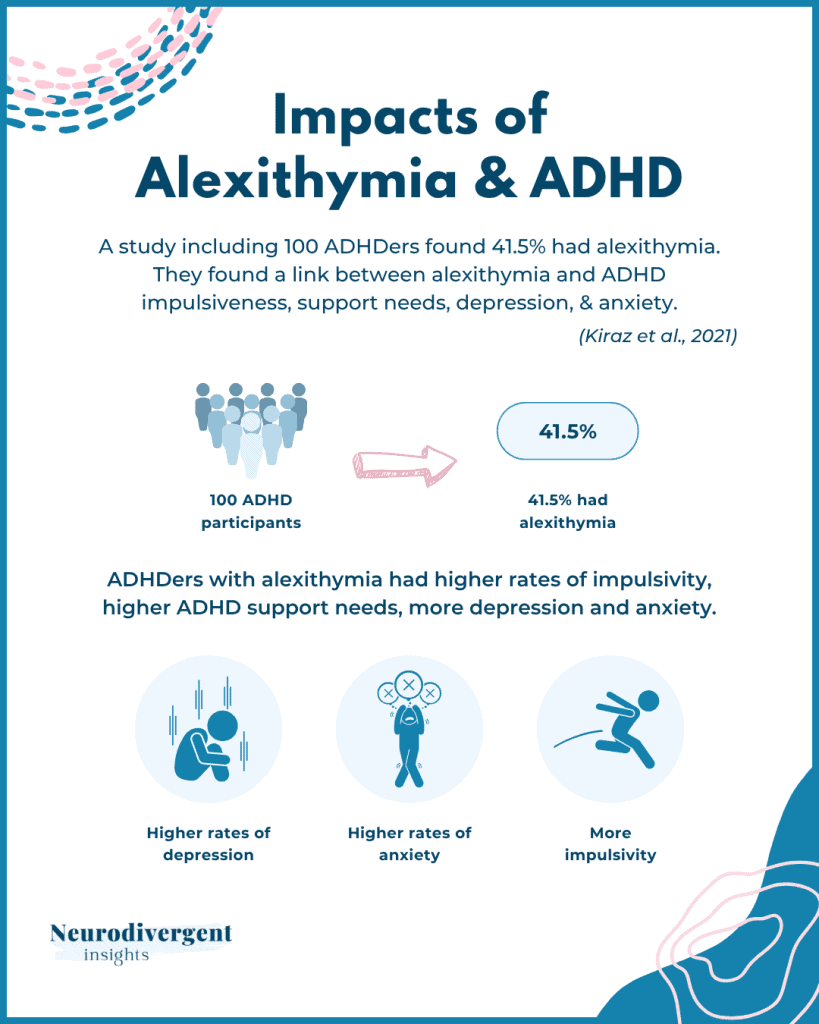
Impulsivity refers to acting without planning, difficulty sticking with tasks, challenges delaying gratification, and struggles regulating emotions. Research shows that ADHDers with alexithymia often experience more impulsive traits. In one study of 100 ADHDers, 41.5% had alexithymia, and the researchers found a clear link between alexithymia and impulsivity (Kiraz et al., 2021).
This means that ADHDers with alexithymia may be more likely to seek out new and stimulating experiences, struggle to persist with tasks, act rashly when in a heightened mood, and be more prone to risky behaviors such as black-out drinking.
For ADHDers with hyperactive or combined presentations, alexithymia can increase vulnerability to problems like substance use. Recognizing this overlap matters because early support and education can lower these risks.
Why ADHDers with Alexithymia May Need More Support
That same study also found that ADHDers with alexithymia had what the researchers called “higher severity of ADHD symptoms.” As a neurodivergent-affirming clinician, I prefer to frame this not as severity but as greater support needs.
In practice, what the study showed is that ADHDers with alexithymia tend to be more impacted by their traits. They may experience more difficulty in school or work, greater challenges in relationships, and more behavioral struggles. This means they often benefit from increased support.
Alexithymia and ADHD: Emotional Processing, Social Anxiety, and Mental Health
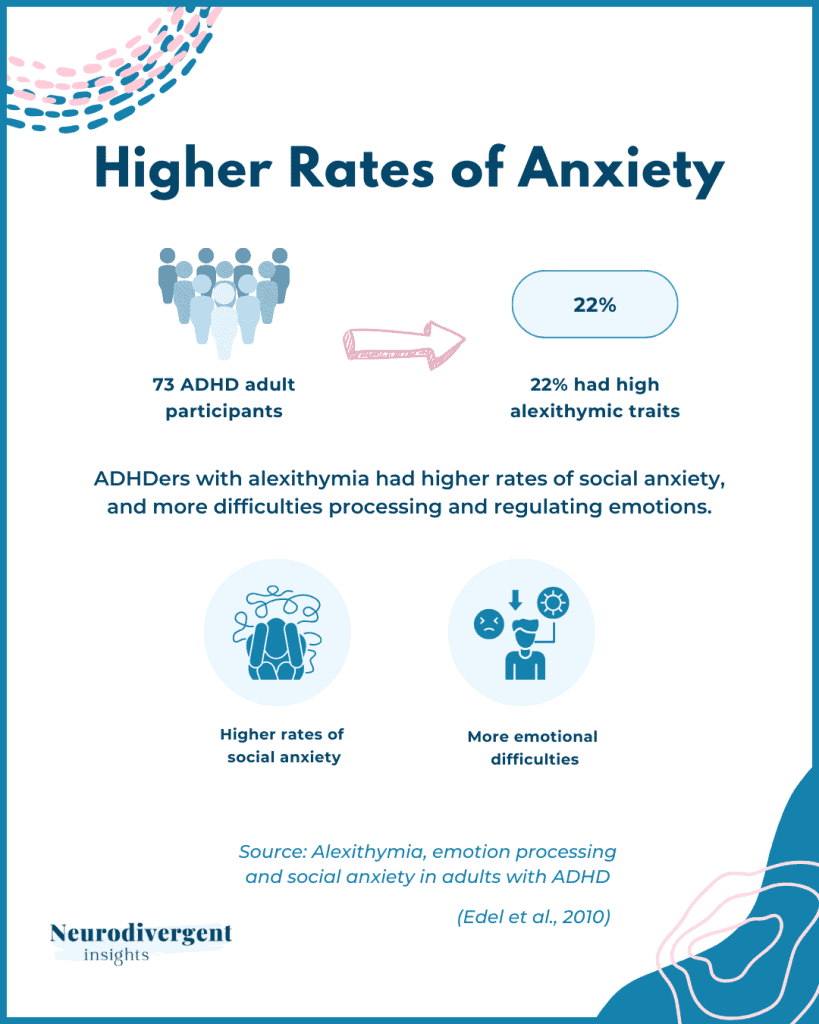
Research by Edel et al. (2010) found that ADHDers with alexithymia were more likely to experience social anxiety and emotional processing difficulties. When emotions are hard to process, they can feel more overwhelming and harder to manage. In these moments, many people turn to coping strategies that avoid or numb feelings, such as emotional eating, substance use, or withdrawing. Over time, this pattern increases vulnerability to depression and anxiety.
For ADHDers with alexithymia, these risks are even greater. They tend to have more difficulty processing emotions effectively and are more likely to experience social anxiety, depression, and other mental health conditions. When ADHD co-occurs with another mental health condition, it is sometimes referred to as “complex ADHD.” This combination can create unique stressors and adds layers of complexity to living with ADHD.
Alexithymia and ADHD: Why Emotional Awareness Matters
Supporting alexithymia really comes down to building emotional awareness, which can be an important part of supporting ADHDers. When someone has both ADHD and alexithymia, the challenges can stack up — but the encouraging part is that with practice alexithymia can be improved.
Some helpful ways to support alexithymia include:
Building interoceptive awareness (through occupational therapy or interoception practices)
Expanding emotional literacy
Practicing naming and identifying emotions
As these skills grow, it becomes easier to notice what we’re feeling and to work with emotions in ways that increase agency and regulation.
If you’d like more structured guidance, I’ve created The Alexithymia Workbook. And for those whose alexithymia is connected to interoception challenges, the Mind-Body Awareness Bundle includes both The Alexithymia Workbook and The Interoception Workbook.
- Tags: Alexithymia