AuDHD Attention
Last week, I explored the architecture of AuDHD attention: what happens inside the control tower of our minds when the radar, spotlight, and controller all run hot at once.
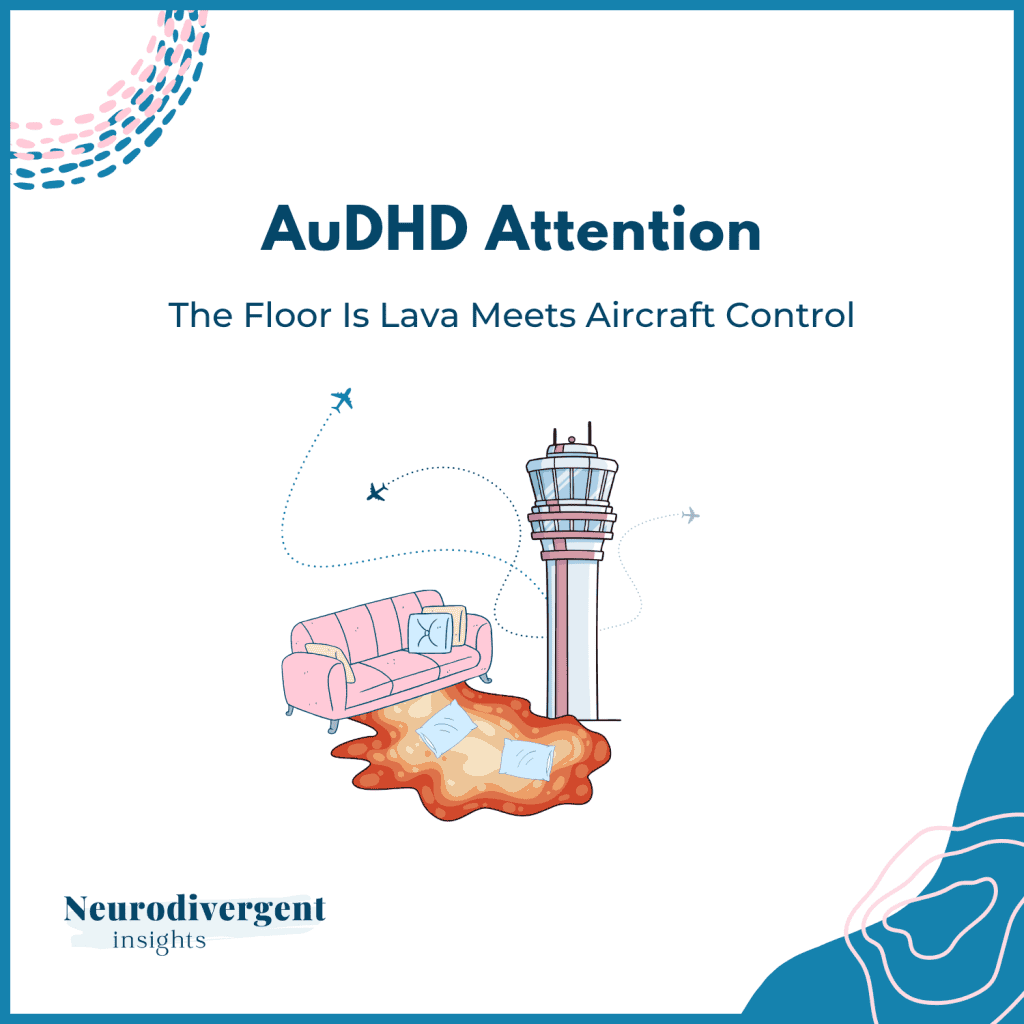
But before the tower, there was the lava — the lived experience beneath the science.
As a child, I used to play a game with my sisters called “Lava.” We’d scatter pillows across the living room floor, each one a safety rock, and leap from cushion to cushion, trying not to fall into the molten carpet below. I remember the tension before each jump, the thrill of landing, the relief of finding steady ground.
I think of that game often when I write about attention. My mind still moves that way, leaping from one island of focus to the next, trying not to fall into the lava of overwhelm that bubbles beneath.
If the lava is the lived experience, the sensory flood and the scramble to find safety, then the tower is the inner system trying to manage it all.
Table of Contents
A Brief Return to the Tower
Researchers describe three key systems that shape attention: the alerting, orienting, and executive control networks. Each plays a different role in how we scan, select, and sustain focus, and in AuDHD, each tells its own story.
I used the metaphor of an air traffic control tower to make sense of the science (and, in uncanny timing, the FAA started the process of reducing air traffic by 10% this week. I hope you haven’t been caught in the delays.)
To those of you feeling the ripple effects of that and the ongoing government shutdown, I’m so sorry. I know both are adding extra stress and noise for many of us right now.
Back to awkwardly timed metaphors and attention … here’s a recap of last week’s essay:
The Radar (Alerting System):
AuDHD minds receive extra noise here, it’s like there are more planes in the sky than the radar can easily track. We’re constantly scanning, and the radar rarely rests. This keeps the nervous system on perpetual standby: hypervigilant, flooded with signals before it can sort out what matters.
→ TL;DR: Too many planes in the air.
The Spotlight (Orienting System):
This is the mechanism that decides where attention lands. In AuDHD, it often swings too wide or too fast, pulled by sensory and emotional salience rather than contextual importance.
→ TL;DR: Easily pulled off course by what feels loudest or most charged, hard to know which planes need our attention most.
**The Controller (Executive Network):**The system meant to manage the chaos: to filter, prioritize, and shift focus. This often gets overloaded. Think of the people in the tower trying to coordinate with pilots: their radios cut in and out, their communication breaks down, and at the same time they’re flooded with extra signals to sort. It’s both hyperconnected and fragmented.→ TL;DR: The controllers are working with glitchy radios, while also sorting through too many signals at once.
If you want a deeper recap of the neuroscience behind this metaphor, you can find it here. For this week, I’m shifting focus from how AuDHD attention works to how it feels: the ways it can soothe and steady us, and the ways it can flood.
Together, these circuits sketch a control system that is bombarded from the outside and fragmented on the inside. It’s not that there’s no one in the tower; it’s that the controller is drowning in signals and disconnected from the very tools meant to help manage them.
The radar, or alerting system, is hypervigilant.
The orienting system is pulled in every direction at once.
And the executive network, the one supposed to make the calls, is trying to land every plane safely with limited radio contact.
It isn’t as simple as chaos. It’s congestion.
Attention as Soothing; Attention as Dysregulating
So if you feel like you have to work hard to focus on what matters, you’re not imagining it. You’re operating an air traffic tower with a hyperactive radar, a spotlight that swings too wide, and a controller who’s listening to too many radio channels at once.
And yet, what we pay attention to matters. As adrienne maree brown writes in Emergent Strategy, “What we pay attention to grows.” I return to that line often. Because attention isn’t just cognitive; it’s emotional. It quietly shapes how we experience ourselves, how we make sense of the world, and how we move through it. What we attend to shapes how we feel, and how we feel shapes what we can attend to.
There are moments when that loop feels nourishing: when attention finally lands somewhere steady. For me, it might be a piece of writing, a clinical idea I’m tracing, or a repetitive sensory rhythm I can sink into. In those moments, my attention becomes a refuge. The noise quiets. My body settles. These are the rocks: the small, solid places of safety surrounded by a world of lava.
It’s what psychologists call flow state: the state of being fully absorbed in something meaningful. It’s that sense of being in the zone, where time stops and our skills and the challenge at hand line up just right: demanding enough to hold our focus, but not so hard that it tips into anxiety.
For many neurodivergent people, especially Autistic and ADHD people, flow isn’t just pleasurable; it’s deeply restorative. It’s one of the few states where mind and body move in the same rhythm, where attention stops splintering and finally syncs.
Recent work on Autistic Flow Theory (Heasman et al. 2024) helps explain why this state can feel so deeply restorative. They suggest Autistic people may be especially predisposed to sustained flow because our attention naturally narrows through monotropism, we crave structure and clarity, and we’re often internally motivated by deep, personal interests. In other words, our brains are built to focus deeply when the conditions are right
When the nervous system stops negotiating
Flow, to me, is that rare moment when my nervous system stops negotiating between the too-muchness of the world and the not-enoughness within it. When the noise quiets and my body finally settles.
But flow also has an edge. The same focus that steadies us can make balance harder to find. Immersion can become so complete that leaving it: to eat, rest, or switch tasks feels abrupt, and distressing. In a study by Rapaport and colleagues, Autistic participants described flow as both a refuge and a risk: profoundly affirming, yet sometimes depleting, especially when life forces an abrupt exit.
Our exit from flow is where we return to the chaos of the flight tower, or the lava. And when that is the alternative it’s easy to see why we keep seeking out that steady rhythm of flow. Flow becomes the refuge we reach for again and again: find the safe rock, jump. Find another rock, jump. Everything else is lava.
I think of it as finding an island of regulation; a place where attention can root deeply enough that the rest of the world goes quiet. Monotropism helps explain this pull toward depth: when our attention is allowed to converge fully, without fragmentation, the system finally rests.
But the same capacity that lets us find safety in depth can also make it hard to leave. The lava that surrounds our islands, the noise, the demands, the transitions, is still there waiting. These are the moments my attention feels like it’s pulling me under. I can’t stop thinking, can’t stop scanning, can’t stop feeling. The never-ending to-do list hums in the background. I wake up in the middle of the night with thoughts of unfinished tasks, I wake up in the morning and am instantly hit with the hundreds of forgotten and unfinished tasks and it hums along like that until I find a thought stream to sink into …
It’s no wonder attention and emotional regulation are so intertwined in AuDHD. When the salience system is on high alert, everything feels urgent. The world comes in too fast, too loud, too close and the refuge are the rocks. But the rocks … they are islands. Disconnected from the other parts of life that need attending to, like eating, maintaining a body, connecting with other humans.
I come in and out — from total immersion in my peaceful flow bubble to navigating a world where the people I love, and the needs that need tending, exist in the lava terrain.
Sometimes attention soothes; other times, it floods. And for those of us who are AuDHD, we’re constantly learning to move between both.
Between the lava and the tower — that’s where so many of us live.
Learning, again and again, how to find our next steady rock.
stay in the neurodivergent loop
For ongoing insights and updates, subscribe to the Neurodivergent Insights Newsletter. Each Sunday, I send out fresh thoughts and a roundup of the newest resources on topics related to neurodivergence, mental health, and wellness. My most personal writing is reserved for my newsletter, and subscribers also get access to the newsletter vault (12+ PDFs) when they join.