Like many neurodivergent people, I understand things best when I can see them, so this article leans on visuals. If you’re looking for the autism criteria, I have a companion article on the DSM-5 criteria for autism.
Table of Contents
Before We Start: A Few Notes on the DSM-5
This is for education only. It isn’t a substitute for medical advice or meant to be used as a diagnostic tool.
A word on language. When I list the criteria, I use the direct language of the DSM. Much of that language is deficit-based and pathologizing, and I don’t agree with all of it (in fact, I don’t!). I include it so you can see what is actually in the manual.
What do A, B, C (and so on) mean? The DSM groups criteria into lettered buckets. A person doesn’t need every trait listed, but every lettered criterion (A through E) needs to be met for a diagnosis.
What about people outside the US? The DSM-5 is published by the American Psychiatric Association. Its ADHD criteria are very similar to the ICD, which is used globally. The 2022 text revision (DSM-5-TR) kept the ADHD criteria essentially the same.
The DSM-5 Criteria for ADHD
To meet criteria for ADHD, five buckets of criteria need to be met (A through E). Criterion A gets the most attention. It has two parts, inattention and hyperactivity-impulsivity, and each part lists nine traits.
For a diagnosis, a person needs six of the nine traits in at least one part (five for people 17 and older). The other criteria mostly help tell ADHD apart from other conditions and experiences.
The DSM-5 calls the different patterns “presentations” (predominantly inattentive, predominantly hyperactive-impulsive, and combined). Most people still say “types,” so I use both words here.
ADHD Criterion A1: Inattention
According to the DSM-5, the inattention criterion is met when “six (or more) of the following symptoms have persisted for at least 6 months to a degree that is inconsistent with developmental level and that negatively impacts directly on social and academic/occupational activities.” For people 17 and older, five traits are enough.
Two parts of that sentence matter most. The traits must be inconsistent with developmental level (noticeably different from peers) and they must have a negative impact on daily life, such as work, school, or relationships. Both need to be true. This is a big part of what separates ADHD from everyday inattention.
Everyone has moments of distraction and trouble focusing. With ADHD, these struggles are part of a person’s baseline and show up across settings. If someone only struggles to focus in chaotic or distracting environments, that is more likely situational inattention.
ADHD, Attention, and the Pandemic
The COVID-19 pandemic brought a lot of confusion about ADHD. When we lost our usual work structures and home and work boundaries collapsed, focus got harder for many people. Anxiety about a global crisis made it harder still. For people whose struggles began with the pandemic, this was usually situational inattention.
At the same time, the pandemic helped many undiagnosed ADHDers recognize their ADHD for the first time. Many people who had been masking, getting by on structure and compensatory strategies, burned out when those supports disappeared. This pattern is common: ADHD often goes unrecognized until stress outpaces coping, for example after the birth of a child or in graduate school.
So both things were true. Some people mistook situational inattention for ADHD, and many others finally understood their ADHD, helped along by a wave of ADHD awareness online. When professionals say “everyone thinks they have ADHD now,” I think they miss how many of those people are ADHDers whose coping strategies were simply exhausted.
A Quick Rabbit Trail
That last section was a bit of a divergent rabbit trail. Interweaving ideas is common for ADHDers, though it isn’t on the DSM list. Some clinicians call non-linear thinking “tangential,” but if you look closer, we are often connecting ideas. It isn’t linear, but it is often purposeful.
This tendency can also look like inattention. When someone tells a story, our mind may wander down a related trail, and we lose the thread of the conversation. I prefer to think of this as difficulty regulating attention: our curiosity has taken us elsewhere, and our attention has gone along with it.
The Nine Inattention Traits
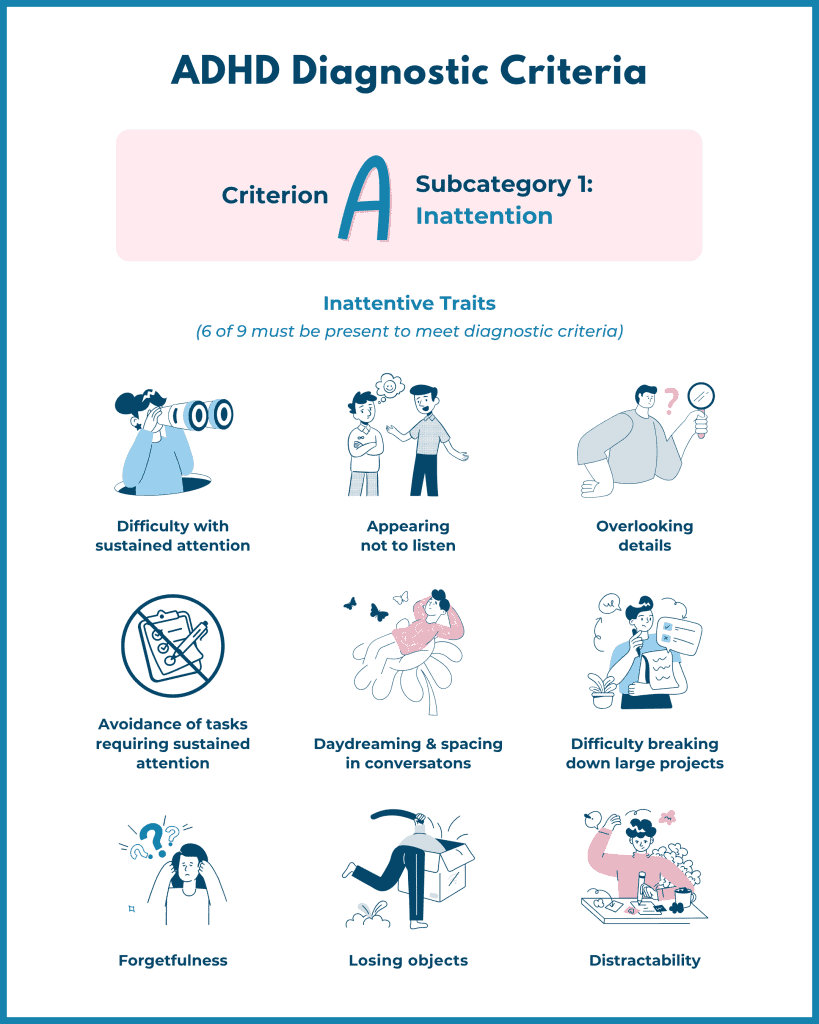
Back to the DSM. To meet criterion A1, a person needs six of these nine traits (five for people 17 and older). The list below is the direct text of the DSM-5.
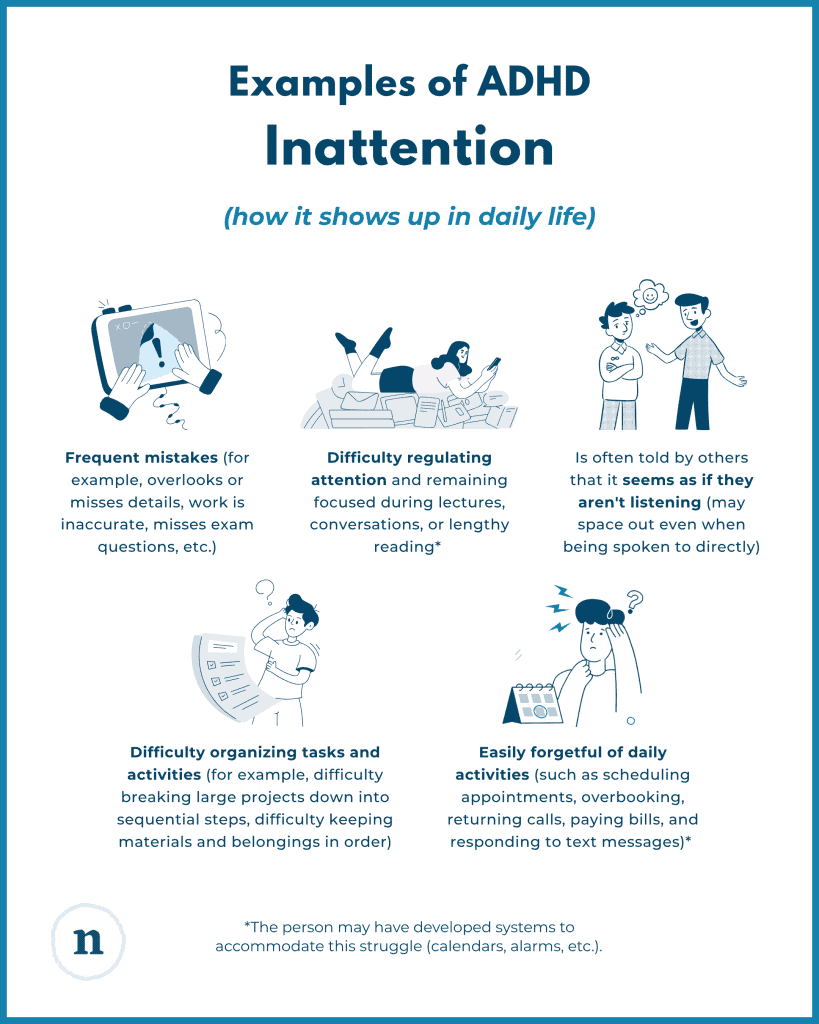
Often fails to give close attention to details or makes careless mistakes in schoolwork, at work, or during other activities (e.g., overlooks or misses details, work is inaccurate).
Often has difficulty sustaining attention in tasks or play activities (e.g., has difficulty remaining focused during lectures, conversations, or lengthy reading).
Often does not seem to listen when spoken to directly (e.g., mind seems elsewhere, even in the absence of any obvious distraction).
Often does not follow through on instructions and fails to finish schoolwork, chores, or duties in the workplace (e.g., starts tasks but quickly loses focus and is easily sidetracked).
Often has difficulty organizing tasks and activities (e.g., difficulty managing sequential tasks; difficulty keeping materials and belongings in order; messy, disorganized work; has poor time management; fails to meet deadlines).
Often avoids, dislikes, or is reluctant to engage in tasks that require sustained mental effort (e.g., schoolwork or homework; for older adolescents and adults, preparing reports, completing forms, reviewing lengthy papers).
Often loses things necessary for tasks or activities (e.g., school materials, pencils, books, tools, wallets, keys, paperwork, eyeglasses, mobile telephones).
Is often easily distracted by extraneous stimuli (for older adolescents and adults, may include unrelated thoughts).
Is often forgetful in daily activities (e.g., doing chores, running errands; for older adolescents and adults, returning calls, paying bills, and keeping appointments).
The DSM Describes ADHD From the Outside
When reading this list, it helps to remember that the DSM is written from the outside. It captures behaviors an observer can see and rarely captures internal experience.
For example, the first trait mentions “careless mistakes.” To an observer, these mistakes may look careless. They are rarely experienced as careless by the ADHDer making them.
It’s also worth naming the interest-based nervous system. Many of these struggles fade when we’re doing something interesting, challenging, novel, or urgent. Dopamine plays a big role in motivation and attention, and interest seems to help bring it online. For this reason, I find “difficulty regulating attention” more accurate than “attention deficit.”
ADHD Criterion A2: Hyperactivity and Impulsivity
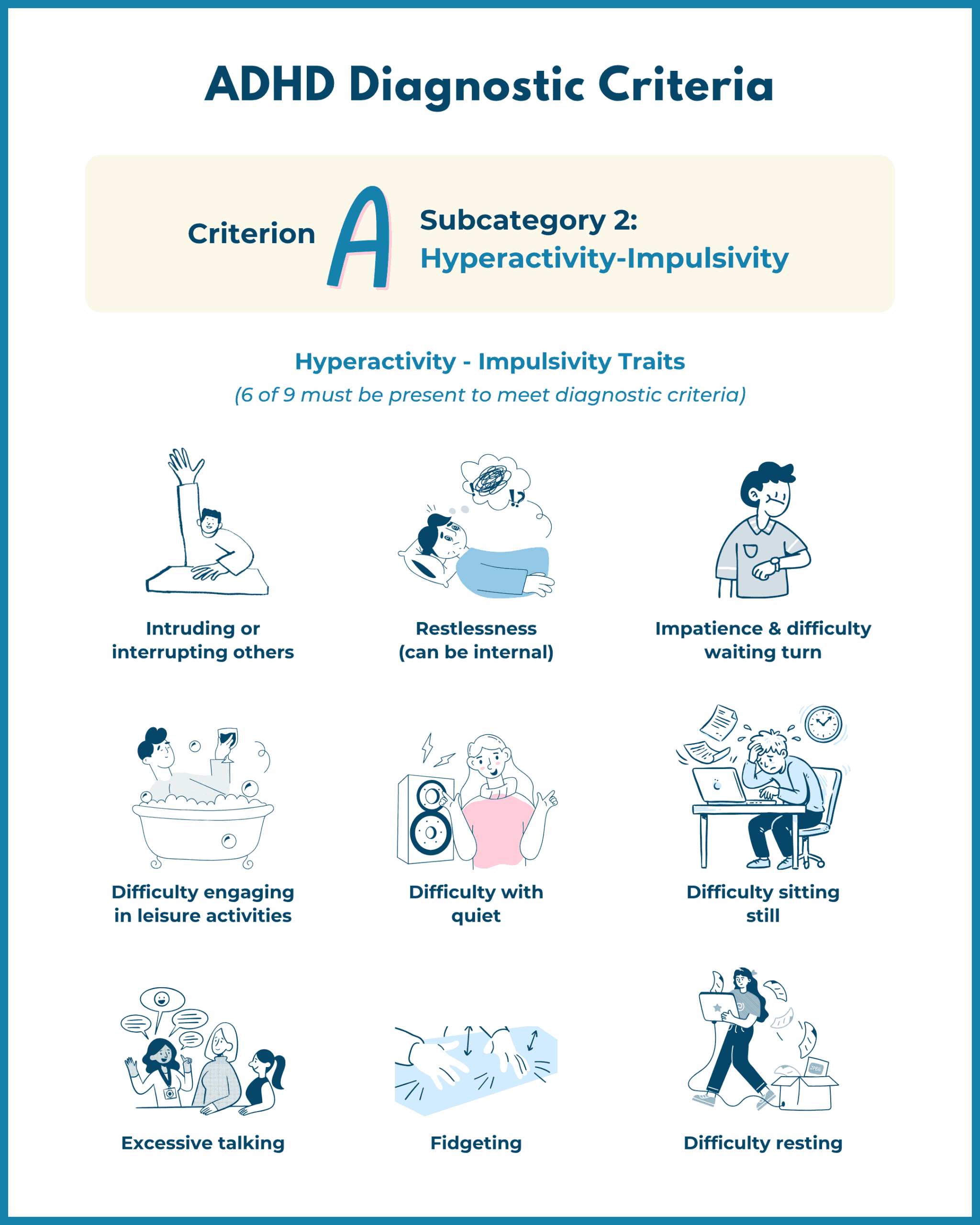
The second part of criterion A covers hyperactivity and impulsivity. Again, six of nine traits need to be present for at least six months, to a degree that is inconsistent with developmental level and has a negative impact on daily life (five traits for people 17 and older). The list below is the direct text of the DSM-5.
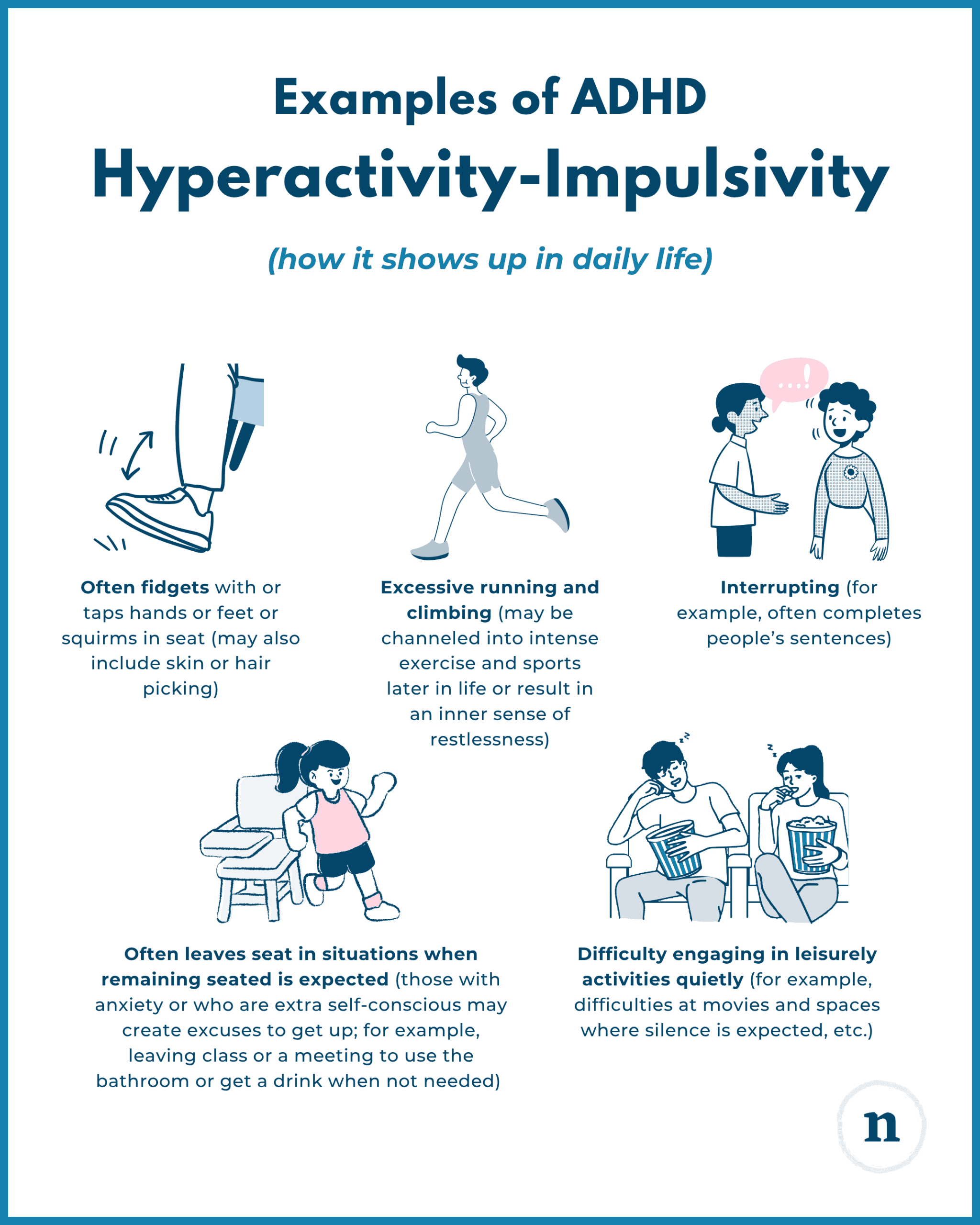
Often fidgets with or taps hands or feet or squirms in seat.
Often leaves seat in situations when remaining seated is expected (e.g., leaves their place in the classroom, in the office or other workplace, or in other situations that require remaining in place).
Often runs about or climbs in situations where it is inappropriate. (Note: In adolescents or adults, may be limited to feeling restless.)
Often unable to play or engage in leisure activities quietly.
Is often “on the go,” acting as if “driven by a motor” (e.g., is unable to be or uncomfortable being still for extended time, as in restaurants, meetings; may be experienced by others as being restless or difficult to keep up with).
Often talks excessively.
Often blurts out an answer before a question has been completed (e.g., completes people’s sentences; cannot wait for a turn in conversation).
Often has difficulty waiting their turn (e.g., while waiting in line).
Often interrupts or intrudes on others (e.g., butts into conversations, games, or activities; may start using other people’s things without asking or receiving permission; for adolescents and adults, may intrude into or take over what others are doing).
Hyperactivity Turned Inward
One critique of these criteria is that they focus on outward behavior and miss hyperactivity turned inward. Because the criteria are behavior-based, internal hyperactivity is harder to see and assess. You have to ask about the person’s inner experience.
Clinically, inward hyperactivity often shows up as anxiety, intense rumination, and a sense of internal agitation or restlessness.
The Three Types (Presentations) of ADHD
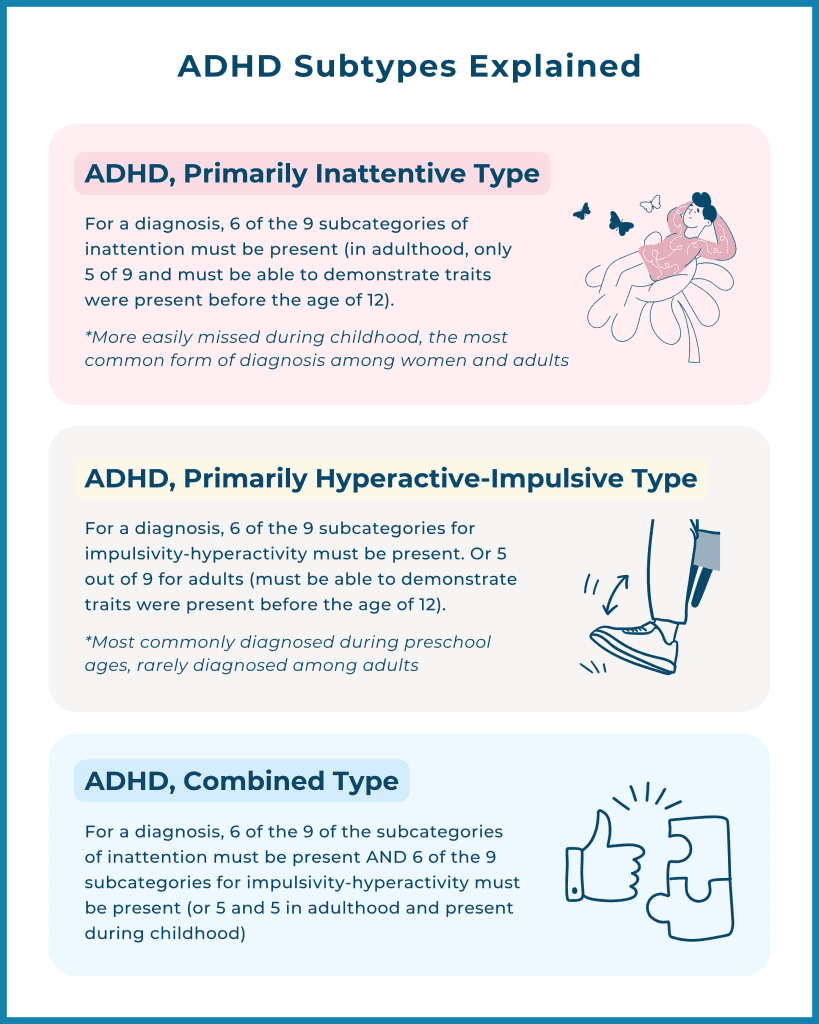
Before leaving criterion A, let’s talk about the three presentations of ADHD that can be diagnosed:
- Predominantly inattentive (ADHD-I): mainly difficulty regulating attention
- Predominantly hyperactive-impulsive (ADHD-HI): mainly hyperactive and impulsive traits
- Combined (ADHD-C): both inattention and hyperactivity-impulsivity
In a 2012 review of prevalence research, the inattentive presentation was the most common in the general population, while the combined presentation was the most likely to be referred for evaluation. Hyperactivity is often most visible in young children.
Because of this, it helps to hold these presentations with some flexibility. A person may meet criteria for different presentations at different points in life. A young child might first be diagnosed with the hyperactive-impulsive presentation, meet criteria for combined in mid-childhood, and only meet criteria for inattentive as an adult.
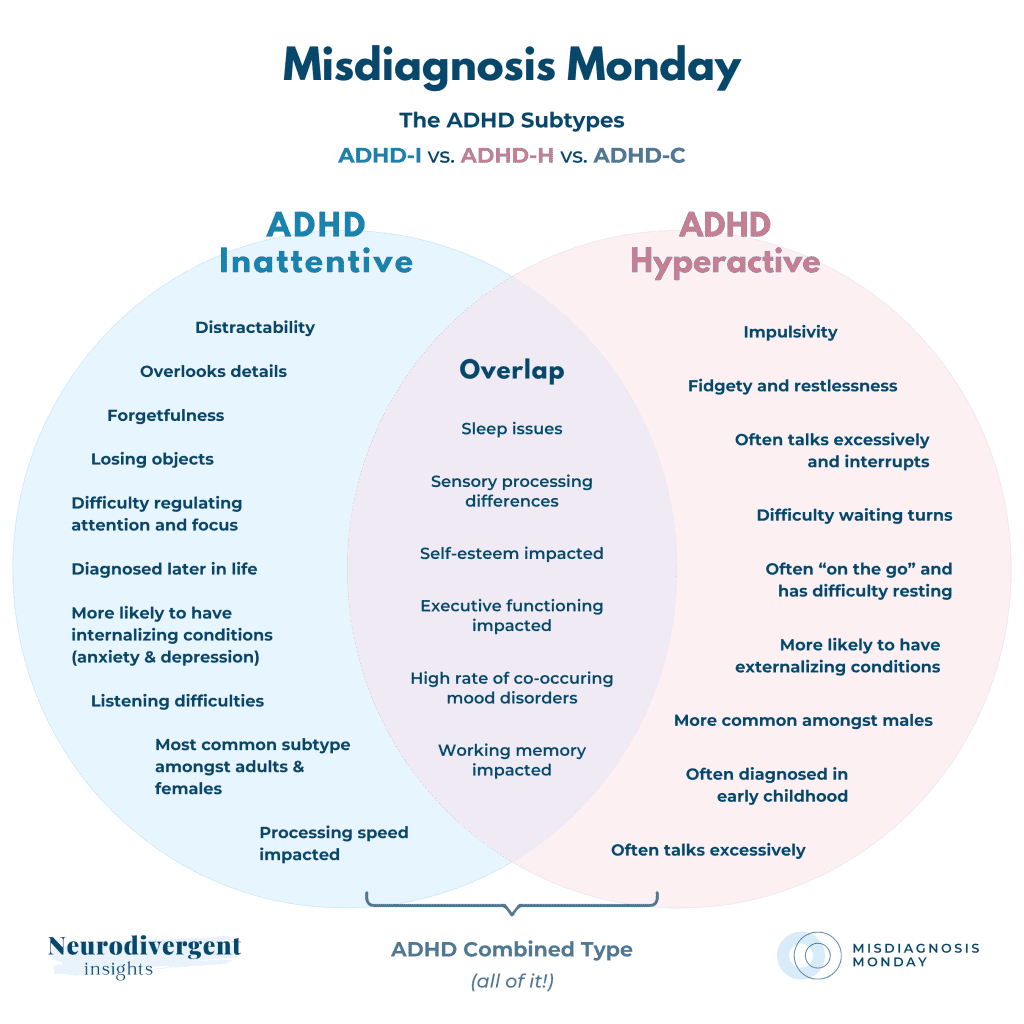
A person either is an ADHDer or isn’t, but how the traits show up can shift a lot across time and settings. So I find it more helpful to think of ADHD as a whole and to notice how it may look different across the lifespan.
There is ongoing debate about whether the three presentations are distinct categories. In my clinical work, I often saw people with the inattentive presentation describe internal restlessness, a form of hyperactivity, which can feed anxiety and depression. That’s why I think of these as different presentations of ADHD rather than fixed categories.
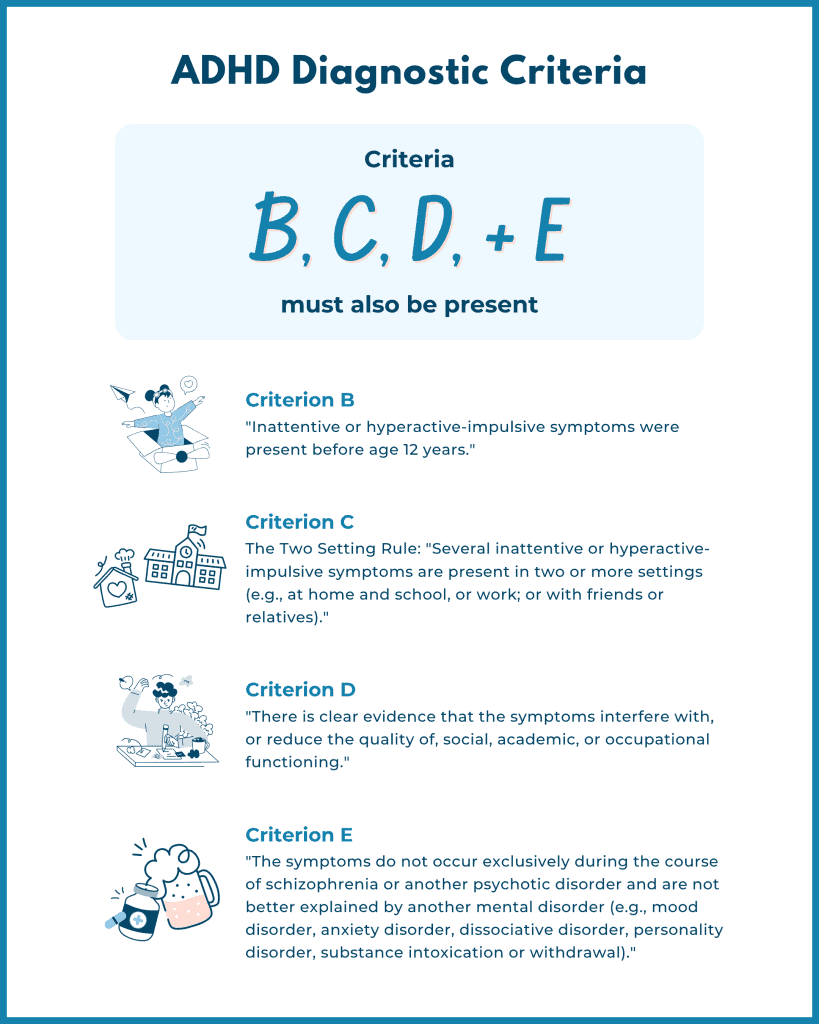
ADHD Criteria B Through E
In the DSM, the last few criteria of a diagnosis usually deal with rule-outs and context. The same is true for ADHD.
Criterion B: Present Before Age 12
ADHD is a neurodevelopmental difference, which means it is present from early in life rather than acquired. The DSM-5 requires that several traits were present before age 12.
ADHD traits may not become obvious until a person is under heavy stress or in an unsupportive environment. Many people also learn to mask their ADHD early in life and aren’t identified until adulthood.
Criterion C: Present in Two or More Settings
As discussed above, ADHD is part of a person’s baseline rather than a response to one situation. One way clinicians check this is by asking whether traits show up in two or more settings, such as home, school, work, or relationships.
I appreciate the goal here. But when this rule is applied rigidly, it can lead to missed diagnoses. Clinically, I’m concerned that people with the inattentive or hyperactive-impulsive presentations, whose struggles may show up most clearly in one setting at a time, are more likely to be overlooked.
Criterion D: Impact on Daily Life
To meet criterion D, there must be clear evidence that the traits interfere with, or reduce the quality of, social, school, or work functioning. Nearly every DSM diagnosis includes a requirement like this.
Criterion E: Ruling Out Other Explanations
Criterion E is about not mistaking ADHD for something else. Many conditions can affect attention, activity level, and impulsivity. This criterion asks clinicians to rule out other explanations, such as a mood, anxiety, or psychotic condition.
This matters a lot when medication is on the table. If inattention and impulsivity are coming from a manic episode, psychosis, or anxiety rather than ADHD, a stimulant could make things worse. This is why a careful assessment is essential.
A Few Closing Thoughts
I hope this helps make the DSM-5 criteria for ADHD a little less mysterious. The criteria are a starting point. They describe ADHD from the outside, and much of what ADHDers live with happens on the inside.
If you’d like to keep learning, my ADHD 10-week series looks at ADHD alongside the conditions it is most often confused with.
DSM-5 ADHD Criteria FAQs
What are the DSM-5 criteria for ADHD?
There are five criteria, A through E. Criterion A lists nine inattention traits and nine hyperactivity-impulsivity traits. Criteria B through E cover onset before age 12, traits in two or more settings, clear impact on daily life, and ruling out other explanations.
How many traits do you need for an ADHD diagnosis?
Six of the nine traits in at least one part of criterion A for children, and five for people 17 and older. The traits need to have lasted at least six months.
What are the three types of ADHD?
The DSM-5 calls them presentations: predominantly inattentive, predominantly hyperactive-impulsive, and combined. A person’s presentation can change over their lifetime.
Did the DSM-5-TR change the ADHD criteria?
No. The 2022 text revision kept the ADHD criteria essentially the same as the DSM-5.
Additional Resources

DSM-5 Criteria for Autism, Explained in Pictures: the companion article for autism

The Interest-Based Nervous System: why interest, novelty, and urgency shape ADHD attention

ADHD 10-Week Series: ADHD and the conditions it is often confused with
The 3 Types of ADHD: a closer look at the three presentations
 Stay in the Neurodivergent Loop
For ongoing insights and updates, subscribe to the Neurodivergent Insights Newsletter. Each Sunday, I send out fresh thoughts and a roundup of the newest resources on topics related to neurodivergence, mental health, and wellness. My most personal writing is reserved for my newsletter, and subscribers also get access to the newsletter vault (12+ PDFs) when they join.
References
American Psychiatric Association. (2013). Diagnostic and statistical manual of mental disorders (5th ed.).
American Psychiatric Association. (2022). Diagnostic and statistical manual of mental disorders (5th ed., text rev.).
Willcutt, E. G. (2012). The prevalence of DSM-IV attention-deficit/hyperactivity disorder: A meta-analytic review. Neurotherapeutics, 9(3), 490–499.