Borderline Personality Disorder (BPD) is a heavily stigmatized condition, and the mental health world can be overly mysterious. I believe the diagnostic process should be as understandable and transparent as possible, so this post walks through the nine DSM-5 criteria for BPD in pictures. (Like many neurodivergent people, unless a thing is visual, I have a hard time understanding it!)
It’s part of our DSM-5 in pictures series. You can check out autism here, and ADHD here.
Table of Contents
What Is Borderline Personality Disorder?
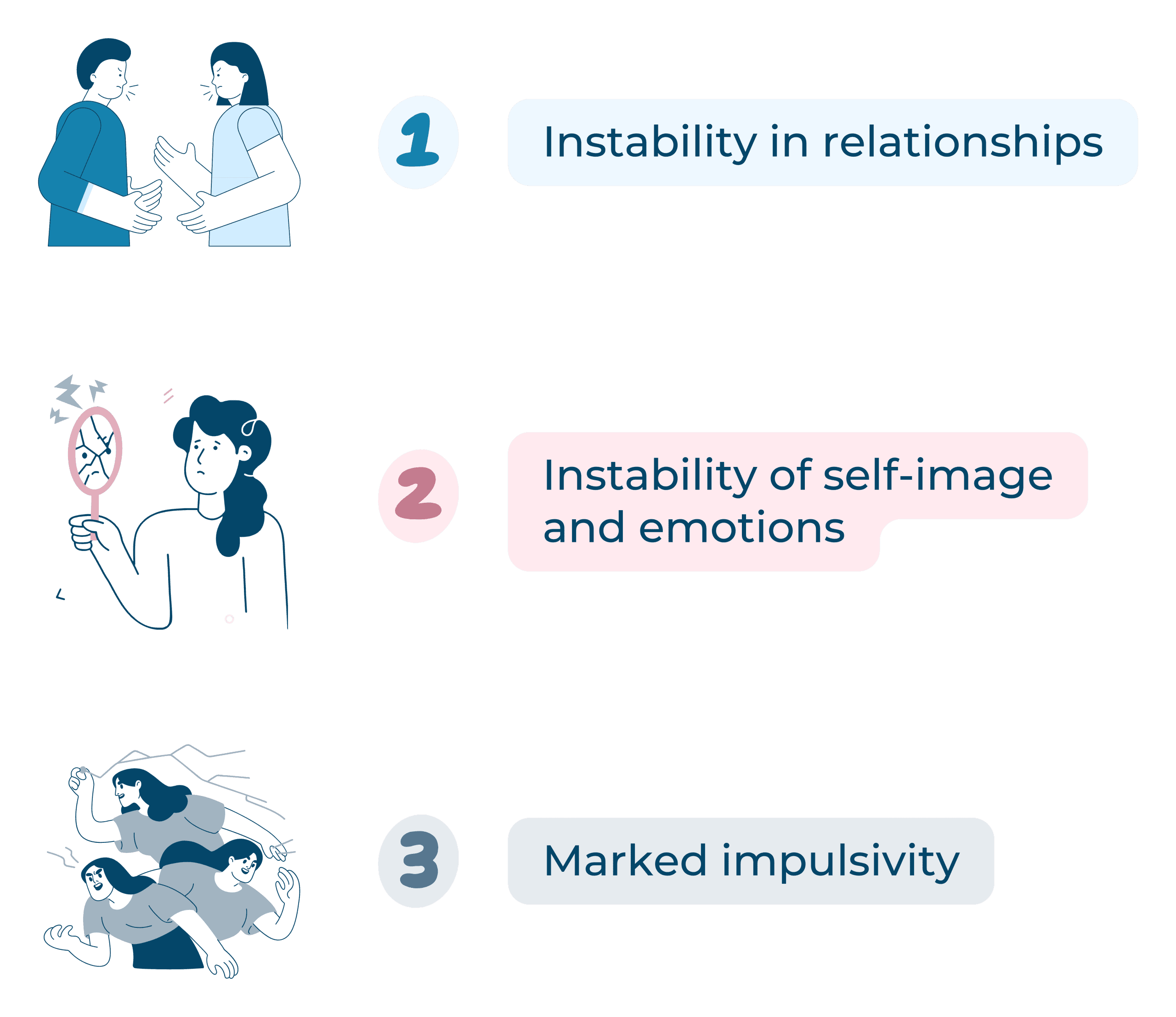
Borderline Personality Disorder (BPD) is characterized by a pervasive pattern of instability in relationships, self-image, emotions, and behavior (impulsivity).
One large US survey found about 5.9% of adults meet criteria for BPD at some point in their lives, with similar rates in men and women. Women are still diagnosed more often in clinical settings.
What Causes Borderline Personality Disorder?
While no specific “cause” has been identified, several risk factors for BPD have been identified. Dominant theories of BPD suggest that it results when a person who has an innate vulnerability (genetics) interacts with a “chronically invalidating environment.”
The DSM-5 Criteria for Borderline Personality Disorder
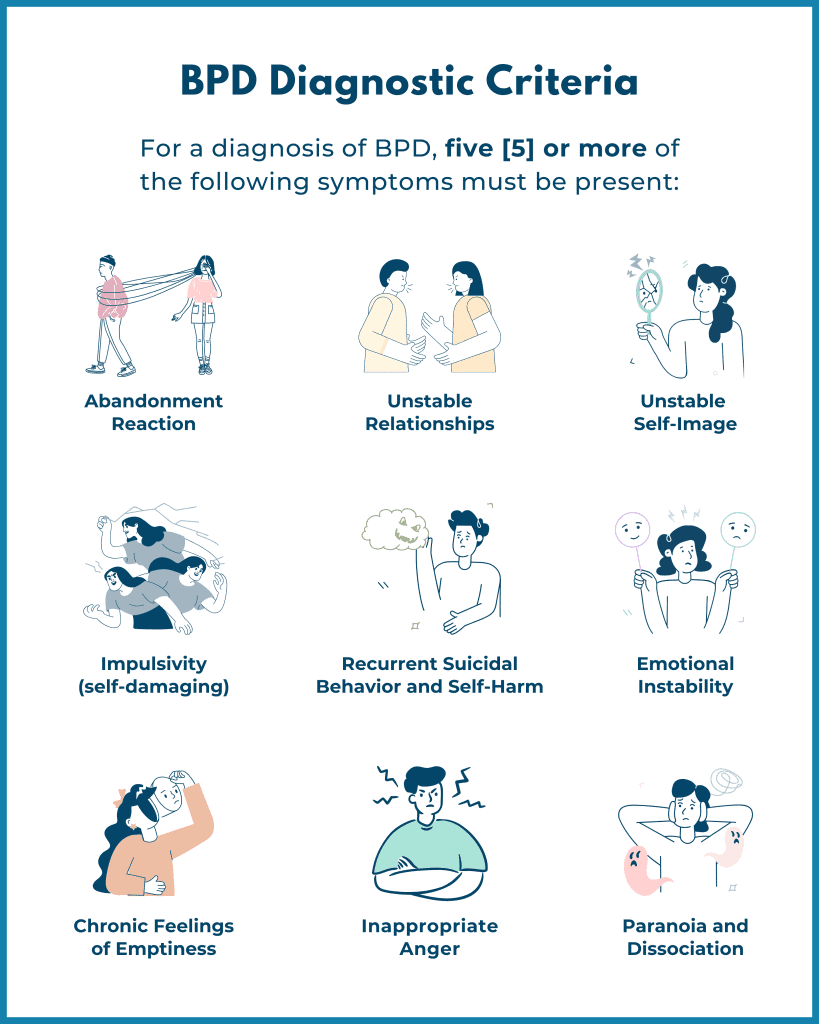
To meet the criteria for Borderline Personality Disorder, five of nine symptoms must be present. The pattern begins by early adulthood, shows up in multiple contexts, and causes significant suffering or impairment in relationships and overall functioning. The nine criteria of Borderline Personality Disorder include:
The Nine Diagnostic Criteria
- 1Frantic efforts to avoid real or imagined abandonment.
- 2A pattern of unstable and intense interpersonal relationships characterized by alternating between extremes of idealization and devaluation.
- 3Identity disturbance: markedly and persistently unstable self-image or sense of self.
- 4Impulsivity in at least two areas that are potentially self-damaging (e.g., spending, sex, substance abuse, reckless driving, binge eating).
- 5Recurrent suicidal behavior, gestures or threats, or self-mutilating behavior.
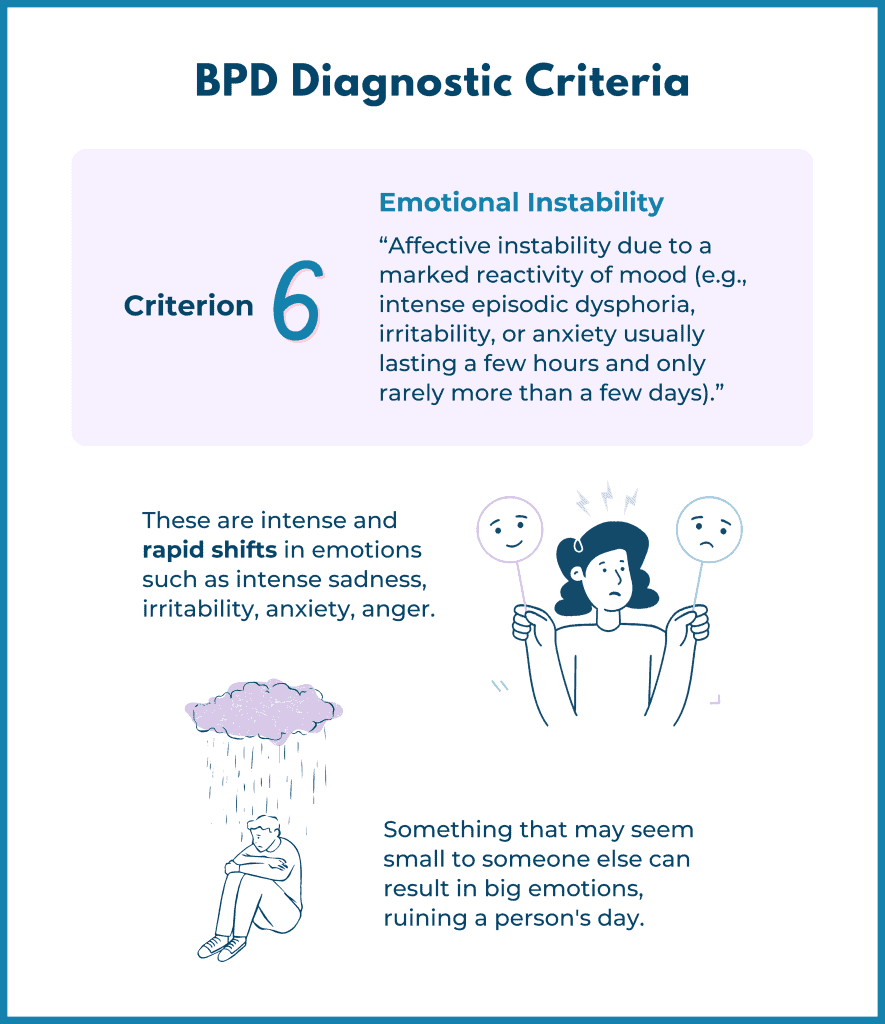
- 6Affective instability due to a marked reactivity of mood (e.g., intense episodic dysphoria, irritability, or anxiety usually lasting a few hours and only rarely more than a few days).
- 7Chronic feelings of emptiness.
- 8Inappropriate, intense anger or difficulty controlling anger (e.g., frequent displays of temper, constant anger, recurrent physical fights).
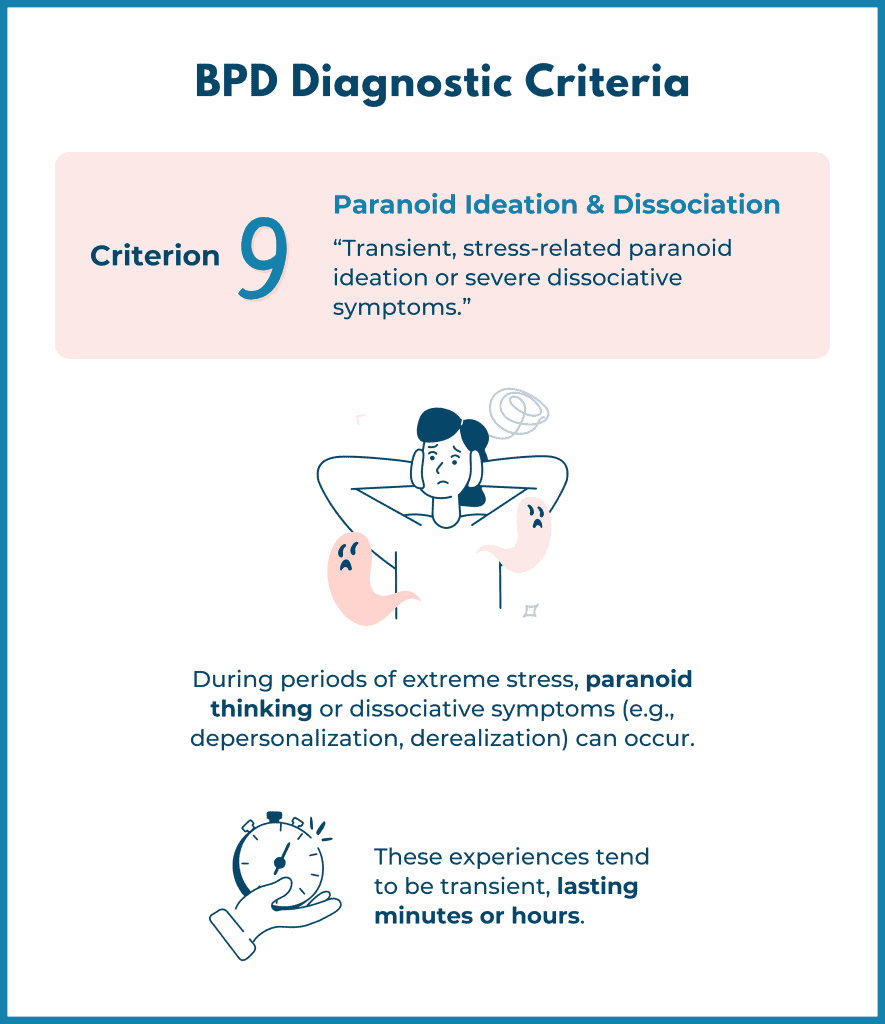
- 9Transient, stress-related paranoid ideation or severe dissociative symptoms.
A Brief Conceptualization of Borderline Personality Disorder
Before reviewing the symptoms of BPD in more detail, I want to provide context for why these symptoms make sense. BPD is a heavily stigmatized condition. When we just talk about symptoms and don’t consider why these symptoms make sense, we perpetuate the stigma associated with BPD.
Many people with BPD have an insecure attachment style, often anxious-preoccupied (and often shaped by early attachment injury). People with this attachment structure tend to believe “I am bad, and others are good.” As such, they often feel insecure and anxious in their relationships. They have a strong need to belong, fit in, and feel accepted. When an attachment (relationship) goes awry (or is perceived to go awry), this tends to confirm to the person that they are worthless and bad. A breakdown in a relationship can cause an intense pain/shame/anger response.
A person with an anxious-preoccupied attachment structure cannot be okay when the relationship is not okay. When there is tension or distance in the relationship, the person struggles to self-soothe (fixing the relationship is what soothes them). This can lead to frantic efforts to repair the relationship or to protest the rupture (lashing out). This can overwhelm the other person, leading to further attachment withdrawal.
A person with an anxious attachment style is also primed to look for attachment ruptures. Their minds are constantly scanning the environment looking for signals of rejection. When our minds do this, we tend to over-interpret events as signs of rejection, which can lead the person to read something neutral as a sign of rejection. This is the brain’s attempt to be on hyper-alert. It is trying to protect the person by being hyper-aware of signs of rejection. Ultimately, it ends up causing the person more suffering.
Attachment injury invokes such intense feelings of shame, badness, and rejection that it tends to overwhelm the person. These feelings are so intense and painful to metabolize that they can often be turned outward to the world through a process known as projective identification.
When some emotions are excruciating, we tend to push them away by projecting them onto others. In projective identification, we act in a way that causes the other person to feel what we are too afraid to feel. For example, when a child feels powerless, they may have a significant tantrum and won’t respond to redirection, causing the parent to feel powerless. The child doesn’t have words for this, but through an unconscious process, they invite their parent to metabolize the emotions too big for them to metabolize.
In the case of BPD, the experience of being rejected is an emotion often too overwhelming to metabolize. The person may therefore project this onto the other by making the other person feel rejected (through belittling, angry outbursts, or more). This is not a conscious process and often feels outside the person’s control. However, learning DBT skills and healing attachment wounds can lead to much more conscious action and agency.
Now let’s turn to the nine criteria.
Criterion One: Intense Fear of Abandonment
People with BPD often experience an intense fear of abandonment. This can result in frantic efforts to avoid real or imagined abandonment.

Common triggers include:
- Upcoming separation
- Rejection (or even the perception of rejection)
- Perception of being neglected
- A loss of external structure
These situations can result in profound changes in a person’s self-image, emotional stability, thoughts, and behavior. This hyper-sensitivity to relational shifts can result in strong reactions, often involving inappropriate anger. The person’s responses may seem disproportionate to the situation.
Separation situations that are planned or unavoidable will still create a strong sense of despair for the person and may result in extreme protest behavior and actions. The perceived abandonment often reinforces the belief that the person is “bad” and invokes their general fear of being alone.
Criterion Two: Unstable Relationships
People with Borderline Personality Disorder often experience instability in interpersonal relationships. Interpersonal challenges are often characterized by unstable and intense relationships that shift between idealization and devaluation. There is often a marked interpersonal sensitivity with extreme efforts (sometimes misunderstood as manipulation, but it’s not that simple) to avoid abandonment.

A person with Borderline Personality Disorder often idealizes potential partners, lovers, and caregivers early in the relationship. This can result in quick and fast bonds (spending lots of time together and sharing intimate details quickly in the relationship).
The relationship can shift quickly (particularly if there is perceived rejection or abandonment). They may feel (and accuse) the other person of not genuinely caring or not being there for them.
There are often sudden and dramatic shifts in relationships. Someone who was once perceived as caring, kind, and wonderful can be seen as cruel and punitive the next moment.
This shift often takes place when the idealized image breaks down. One way of thinking about this dynamic is as despair turned outward. The despair is too painful to metabolize, so it is turned outward through devaluation and anger.
Criterion Three: Unstable Self-Image
A person with BPD often experiences a diffuse sense of self that is prone to sudden and dramatic shifts of identity.

These changes are often characterized by
- shifting goals and future plans
- sexual and gender identities
- values
- political ideologies
- views on friendships
- career decisions
One extreme form is when the person changes from the role of being a “needy supplicant” to that of a “righteous avenger of past mistreatment” (DSM-5).
At other times this instability may show up as a general sense of not existing. These experiences typically occur when the person feels a lack of connection and of meaningful, nurturing, and supportive relationships. People with BPD may find unstructured work or school settings harder.
Criterion Four: Impulsivity (Self-Damaging)
People with Borderline Personality Disorder often “display impulsivity in at least two areas that are potentially self-damaging.”

This may include:
- gambling
- spending money irresponsibly
- binge eating
- abusing substances
- engaging in unsafe sex
- reckless driving
Self-damaging impulsivity typically occurs in response to perceived rejection or abandonment and is typically a response to emotional dysregulation.
(Note: while this may look similar to ADHD impulsivity, it is distinct from it and has different causes. To learn more about the similarities and differences between ADHD and BPD, check out the ebook here).
Criterion Five: Recurrent Suicidal Behavior & Self-Harm
People with Borderline Personality disorder often experience recurrent suicidal behavior, gestures, suicidal threats, or self-harming behavior.

These behaviors are often triggered by fear of abandonment and abandonment reactions. These behaviors can also be a response to emotional dysregulation and dissociative experiences.
While the prevalence rates of self-harm have been estimated to be around 17% in adolescents and 6% in adult samples of the general population, the prevalence rates among people with BPD are 95% (adolescents) and 90% (adults).
Self-harm can function to serve several purposes (it may be a reaction to emotional dysregulation or dissociative experiences). In BPD, self-harm tends to happen around relationship conflict and emotional dysregulation.
While there are many reasons a person engages in self-harm, the most common reason among people with BPD is related to emotional regulation. In some studies, over 95% of women with BPD who self-harm named emotional relief as one of the reasons.
Criterion Six: Affective Instability
People with BPD tend to experience intense and rapid shifts in emotions. They often experience heightened emotional sensitivity. Something that may seem small to someone else can result in big emotions (intense sadness, irritability, anxiety, anger).
People with BPD are more likely to experience emotional stress and affective instability related to perceived abandonment and relationship stress. Relationship tension can lead to a sense of hopelessness and frantic panic.
The person’s baseline mood tends to be “dysphoric” (sad, depressed), with limited access to the positive emotions of joy, happiness, and hope. The person’s baseline depressed mood is often disrupted by periods of anger, panic, or despair.
Criterion Seven: Chronic Feelings of Emptiness
People with Borderline Personality Disorder often live with chronic feelings of emptiness.

This may show up as feeling easily bored, and they may constantly be seeking something to do to distract from the sense of emptiness.
(*Note this can look similar to the ADHD need for stimulation and difficulty with resting or similar to a diffuse sense of self often seen in Autistic people who mask a lot). To read more about the similarities and differences between autism and BPD, check out my ebook here.
Criterion Eight: Inappropriate Anger
People with BPD often experience difficulty controlling their anger which can manifest as intense forms of angry outbursts. This may present as belittling others through extreme sarcasm or verbal outbursts, and it can also present as persistent bitterness directed at others.

Anger is often triggered when a caregiver, partner, or intimate friend is perceived as being neglectful, withholding, or abandoning. Such expressions of anger are often followed by shame and guilt, leading to a negative and shame-based view of self.
Criterion Nine: Paranoid Ideation & Dissociation
During periods of extreme stress, paranoid thinking or dissociative symptoms (e.g., depersonalization, derealization) can occur. These experiences are most often triggered by real or imagined abandonment. These experiences tend to be transient, lasting minutes or hours.
Borderline Personality Disorder, ADHD, and Autism
Since our focus at Neurodivergent Insights is autism and ADHD, here are a few considerations about Borderline Personality Disorder, ADHD, and autism.
Co-Occurring BPD, ADHD, and Autism
BPD shows up more often among ADHD people. A 2026 meta-analysis found about 1 in 5 adults with ADHD in clinical settings also met criteria for BPD. For autism, the research is thinner. One meta-analysis found BPD in about 4% of autistic samples, mostly from small clinical studies.
Research on autism and on ADHD suggests we may be more vulnerable to developing PTSD after trauma. We also experience more victimization, discrimination, and ableism. To have an innate neurodivergence is to live with many extra vulnerabilities, and these may make PTSD and personality disorders more likely.
Misdiagnosis
Outside of co-occurrence, BPD is also a common misdiagnosis of Autistic and ADHD people (particularly women and gender expansive people). To an untrained eye, several ADHD traits (impulsivity, hyperactivity, difficulty regulating emotions) can look like BPD.
Similarly, common experiences for Autistic people who mask a lot can look like BPD (a diffuse sense of self from masking, sensory overload can look like angry outbursts, and difficulty with emotions and relationships).
For this reason, whenever a person is being assessed for BPD, I think it is important that autism and ADHD also be considered (as either occurring alongside the BPD or instead of the BPD). If you want to learn more about the overlapping occurrences, traits, and more, you can check out my Misdiagnosis Ebook series, where I go into more detail on these topics.
BPD DSM Criteria FAQs
How many BPD criteria do you need for a diagnosis?
To meet the criteria for Borderline Personality Disorder, five of nine symptoms must be present. The pattern begins by early adulthood, shows up in multiple contexts, and causes significant suffering or impairment in relationships and overall functioning.
What causes borderline personality disorder?
While no specific “cause” has been identified, several risk factors for BPD have been identified. Dominant theories of BPD suggest that it results when a person who has an innate vulnerability (genetics) interacts with a “chronically invalidating environment.”
Can autism or ADHD be mistaken for BPD?
Yes. BPD is a common misdiagnosis of Autistic and ADHD people (particularly women and gender expansive people). Several ADHD traits (impulsivity, hyperactivity, difficulty regulating emotions) can look like BPD. For Autistic people who mask a lot, a diffuse sense of self from masking, sensory overload that looks like angry outbursts, and difficulty with emotions and relationships can also look like BPD. Whenever a person is being assessed for BPD, I think it is important that autism and ADHD also be considered.
And while BPD can be a misdiagnosis of autism or ADHD, it can also co-occur with them, so it’s worth considering that both may be present.
Is BPD impulsivity the same as ADHD impulsivity?
While it may look similar, it is distinct and has different causes. In BPD, self-damaging impulsivity typically occurs in response to perceived rejection or abandonment, and to emotional dysregulation. To learn more, check out my ADHD vs. BPD ebook.
Additional Resources

ADHD vs. BPD eBook: More on the similarities and differences between ADHD and BPD.

Autism or BPD eBook: More on the similarities and differences between autism and BPD.

Rejection Sensitive Dysphoria: Managing Rejection Sensitive Dysphoria: Tools to Support ADHD Brains
BPD, ADHD, and Autism: Understanding the Overlap
 Stay in the Neurodivergent Loop
For ongoing insights and updates, subscribe to the Neurodivergent Insights Newsletter. Each Sunday, I send out fresh thoughts and a roundup of the newest resources on topics related to neurodivergence, mental health, and wellness. My most personal writing is reserved for my newsletter, and subscribers also get access to the newsletter vault (12+ PDFs) when they join.
References
Adamis, D., et al. (2026). Prevalence and moderators of personality disorders in adults with ADHD: A meta-analysis. Psychiatry Research.
Agrawal, H. R., et al. (2004). Attachment studies with borderline patients: A review. Harvard Review of Psychiatry.
American Psychiatric Association. (2013). Diagnostic and statistical manual of mental disorders (5th ed.).
Colle, L., et al. (2020). Self-harming and sense of agency in patients with borderline personality disorder. Frontiers in Psychiatry.
Crowell, S. E., Beauchaine, T. P., & Linehan, M. M. (2009). A biosocial developmental model of borderline personality: Elaborating and extending Linehan’s theory. Psychological Bulletin.
Dudas, R. B., et al. (2017). The overlap between autistic spectrum conditions and borderline personality disorder. PLoS ONE.
Grant, B. F., et al. (2008). Prevalence, correlates, disability, and comorbidity of DSM-IV borderline personality disorder: Results from the Wave 2 National Epidemiologic Survey on Alcohol and Related Conditions. Journal of Clinical Psychiatry.
Littman, E. (2018, updated 2025). When women battle ADHD and borderline personality disorder. ADDitude.
May, T., Pilkington, P. D., Younan, R., & Williams, K. (2021). Overlap of autism spectrum disorder and borderline personality disorder: A systematic review and meta-analysis. Autism Research.
Reichl, C., & Kaess, M. (2021). Self-harm in the context of borderline personality disorder. Current Opinion in Psychology.
Rumball, F., Happé, F., & Grey, N. (2020). Experience of trauma and PTSD symptoms in autistic adults: Risk of PTSD development following DSM-5 and non-DSM-5 traumatic life events. Autism Research.
Spencer, A. E., et al. (2016). Examining the association between posttraumatic stress disorder and attention-deficit/hyperactivity disorder: A systematic review and meta-analysis. Journal of Clinical Psychiatry.
Weiner, L., Perroud, N., & Weibel, S. (2019). Attention deficit hyperactivity disorder and borderline personality disorder in adults: A review of their links and risks. Neuropsychiatric Disease and Treatment.