During my first year of training as a psychologist, there was a lot of focus on naming emotions. We practiced reflections that would accurately and empathically capture what a client was feeling. This part was hard for me, and I didn’t understand why until I learned I was Autistic and ADHD, with alexithymia.
I’ve always treated emotions like “pesky little things.” I struggled to see the logic in them, so I struggled to take them seriously. Learning the science of why naming emotions helps changed that, and now it’s something I care about a lot.
What Is Emotional Identification?
Emotional identification means noticing and naming the emotion we’re feeling in a given moment. It’s often the first step in regulating emotions: when we can name what we feel, we have more choice about what to do with it.
Many neurodivergent people find this harder. Interoception differences (how we sense signals from inside the body), alexithymia, and differences in how we process and express emotions all play a part. Alexithymia is especially common among Autistic people: a 2019 meta-analysis found that about half of Autistic people have high alexithymia, compared with about 5% of the general population.
Why Naming Emotions Helps
In one study at UCLA, 88 people who were afraid of spiders were asked to approach a live tarantula. One group described their feelings out loud (“I’m anxious and frightened of this spider”). Others reframed their thoughts (“this spider can’t hurt me”), distracted themselves, or said nothing.
A week later, the people who had named their feelings showed a calmer body stress response than the other groups and tended to get a bit closer to the spider. Interestingly, their self-reported fear wasn’t lower. Naming the feeling didn’t make it go away, but it seemed to take some of the charge out of it.
Putting feelings into words seems to calm the brain’s alarm system a little. It brings in the thinking parts of the brain to help settle the more reactive ones. When we take two seconds to pause and name what we feel, we give ourselves a little room.
This may be one reason anxiety is more common among people with alexithymia: when we can’t name a feeling, we have one less way to soothe ourselves when fear kicks in.
Emotional awareness also supports how we communicate, how we ask for what we need, and how we connect with others:
Self-advocacy: it’s hard to ask for what we need when we don’t know how we feel.
Communication: naming feelings helps across neurotypes, where misunderstandings are common.
Self-understanding: over time, we start to see our patterns, triggers, and underlying needs.
5 Emotional Identification Activities
Not all of these will resonate, and that’s okay. Finding one or two that fit is enough to start.
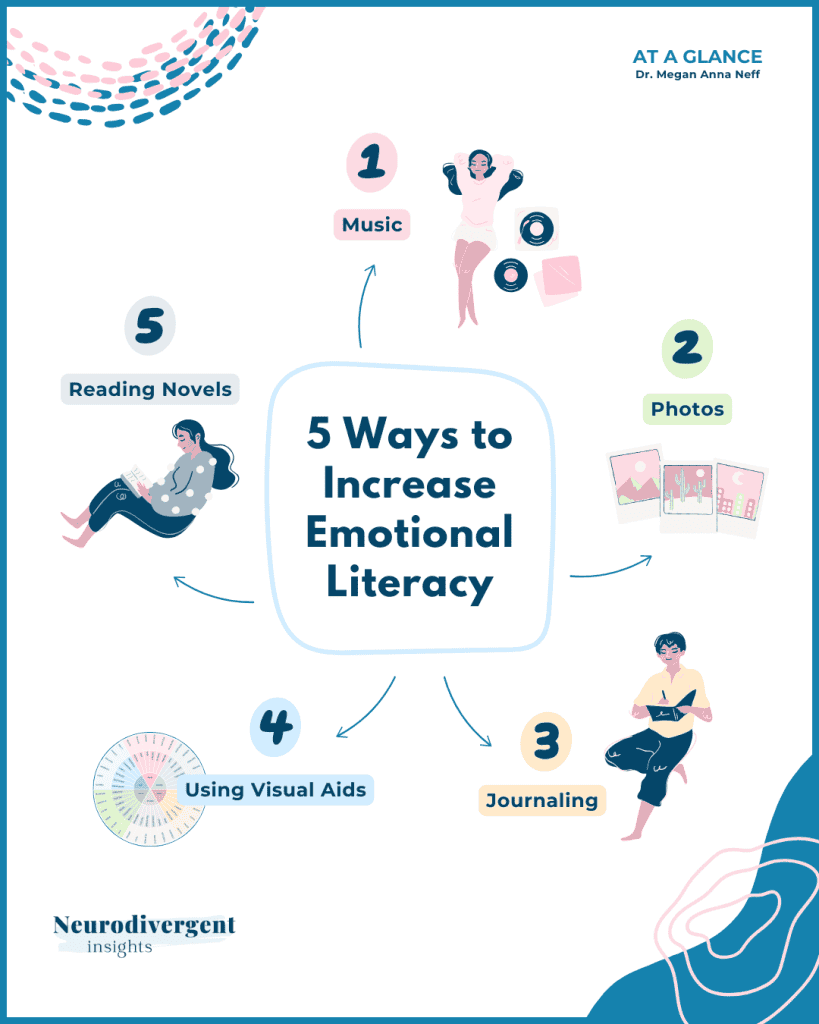
1. Visual Tools: The Feelings Wheel and the Arousal-Valence Model
Visual tools can be especially helpful for neurodivergent people, because they don’t depend only on finding the right words in the moment.
The Feelings Wheel. The Feelings Wheel, developed by Gloria Willcox, organizes 72 feelings around six core ones: sad, mad, scared, joyful, powerful, and peaceful. As you move toward the outer edge, the feelings get more specific, which helps tease apart what you’re feeling.
To use it:
1Spend a few minutes getting familiar with the wheel.
2When you notice a feeling during the day, pause and find it on the wheel. Pointing to it can help.
3Over time, notice patterns. What situations bring up certain feelings? What helps?
Some people also use the wheel to look for what they might be longing for. If I feel powerless, for example, part of me may be wanting to feel strong.
The Arousal-Valence Model. If the wheel feels like too much, the arousal-valence model is a simpler place to start. It maps emotions on two lines: arousal (how activated or energized we feel) and valence (how pleasant or unpleasant the feeling is). That gives four quadrants:
High energy, pleasant: excited, joyful
High energy, unpleasant: angry, afraid
Low energy, pleasant: content, relaxed
Low energy, unpleasant: sad, bored
To use it:
1Notice your energy level: high or low?
2Notice whether the feeling is more pleasant or unpleasant.
3Once you’ve found your quadrant, see if you can name the feeling more specifically. You may notice more than one.
4Use it as a guide. High energy and unpleasant may call for something calming. Low energy and unpleasant may call for gentle movement, upbeat music, or time with a special interest.
2. Stories and Novels
Novels give us an inside view of characters’ emotional lives. I’ve always found Dostoevsky compelling for the way he captures how complicated people are. Spending time with characters’ feelings can grow our emotional vocabulary.
To get more from it, pause when a moment stirs something in you and ask what you’re feeling and why. If novels aren’t your thing, anime, comics, films, and other stories work too.
3. Music
Music can reach feelings that are hard to access any other way, which makes it especially useful for those of us with alexithymia.
1Pick music that stirs a strong feeling, happy, sad, or angry.
2Notice what changes in your body and mood as you listen.
3Afterward, reflect: what was the feeling, and what might it be connected to?
If you’re in therapy and find it hard to talk about feelings, bringing in a song that captures how you feel and listening together can open up the conversation.
4. Journaling
Writing about feelings and experiences helps us label emotions and notice patterns over time.
1Find a time and place where you won’t be interrupted. A regular time can help.
2Write about what you felt today, using the most specific words you can find.
3Note what happened before the feeling showed up.
4Every so often, look back. What tends to bring up certain feelings? What helps?

If open-ended journaling feels like too much, try jotting down three feelings you noticed in the day. Guided journals can help too.
This post contains affiliate links. If you buy through them, we may earn a small commission at no extra cost to you. We only link to things we use or trust.
Wreck This Journal by Keri Smith mixes collage and journaling. It was a lifeline for me as a depressed, undiagnosed Autistic-ADHD teenage girl.
5. Photos

Many neurodivergent people are visual thinkers, so images can bring up feelings that are hard to reach through words alone.
1Gather a few photos that stir something in you. They can be your own, or from a free site like Unsplash.
2Look at each one and notice what you feel.
3Ask what the feeling is and what it might be connected to.
This can feel strange at first. That’s okay. Like the other activities, it tends to get easier with practice.
Other tools, like mood journals, emotion cards, and mindfulness cards, can work the same way. Use them as a starting point for noticing and naming.
A Few Closing Thoughts
Naming emotions doesn’t come easily to everyone, and it took me a long time to see why it was worth practicing. Naming a feeling doesn’t make it disappear, but it can give us a little more room.
Be gentle with yourself as you try these. Some will feel awkward at first. For a deeper look at what emotions are for, see The Function of Emotions.
Emotional Identification FAQs
Additional Resources
For ongoing insights and updates, subscribe to the Neurodivergent Insights Newsletter. Each Sunday, I send out fresh thoughts and a roundup of the newest resources on topics related to neurodivergence, mental health, and wellness. My most personal writing is reserved for my newsletter, and subscribers also get access to the newsletter vault (12+ PDFs) when they join.
References
Kinnaird, E., Stewart, C., & Tchanturia, K. (2019). Investigating alexithymia in autism: A systematic review and meta-analysis. European Psychiatry, 55, 80–89. https://pmc.ncbi.nlm.nih.gov/articles/PMC6331035/
Kircanski, K., Lieberman, M. D., & Craske, M. G. (2012). Feelings into words: Contributions of language to exposure therapy. Psychological Science, 23(10), 1086–1091. https://pubmed.ncbi.nlm.nih.gov/22902568/
Lieberman, M. D., et al. (2007). Putting feelings into words: Affect labeling disrupts amygdala activity in response to affective stimuli. Psychological Science, 18(5), 421–428. https://pubmed.ncbi.nlm.nih.gov/17576282/








 Stay in the Neurodivergent Loop