What exactly is a sensitive child? How does sensitivity intersect with ADHD, autism and giftedness, and how is it different? The reality is that these distinctions are rarely clear-cut. Personally, I’m navigating the parenting journey with a child who embodies the unique blend of ADHD, giftedness, HSP, and OCD traits, alongside another who is both autistic, ADHD, and gifted with traces of HSP. Highly sensitive children often exist within the intricate overlap of various neurodivergent traits.
For the basics, see What Is a Highly Sensitive Child? Here, we’ll look at how high sensitivity overlaps with sensory processing differences, autism, ADHD, giftedness and anxiety.
Table of Contents
Highly Sensitive Children and Neurodivergence
Is Highly Sensitive Child a Real Thing?
Is “highly sensitive child” a valid concept? Yes and no, depending on what we mean by valid.
- Is it a recognized mental health or medical diagnosis? No, it is not.
- Is there substantial research aligning with the broad concept of highly sensitive children and individuals? Yes, there is.
The term “Highly Sensitive Child” serves as somewhat of an umbrella term that encompasses the experiences of individuals with heightened sensitivity. Personality research shows that temperament plays a big part in who we become. Research on environmental sensitivity also shows that some children are more sensitive to their environment than others.
The challenge comes when adults assume being highly sensitive explains all of a child’s experiences, and other forms of neurodivergence get missed.
When autism, ADHD, sensory processing differences or anxiety are overlooked this way, the child may not receive the accommodations that could support their distinct brain style. They may also miss out on an identity and community that could help them better understand themselves.
So the concept holds up. The caution is not to explain everything through this one lens.
Highly Sensitive Children and Sensory Processing
In research, high sensitivity is called sensory processing sensitivity (SPS), a personality trait characterized by increased sensitivity and responsiveness to sensory stimuli. Estimates vary: older research suggested about 10–20% of people are highly sensitive (Malinakova et al., 2021), while newer studies place about 30% in a high-sensitivity group on a continuum. However, this is distinct from sensory processing disorder which impacts how the brain filters and processes sensory information.
What is Sensory Processing Sensitivity?
People with sensory processing sensitivity tend to have heightened awareness and sensitivity to sensory information, such as sounds, lights, smells, textures, and emotions. They may be more easily overwhelmed by loud noises, bright lights, and crowded environments and may have a lower tolerance for certain types of stimuli.
People with sensory processing sensitivity often experience emotions more strongly and deeply than others. They may be more empathetic and have a greater ability to pick up on subtle emotional cues from others.
SPS is believed to have a genetic basis, and it is thought to be a normal trait that is present in a minority of the population. It is not considered a disorder or a mental health condition but rather a personality characteristic.
Sensory Processing Sensitivity (SPS)
- Common Trait: High sensitivity to sensory input, such as sights, sounds, smells, textures, and tastes.
- Not a Diagnosis: SPS is not a formal medical or psychological diagnosis but rather a personality trait.
- Varied Responses: Children with SPS may respond to sensory input more intensely, but these responses can vary widely from person to person.
- Strengths: Often displays heightened perceptiveness, creativity, thoughtfulness, and empathy.
- Appreciation for Sensory Experiences: May have a deep appreciation for art, music, nature, and aesthetic details.
- Intuitive Abilities: May excel in fields requiring intuition, emotional connection, or attention to detail.
What Is Sensory Processing Disorder?
Sensory Processing Disorder (SPD), on the other hand, is a neurological condition (or form of neurodivergence) characterized by difficulties in processing and responding to sensory information from the environment. Sensory Processing Disorder (SPD) involves atypical patterns of how the brain processes sensory information, often resulting in heightened or diminished responses to sensory stimuli, and early brain-imaging research has found differences in white-matter connections in posterior (sensory-integration) brain regions in children with SPD.
Children with SPD may experience heightened sensitivity or, conversely, reduced sensitivity to various sensory stimuli, such as touch, sound, taste, or smell. This atypical sensory processing can lead to significant challenges in everyday activities and social interactions.
Sensory Processing Disorder (SPD)
- Diagnosis: SPD isn’t in the DSM, but some clinicians, especially occupational therapists, use it (see footnote).
- Consistent Challenges: Children with SPD consistently struggle to process sensory information, impacting daily functioning.
- Specific Symptoms: Symptoms may include sensory-seeking or sensory-avoiding behaviors, difficulty with sensory modulation, sensory-related anxiety, as well as sensory shutdowns and sensory meltdowns.
- Therapeutic Intervention: Occupational therapy, sometimes including sensory-based approaches, may help as part of a broader plan; research on these therapies is still limited.
- Not a Personality Trait: Unlike SPS, SPD is considered a neurological condition that affects sensory processing rather than categorized as a temperament or personality trait.
Sensory Processing Disorder is a distinct condition from Sensory Processing Sensitivity (SPS), which is considered a normal variation in sensory processing observed in highly sensitive individuals. SPS is not classified as a neurological disorder and does not necessarily require therapeutic intervention.*
The Double-Edged Coin Of Sensitive Sensory Processing
Both SPS and SPD can bring challenges as well as strengths. Understanding sensory processing sensitivity, and the possibility of SPD, can help parents support their child, for example with sensory-friendly spaces, built-in rest, and understanding from others.
Is A Highly Sensitive Child Autistic?
Highly sensitive children and autism are distinct concepts, but they can sometimes intersect. Highly sensitive children have a heightened awareness and strong reactions to stimuli, including noise, light, and emotional situations. They may also be empathetic and can be easily overwhelmed by new contexts and changes.
Highly Sensitive and Autistic: Similarities
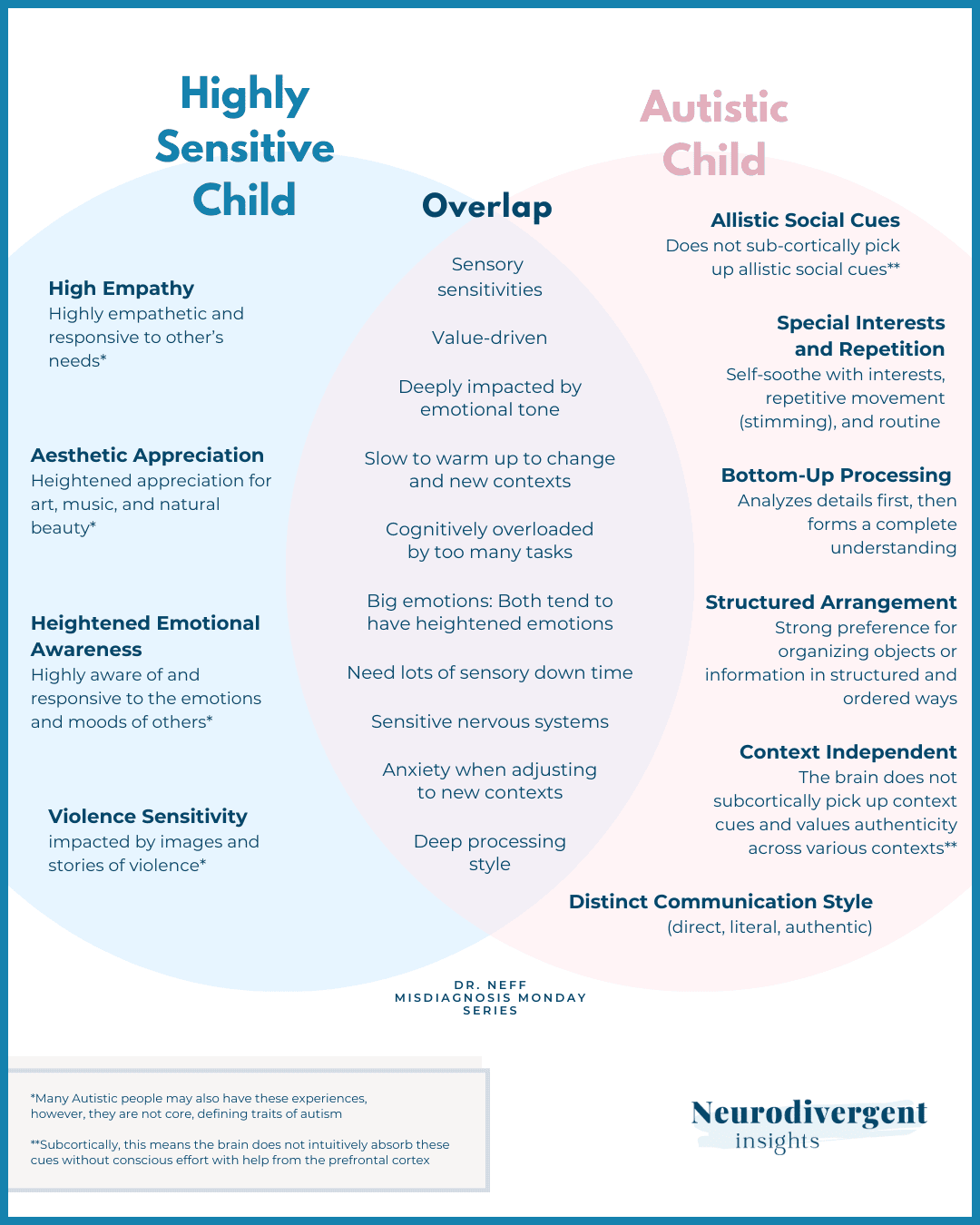
- Heightened Sensory Awareness: Both highly sensitive and autistic children often have a heightened awareness of sensory stimuli, including sensitivities to noise, light, touch, and other sensory inputs. Sensory sensitivities experienced by highly sensitive children can overlap with those seen in autistic children, leading to sensory overload and meltdowns.
- Emotional Reactivity: Both groups may exhibit strong emotional reactions to external stimuli or situations, which can lead to overwhelm or overstimulation.
- Overwhelm in New Contexts: Both highly sensitive and autistic children may struggle with transitions or new environments, finding them overwhelming or anxiety-inducing.
- Emotional Tone: Both tend to be highly impacted by the emotional tone in the room or other people’s energy.
- Value-Driven: Both often exhibit strong reactions to injustice, with their values deeply intertwined with their identity.
- Sensitive Nervous Systems: Both groups typically possess highly sensitive nervous systems, which react rapidly and intensely to external stressors and stimuli.
Highly Sensitive and Autistic: Differences
In contrast to highly sensitive children, autism encompasses a broader range of characteristics beyond sensitivity alone. Autism is characterized by a distinct brain style that involves:
- Bottom-Up Processing Style: Autism often involves a deep, bottom-up processing style, which may not be as characteristic of highly sensitive children.
- Special Interests and Repetition: Autistic individuals often exhibit intense interests in specific topics or activities, frequently engage in repetitive behaviors, and find comfort in routine, which may not be as prominent in highly sensitive children.
- Distinct Communication Style: Autism is associated with a distinct communication style that tends to be direct, literal, and authentic, while highly sensitive children may not necessarily share these communication traits.
- Self-Soothing Mechanisms: Autistic children frequently use self-soothing mechanisms like stimming (repetitive movements or sounds) and prefer predictability and routine, which may not be as prevalent in highly sensitive children.
- Structured Arrangement: Many autistic individuals have a preference for organizing objects or information in structured and ordered ways, while highly sensitive children may not have this particular trait.
- Context Independent: The brain does not subcortically pick up context cues and values authenticity across various situations.**
- Empathy Variance: While many autistic people exhibit hyper-empathy, some also experience hypo-empathy
- Allistic Social Cues: Does not subcortically pick up allistic social cues*
*Subcortically, this means the brain does not intuitively absorb these cues without conscious effort and help from the prefrontal cortex.
These distinctions highlight that while both groups share some similarities in sensory sensitivity and emotional reactivity, autism is a distinct form of neurodivergence (neurotype) with a unique set of characteristics that extend beyond sensory processing and emotional responses.
Many autistic children may also exhibit traits of being highly sensitive. However, not all highly sensitive children have autism, and not all autistic children are highly sensitive. It’s essential to consider the whole picture and avoid making assumptions based solely on traits associated with either group.
The support needs of highly sensitive children and autistic children do share some overlap. Both require highly attuned strategies to create a calm and predictable environment, benefit from sensory breaks and need coping and stress reduction mechanisms. Additionally, both are sensitive to the emotional tone of their environment and thrive in calm surroundings. Understanding and addressing these shared needs can create more supportive environments for all children, regardless of their unique neurodivergent traits.
Highly Sensitive Children and ADHD
Similarly to highly sensitive children and autism, there is also an overlap between highly sensitive children and ADHD. ADHD, similarly to autism, is classified as a neurodevelopmental condition (a distinct neurotype) characterized by difficulties with regulating attention and emotions and hyperactivity and impulsivity. Children with ADHD may struggle with focusing on tasks, have trouble sitting still, and act impulsively without awareness of the consequences.
Although highly sensitive children and children with ADHD are distinct, there can be some overlap. For example:
Highly Sensitive and ADHD: Similarities
- Both groups may struggle with difficulty focusing and becoming easily overwhelmed (but for different reasons).
- Many ADHD children exhibit sensitive responses to stimuli, which contributes to distractibility.
- Similarly, many children with ADHD experience a sensitive response to perceived rejection, known informally as rejection sensitive dysphoria (RSD), a widely used but not formally recognized term, leading to a sensitive emotional profile.
- Children with ADHD often display a heightened sensitivity to their emotional environment and may face challenges in distinguishing their emotions from those of others.
Highly Sensitive and ADHD: Differences
- Highly sensitive children primarily have sensory processing sensitivity, which may lead to heightened awareness of environmental stimuli.
- Children with ADHD typically have challenges related to executive functioning, impulse control, and hyperactivity, which contribute to their difficulties in focus and self-regulation.
- While both groups may exhibit emotional sensitivity, the underlying causes and expressions of this sensitivity can differ. Highly sensitive children may be more empathetic and emotionally responsive to others, while children with ADHD may struggle with emotional regulation due to impulsivity.***
- Highly sensitive children often have a deep appreciation for art, music, and nature, while children with ADHD may be drawn to novelty and excitement.
Not all highly sensitive children have ADHD, and not all children with ADHD are highly sensitive. However, for those who fall into both categories, it can present additional struggles. These children may be more vulnerable to feeling overwhelmed and anxious in their daily lives, and they may require strategies and support that address both their sensitivity and their ADHD traits.
In working with highly sensitive children with ADHD, it can be helpful to create an environment that minimizes sensory overload and provides a calm and predictable routine. This may involve reducing noise levels, providing visual cues for transitions, supporting underlying executive functioning struggles, and allowing for regular breaks. It is also important to provide emotional support and teach coping skills for managing the emotional intensity that may accompany both being highly sensitive and having ADHD.
Highly Sensitive Children and Giftedness
Like “highly sensitive child,” giftedness isn’t a formal diagnosis. Both are broad concepts, and they often overlap. Highly sensitive children are those who have a heightened sensitivity to their environment and stimuli, including emotions and sensory experiences.
Giftedness, on the other hand, refers to exceptionally high intelligence or talent in specific areas. Gifted children may have advanced cognitive abilities, such as exceptional problem-solving skills, creativity, or a deep knowledge in a particular subject area. They may also show a high level of curiosity and a strong desire to learn. Giftedness is much more nuanced than high intelligence. Gifted children tend to be deep and existential thinkers. And deep, existential thinkers tend to be sensitive souls! The exquisite attunement that comes with being gifted often lends to a sensitive temperament.
Similarities Between Highly Sensitive Children and Giftedness
- Heightened Sensitivity: Both highly sensitive children and gifted individuals often display heightened sensitivity to their environment, emotions, and sensory experiences.
- Deep Thinking: Highly sensitive and gifted children frequently exhibit a preference for deep thinking and processing information, showing an inclination towards profound contemplation.
Differences Between Highly Sensitive Children and Giftedness
- Nature of Traits: Highly sensitive children primarily exhibit heightened sensory and emotional sensitivity, while giftedness pertains to exceptionally high intelligence or talent in specific areas.
- Giftedness Nuances: Gifted individuals may possess advanced cognitive abilities, such as exceptional problem-solving skills, creativity, and in-depth knowledge in specific subjects. Their intellectual abilities go beyond sensitivity alone.
- Curiosity and Learning Drive: Gifted children often display a strong curiosity and a desire for continuous learning, while this drive may not be as prominently observed in highly sensitive children.
- Perfectionism and Challenges: Some gifted children struggle with perfectionism, which can make it hard to persevere when things get difficult, though research suggests perfectionism isn’t a core feature of giftedness.
- Existential Thinking: Gifted children may engage in deep and existential thinking, a trait not solely related to sensitivity but intertwined with their intellectual capabilities.
Many highly sensitive children are also gifted, although not all gifted children are highly sensitive. The overlap between the two can be attributed to their shared characteristics of heightened awareness, intensity, and preference for deep thought.
While the term “gifted” can sound pretentious to the outside, it’s important to note that being “gifted” does not automatically equate to success or happiness. Some gifted children struggle with perfectionism, which can make it hard to persevere in the face of difficulties. Gifted children, like highly sensitive children, require understanding and supportive environments.
Highly Sensitive Children and Anxiety
Highly sensitive children tend to be more aware and affected by their surroundings, emotions, and stimuli compared to their peers. This heightened sensitivity can make them more susceptible to anxiety.
Not all children who experience anxiety are highly sensitive, and not all highly sensitive children will develop an anxiety disorder. However, there is a lot of overlap between these two! Here’s a bit more about how they are similar and distinct from one another.
Similarities Between Highly Sensitive Children and Anxiety
- Emotional Sensitivity: Both highly sensitive children and children with anxiety often exhibit heightened emotional sensitivity. They may easily pick up on and internalize the emotions of others, leading to increased emotional reactions.
- Overstimulation: Highly sensitive and anxious children can become overwhelmed by excessive sensory input or highly stimulating environments, leading to feelings of distress and discomfort.
- Sensitivity to Negative Situations: Both highly sensitive and anxious children are more affected by negative or stressful situations. Changes in routine, conflicts, or criticism can trigger heightened emotional responses and anxious feelings.
- Perfectionism: Many highly sensitive and anxious children are perfectionistic and highly self-critical. They may fear making mistakes, worry about disappointing others, and seek to please others.
- Intense Worry: Both groups may experience intense worry and rumination, often related to their sensitivity to various stressors and potential negative outcomes.
Differences Between Highly Sensitive Children and Anxiety
- Nature of Sensitivity: Highly sensitive children primarily exhibit heightened sensory and emotional sensitivity as part of their temperament. Anxiety, on the other hand, is a mental health condition characterized by excessive worry and fear that is disproportionate to the anxiety trigger and causes a significant impact on the child’s day-to-day life.
- Permanence: While sensitivity is a trait that is a consistent part of a highly sensitive child’s personality, anxiety can be a temporary or chronic condition that may come and go.
- Diagnostic Distinction: Anxiety is a recognized mental health diagnosis, while sensitivity is a personality trait. Highly sensitive children may experience anxiety, but not all sensitive children will develop an anxiety disorder.
- Treatment Approach: Highly sensitive children may benefit from strategies that help them manage and embrace their sensitivity, while individuals with anxiety may require specific therapeutic interventions to address their anxiety symptoms.
A Few Closing Thoughts
Highly sensitive children can share traits with children who have sensory processing differences, or who are autistic, ADHD, gifted or anxious. Many children carry more than one of these.
If sensitivity doesn’t seem to explain everything you’re seeing, stay curious. Looking at the whole child is what helps them get the right support.
Highly Sensitive Child FAQs
Is "highly sensitive child" a diagnosis?
No. “Highly sensitive child” describes a temperament, not a mental health or medical diagnosis. In research, high sensitivity is called sensory processing sensitivity (SPS), a personality trait linked to deeper processing and stronger responses to sensory and emotional input.
What is the difference between sensory processing sensitivity and sensory processing disorder?
Sensory processing sensitivity is a personality trait and isn’t considered a disorder. Sensory processing disorder (SPD) describes sensory differences that consistently get in the way of daily life. SPD isn’t in the DSM, but some clinicians, especially occupational therapists, use the term.
Can a child be highly sensitive and also autistic or ADHD?
Yes. Many autistic and ADHD children are also highly sensitive, and some children are all three. The risk is assuming sensitivity explains everything, so that autism, ADHD, sensory processing differences or anxiety get missed.
How common is it to be highly sensitive?
Estimates vary. Older research suggested about 10–20% of people are highly sensitive. Newer studies describe sensitivity as a continuum and place about 30% of people in a high-sensitivity group.
Additional Resources


For parents: The Sensory Code by my friend Laura Petix, MS, OTR/L (The OT Butterfly) (affiliate link)

ShopMy: Sensory Support picks
 Stay in the Neurodivergent Loop
For ongoing insights and updates, subscribe to the Neurodivergent Insights Newsletter. Each Sunday, I send out fresh thoughts and a roundup of the newest resources on topics related to neurodivergence, mental health, and wellness. My most personal writing is reserved for my newsletter, and subscribers also get access to the newsletter vault (12+ PDFs) when they join.
References
* The diagnosis of SPD is also not without debate. Sensory Processing Disorder (SPD) is a diagnosis that gained recognition primarily within occupational therapy and related fields, particularly in the United States. It describes difficulties in sensory processing and integration that can impact daily functioning, especially in children. SPD has never been a standalone DSM diagnosis. DSM-5 instead added sensory hyper- or hyporeactivity as a feature of autism, and SPD does appear in the Zero to Three early-childhood classification (DC:0-5). Its absence from the DSM has sparked ongoing debate within the medical and psychological communities. Some experts argue for its inclusion as a distinct diagnosis, while others believe it overlaps with existing diagnostic categories like autism spectrum disorder (ASD) or attention-deficit/hyperactivity disorder (ADHD). Consequently, SPD is not listed as a separate diagnosis in the DSM-5-TR (2022), the current edition of the manual used by mental health professionals for diagnosing psychiatric and developmental disorders. Nevertheless, many healthcare providers and occupational therapists recognize SPD as a valid and clinically significant condition, often employing interventions like sensory integration therapy to address the unique sensory challenges faced by individuals with SPD.
** Context Independent is a term coined by Dr. Amara Brook (personal communication), this provides an alternative term to the more commonly used “context blindness”
***This is not to say that ADHD children cannot also be highly empathetic; many are! Empathy is a personality trait that can be present in individuals with ADHD —it’s just not a core component of ADHD. Further some children may have both ADHD and be a highly sensitive child, which can contribute to their empathetic nature. The key distinction lies in the underlying factors driving emotional responses: for highly sensitive children, empathy is often intertwined with their sensory profile, while ADHD symptoms, including emotional regulation challenges and impulsivity, are inherent aspects of the neurotype, particularly in cases of ADHD combined type or hyperactive type.
Lionetti, F., Aron, A., Aron, E. N., Burns, G. L., Jagiellowicz, J., & Pluess, M. (2018). Dandelions, tulips and orchids: Evidence for the existence of low-sensitive, medium-sensitive and high-sensitive individuals. Translational Psychiatry, 8, 24. https://doi.org/10.1038/s41398-017-0090-6
Malinakova, K., Novak, L., Trnka, R., & Tavel, P. (2021). Sensory Processing Sensitivity Questionnaire: A psychometric evaluation and associations with experiencing the COVID-19 pandemic. International Journal of Environmental Research and Public Health, 18(24), 12962. https://doi.org/10.3390/ijerph182412962
Owen, J. P., Marco, E. J., Desai, S., et al. (2013). Abnormal white matter microstructure in children with sensory processing disorders. NeuroImage: Clinical, 2, 844–853. https://doi.org/10.1016/j.nicl.2013.06.009
Stricker, J., Buecker, S., Schneider, M., & Preckel, F. (2020). Intellectual giftedness and multidimensional perfectionism: A meta-analytic review. Educational Psychology Review, 32, 391–414. https://doi.org/10.1007/s10648-019-09504-1
Zimmer, M., Desch, L., et al. (2012). Sensory integration therapies for children with developmental and behavioral disorders. Pediatrics, 129(6), 1186–1189. https://doi.org/10.1542/peds.2012-0876