What exactly is hypoarousal, and how does it differ from hyperarousal? When working with ADHD adults, I see how understanding these states helps people feel less at the mercy of their body’s responses. By learning about the nervous system, you can better observe what’s happening within and respond to your body’s needs in the moment.
For a deeper dive, see our article on nervous system basics.
Table of Contents
The Window of Tolerance
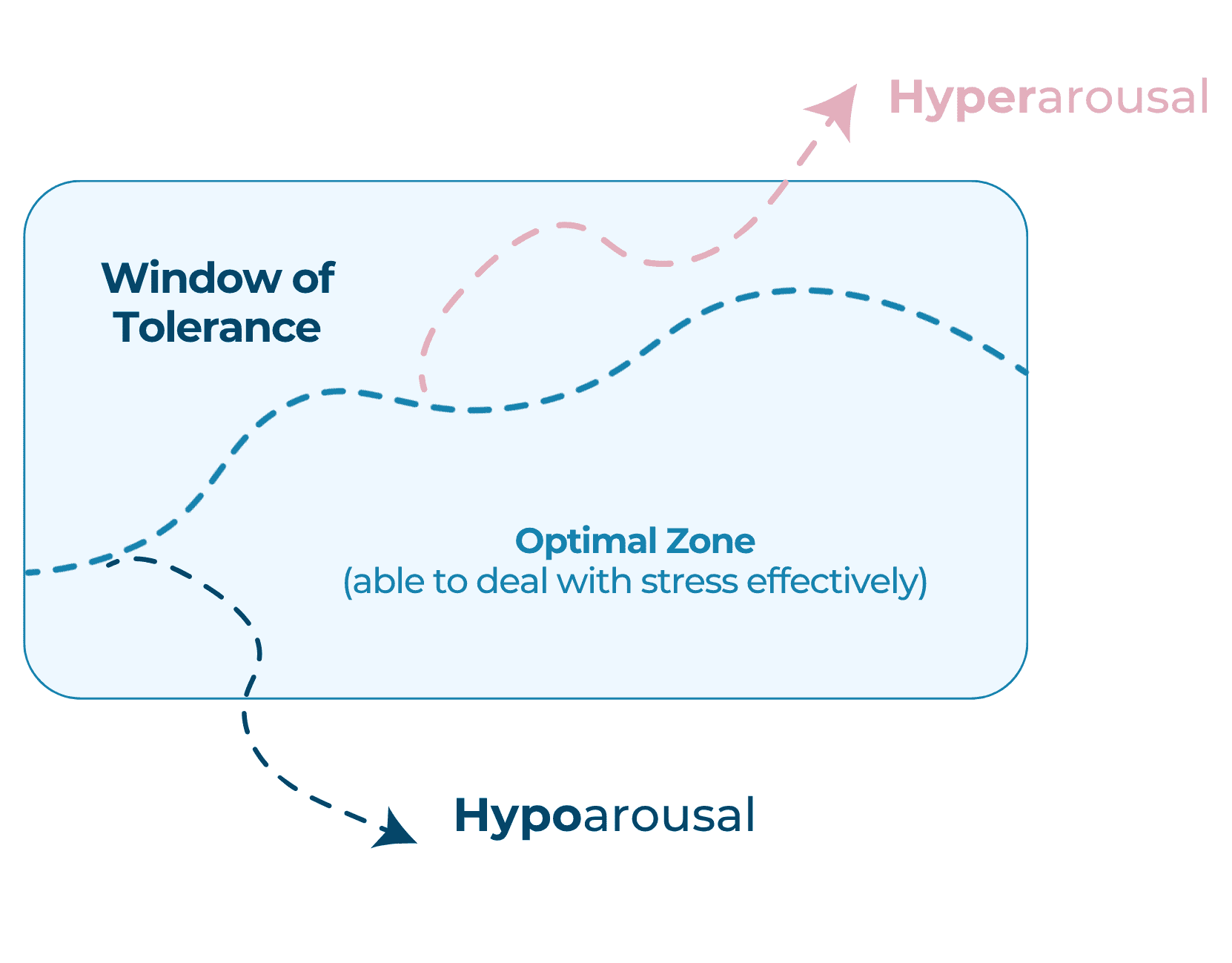
Before diving into hypoarousal and hyperarousal, it’s helpful to understand the window of tolerance, a concept introduced by psychiatrist Dan Siegel (1999). This is a way to think about our capacity to handle intense emotions and stress.
When we’re within our window of tolerance, we can handle life’s challenges. In this state, our sympathetic nervous system (which helps us respond to stress) and parasympathetic nervous system (which helps us rest and recover) work together. This balance allows us to stay present, calm, and engaged, even in the face of stress.
A large window of tolerance means you have a greater capacity to manage stress and emotions without becoming overwhelmed. It’s like driving a car smoothly, with the gas and brake pedals working in sync. However, when stress exceeds what we can handle within this window, we may become dysregulated, leading to either hyperarousal (where we’re revved up and anxious) or hypoarousal (where we shut down and disconnect).

For example, when you’ve had a good night’s sleep, eaten well, and moved regularly, you likely notice it takes more stressors to cause you to “blow a fuse.” This is because your window of tolerance is wider, giving you more capacity to handle challenges without becoming overwhelmed. Let’s explore what happens when we move beyond our window of tolerance.
Hypoarousal

When people think of stress, they often imagine the fight-or-flight response. But our bodies have another way of coping with overwhelming stress: slowing down into a state of hypoarousal. This is when our nervous system essentially hits the brakes, lowering overall activity to protect us from too much stimulation.
Hypoarousal can show up in different ways. Some people might feel mildly foggy, disconnected, or fatigued, while others might experience more intense symptoms like dissociation (though physiological research on how dissociation fits here is still mixed). It’s important to note that hypoarousal is different from the freeze response, which involves both sympathetic and parasympathetic activation and leads to full-body immobilization.
For example, when I experience sensory overload, my body shifts into a hypoarousal state. My senses dull, I feel heavy and tired, and a sense of fogginess takes over. This is a mild form of hypoarousal, but for many ADHD and autistic people, sensory overload can push us out of our window of tolerance and into this state.
Let’s take a closer look at the signs of hypoarousal.
Traits of Hypoarousal
Mental and emotional signs
 brain fogdissociationlack of focussleepinessshutdownlow energynumbnesslow moodreaching for screenscravings for substances
Physical signs
fatigueslowed heart ratelower blood pressureshallow, irregular breathingdigestive issuessensitivity to coldPurpose of Hypoarousal
Hypoarousal occurs when the body slows down in response to overwhelming stress. It’s as if your nervous system is saying, “This is too much; let’s power down for a while.” This response can show up as fatigue, numbness, or a sense of disconnection. At its most intense, hypoarousal is a last-resort survival response when fighting or fleeing isn’t possible; in milder forms it can look like conserving energy when stress becomes too much.
In modern life, hypoarousal often kicks in during prolonged stress, leading to feelings of being stuck or unmotivated. For instance, facing an overwhelming project might trigger a shutdown, making it difficult to start. It can feel unhelpful now, but it’s still the body’s way of protecting itself. Seeing it that way makes room for self-compassion.
Hyperarousal

When we enter a hyperaroused state, our sympathetic nervous system kicks into high gear. This means we’re mobilized to either confront a threat (fight) or escape from it (flight). In this state, we become hypervigilant and energized, but often also anxious or reactive.
Traits of Hyperarousal
Mental and emotional signs
panicfearworryirritationangerfrustrationimpulsivityhigh energystressaggressionanxietyreckless behaviorPhysical signs
fast heart rateshallow and quick breathshigh blood pressurehigh cortisolhigh adrenalinemuscle tensionPurpose of Hyperarousal
Most people understand the fight-or-flight response as a survival mechanism. It gives us the energy to either confront a threat or escape from it. Whether we’re being chased by a wild animal or facing danger in a city, hyperarousal kicks in to help us survive by boosting our energy, alertness, and physical capabilities.
Somatic therapist Peter Levine has observed that animals often shake or tremble after escaping danger, which he theorizes helps discharge stress energy. Picture an impala that narrowly escapes a lion: once safe, it may literally shake its body. Many of our pets do something similar, shaking or running around after a stressful event.
Humans may need ways to release this built-up energy too. Many cultures have communal practices like singing, dancing and drumming that may help people settle after stress and return to their window of tolerance.
Hyperarousal and Modernity
In modern life, many of us spend a lot of time in hyperarousal. Unlike our ancestors, who faced immediate dangers like predators, we now deal with long-term stressors (work deadlines, bills, and financial pressures) that our stress response didn’t evolve for. Because these stressors are constant, our fight-or-flight response can get stuck in the “on” position, leaving us in a state of hyperarousal with no clear way to release that built-up energy.
Adding to the challenge, many cultural practices that helped our ancestors discharge this energy, like communal dances or rituals, have faded in modern society. Without these outlets, it’s easy to stay in a heightened state of stress, struggling to wind down and return to a more balanced state.
How Large Is Your Window of Tolerance?
Ideally, you’d have a wide window of tolerance, giving you plenty of bandwidth to handle stressors as they come. But for many people, especially those seeking mental health support, that window can be pretty narrow.
If you grew up in a home filled with constant stress or trauma, your nervous system might have stayed in a heightened state of alert as a protective mechanism. This can leave you with a smaller window of tolerance in adulthood.
For many autistic, ADHD and OCD people, the window is often narrower, shaped by sensory sensitivities, differences in how the nervous system handles stress (seen in both ADHD and autism research), and higher rates of victimization. Similarly, people with PTSD or complex PTSD (C-PTSD) may find their window of tolerance limited.
This isn’t a failure on your part. It’s your body’s way of protecting you based on past experiences.
If you find yourself getting stressed or overwhelmed more easily than others, it may be connected to your nervous system, not something within your immediate control. This can open the door to self-compassion. With practice, the window can widen over time.

Nervous System Check-Ins
If you’re aiming to expand your window of tolerance and spend less time in hyperarousal or hypoarousal, one way to do this is by getting to know your nervous system through regular check-ins. By observing how your body responds to stress, you can recognize patterns and better understand your nervous system.
For example, if your heart rate speeds up and anxiety creeps in, you might be entering hyperarousal. Taking deep breaths or going for a walk can help bring you back to a regulated state. Alternatively, if you feel foggy and disconnected, engaging in an upregulating activity, like a brisk walk, might help.
While these check-ins and nervous system exercises are helpful, they don’t replace the deeper work needed to heal underlying trauma, attachment wounds, or chronic stress. Depth work, such as trauma-focused therapy, is often what makes lasting change possible.

Start with daily check-ins, taking a moment to scan your body, mind, and emotions. Are you noticing signs of hyperarousal or hypoarousal? Tracking these patterns gives you insight into your stress triggers and provides you with more agency in how you respond to stress.
To dive deeper into this practice and access tools like worksheets for nervous system mapping, you can check out our Nervous System Workbook.
A Few Closing Thoughts
When we’re grounded and engaged, we’re in our window of tolerance. When stress overwhelms us, we may shut down (hypoarousal) or rev up (hyperarousal). Both are the body’s way of trying to protect us.
A simple place to start is a daily check-in: notice where you are, and what helps you come back. If you want worksheets for mapping your own patterns, the Nervous System Workbook goes deeper.
Hypoarousal and Hyperarousal FAQs
What is hypoarousal?
Hypoarousal is a nervous system state where the body slows down in response to overwhelming stress. It can feel like brain fog, fatigue, numbness or disconnection, and at its most intense it can involve dissociation.
What is the difference between hypoarousal and hyperarousal?
Hyperarousal is the revved-up state of fight or flight: a fast heart rate, anxiety, irritability and high energy. Hypoarousal is the shut-down state: low energy, fogginess and disconnection. Both happen when stress pushes us outside our window of tolerance.
What is the window of tolerance?
The window of tolerance, a concept introduced by psychiatrist Dan Siegel, describes the range in which we can handle stress and emotions while staying present and engaged. Outside it, we tend to move into hyperarousal or hypoarousal.
Can you widen your window of tolerance?
Often, yes. Regular nervous system check-ins, rest, movement, and support for underlying trauma or chronic stress can all help the window widen over time.
Visual Guide

Prefer to engage or share this information visually? Our free NDI Visual Guides are abbreviated, visual-forward highlights of our longer articles. This one, What Is the Nervous System?, walks through the basics.
Additional Resources



Shop my favorite nervous system supports (affiliate links)
 Stay in the Neurodivergent Loop
For ongoing insights and updates, subscribe to the Neurodivergent Insights Newsletter. Each Sunday, I send out fresh thoughts and a roundup of the newest resources on topics related to neurodivergence, mental health, and wellness. My most personal writing is reserved for my newsletter, and subscribers also get access to the newsletter vault (12+ PDFs) when they join.
References
Bellato, A., Arora, I., Hollis, C., & Groom, M. J. (2020). Is autonomic nervous system function atypical in attention deficit hyperactivity disorder (ADHD)? A systematic review of the evidence. Neuroscience & Biobehavioral Reviews, 108, 182–206. https://doi.org/10.1016/j.neubiorev.2019.11.001
Beutler, S., Mertens, Y. L., Ladner, L., Schellong, J., Croy, I., & Daniels, J. K. (2022). Trauma-related dissociation and the autonomic nervous system: A systematic literature review of psychophysiological correlates of dissociative experiencing in PTSD patients. European Journal of Psychotraumatology, 13(2), 2132599. https://doi.org/10.1080/20008066.2022.2132599
Kozlowska, K., Walker, P., McLean, L., & Carrive, P. (2015). Fear and the defense cascade: Clinical implications and management. Harvard Review of Psychiatry, 23(4), 263–287. https://doi.org/10.1097/HRP.0000000000000065
Siegel, D. J. (1999). The developing mind: Toward a neurobiology of interpersonal experience. Guilford Press.
Spratt, E. G., Nicholas, J. S., Brady, K. T., et al. (2012). Enhanced cortisol response to stress in children with autism. Journal of Autism and Developmental Disorders, 42(1), 75–81. https://doi.org/10.1007/s10803-011-1214-0