Is Bipolar 2 just a milder version of Bipolar 1? The question comes up often, and not only from people trying to make sense of their own diagnosis. Clinicians mix them up too. A common misconception is that Bipolar 2 is a less severe version of Bipolar 1.
Hypomania is less intense than mania, yes. But that does not make Bipolar 2 the gentler condition. For most people with Bipolar 2, the depression is the bigger part of the picture, and it gets underestimated all the time.
What Are the Types of Bipolar Disorder?
Bipolar disorders as described in the DSM-5-TR cause big fluctuations in mood, energy, and ability to function. The term “bipolar” reflects the experience of shifting between two emotional poles, highs and lows, sometimes with little warning. There are three main types:
Bipolar 1
What it looks like: Full manic episodes with euphoric (or irritable) highs, boundless energy, and impulsive behavior. Depressive episodes are common too.
Diagnosis: At least one manic episode, with or without depressive episodes.
Bipolar 2
What it looks like: Hypomanic episodes plus major depression, which usually takes up far more time.
Diagnosis: At least one hypomanic episode and one major depressive episode, and never a full manic episode.
Cyclothymia
What it looks like: Many periods of hypomanic symptoms and depressive symptoms, lasting at least two years (one year for children and teens).
Diagnosis: Symptoms never meet full criteria for a hypomanic or major depressive episode (NIMH).
Episodes, Cycling, and Mixed Features
Bipolar disorder is episodic, meaning people experience periods of symptoms interspersed with phases of stability (referred to as euthymia). Mood cycles can vary greatly, with some people experiencing rapid cycling (four or more episodes in a year) and others more prolonged phases. Mania and depression can also show up at the same time. The DSM-5 dropped the old “mixed episode” category and now calls this “with mixed features,” a specifier that can be attached to either pole.
How Common Is Bipolar Disorder?
Current figures suggest that about 2.4% of people worldwide experience bipolar spectrum disorders, according to a large World Mental Health survey that pooled data from eleven countries. That figure includes about 0.6% with Bipolar 1 and 0.4% with Bipolar 2; the rest have symptoms below the full diagnostic threshold. In the U.S., around 4.4% of adults will experience bipolar disorder at some point in their lives (NIMH).
Bipolar disorder also takes a toll on physical health. A 2022 meta-analysis put the loss of life expectancy at roughly 13 years, split almost evenly between physical illness and unnatural causes such as suicide and accidents.
If you’re struggling or having thoughts of suicide, our crisis support page lists people and lines you can contact.
Diagnosis is slow, too. A 2025 meta-analysis found an average of about nine years of untreated or undiagnosed bipolar disorder. The delay was shorter for people with Bipolar 1 or psychosis, and longer when the first episode was depression, which is often how Bipolar 2 begins.
When Does Bipolar Disorder Usually Start?
Bipolar disorder most often begins in the late teens and twenties, though a later first episode is not rare. One large study found a second, smaller peak in the mid-40s to mid-50s. One epidemiology review notes that pinning down onset is hard precisely because so many years can pass between early symptoms and a first contact with services.
Bipolar 1 vs. Bipolar 2: Mania vs. Hypomania
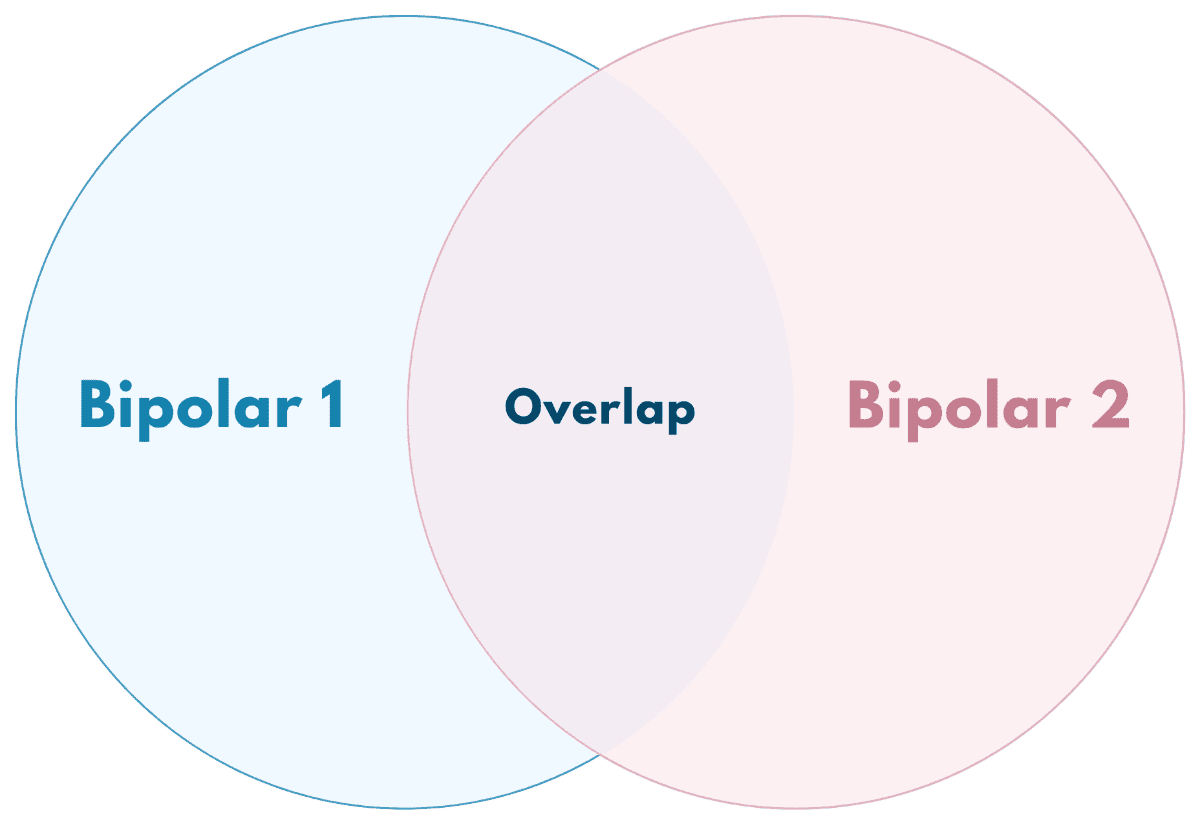
The primary difference between Bipolar 1 and Bipolar 2 is whether a person has had a manic episode or a hypomanic one.
Mania (Bipolar 1)

Duration: At least seven days, or any length if it requires hospitalization.
Symptoms: Intense elevated or irritable mood plus a clear increase in energy or activity, reduced need for sleep, racing thoughts, high-risk behavior, and sometimes a loss of touch with reality.
Severity: Often disabling. A 2022 meta-analysis found that around six in ten people with Bipolar 1 experience psychotic symptoms at some point.
Hypomania (Bipolar 2)

Duration: At least four consecutive days.
Symptoms: Elevated mood and increased activity that others notice, but not severe enough to cause marked disruption or require hospitalization. No psychotic features (if psychosis is present, the episode counts as mania by definition).
Severity: Less disabling than mania. Some people describe hypomania as productive or even pleasant, which is part of why it so often goes unreported.
Psychosis can still happen: The same meta-analysis found that about 1 in 5 people with Bipolar 2 had psychotic symptoms at some point, usually during depression.
Key distinction: Depression isn’t required for a Bipolar 1 diagnosis, but it is for Bipolar 2. And if someone with Bipolar 2 ever has a full manic episode, the diagnosis changes to Bipolar 1.
Why Depression Is the Bigger Story in Bipolar 2
Bipolar 2 is characterized by a dominance of depressive episodes. The clearest picture of this comes from a pair of long-term studies that tracked people week by week for more than a decade. In Bipolar 1, people spent roughly three and a half times as many weeks with depressive symptoms as with manic or hypomanic ones. In Bipolar 2, the ratio was closer to 39 to 1: depressive symptoms in half of all weeks, hypomanic symptoms in barely one percent of them. And much of that depression was low-grade and chronic rather than episodic.
Because depression takes up so much time, Bipolar 2 often gets diagnosed as unipolar depression, especially early on, before anyone has asked about hypomania. Bipolar depression does tend to look a little different from unipolar depression, though. No single feature is diagnostic, but a widely used clinical guide, which later research found works for both types, describes a cluster of features that raise the likelihood of bipolarity:
- Early onset. A first depression before about age 25.
- Heaviness in the body. A leaden feeling in the arms and legs (clinically called leaden paralysis), along with slowed movement and thinking.
- Sleeping and eating more, not less. Hypersomnia and increased appetite, the reverse of the insomnia and appetite loss many people picture when they think of depression.
- Mixed features. Restlessness, racing thoughts, or irritability during a depressive episode. In one family study, mixed features were what set Bipolar 2 depression apart from unipolar depression.
- Family history and episode pattern. A family history of bipolar disorder, and many short depressive episodes rather than a few long ones.
Is Bipolar 2 Milder?
I don’t think “more severe” is a useful frame.
A common myth is that Bipolar 1 is more severe because of its manic episodes. Mania can be dangerous, and it can result in psychosis and hospitalization. But the depression in Bipolar 2 is often long, hard to treat, and disabling in ways that get underestimated because there’s no dramatic episode to point to. People with Bipolar 2 can experience significant burden from their depressive episodes and go years without anyone recognizing how much they’re carrying. The DSM itself says Bipolar 2 is no longer thought of as the milder condition.
Treatment and Co-occurring Neurodivergence
Both types of bipolar disorder call for treatment built around the person’s symptoms and life context. Treatment may include medication, psychotherapy, lifestyle adjustments, and supportive strategies. Getting the type right matters, since the medication conversation for Bipolar 2 depression is not the same as for unipolar depression.
Treatment should also account for co-occurring neurodivergence. A 2021 meta-analysis found that about one in six adults with bipolar disorder also has ADHD. Among Autistic adults, a 2022 meta-analysis put the rate of bipolar disorder at around 7.5%, several times the general-population figure. OCD and eating disorders also co-occur at elevated rates. Many of us live with several of these at once, and each one can change how bipolar disorder shows up and make it harder to recognize.
A Few Closing Thoughts
Mania is what separates the two diagnoses on paper. But for many people with Bipolar 2, depression is the larger part of daily life, and it is often long and hard for others to see.
For those of us who live with bipolar, it can take a long time to be seen accurately. If you have spent years being treated for depression and something has never quite fit, it might help to check whether anyone has ever asked you about hypomania. Often no one has. (I’ve written more about living with bipolar in Not Everything Needs an Upside.)
Bipolar 1 vs. Bipolar 2 FAQs
Additional Resources
For ongoing insights and updates, subscribe to the Neurodivergent Insights Newsletter. Each Sunday, I send out fresh thoughts and a roundup of the newest resources on topics related to neurodivergence, mental health, and wellness. My most personal writing is reserved for my newsletter, and subscribers also get access to the newsletter vault (12+ PDFs) when they join.
References
American Psychiatric Association. (2022). Diagnostic and statistical manual of mental disorders (5th ed., text rev.). https://www.psychiatry.org/psychiatrists/practice/dsm
Aminoff, S. R., et al. (2022). Lifetime and point prevalence of psychotic symptoms in adults with bipolar disorders: A systematic review and meta-analysis. Psychological Medicine. https://doi.org/10.1017/S003329172200201X
Chan, J. K. N., et al. (2022). Life expectancy and years of potential life lost in bipolar disorder: Systematic review and meta-analysis. British Journal of Psychiatry. https://doi.org/10.1192/bjp.2022.19
Frankland, A., et al. (2015). Comparing the phenomenology of depressive episodes in bipolar I and II disorder and major depressive disorder within bipolar disorder pedigrees. Journal of Clinical Psychiatry. https://doi.org/10.4088/JCP.14m09293
Judd, L. L., et al. (2002). The long-term natural history of the weekly symptomatic status of bipolar I disorder. Archives of General Psychiatry. https://doi.org/10.1001/archpsyc.59.6.530
Judd, L. L., et al. (2003). A prospective investigation of the natural history of the long-term weekly symptomatic status of bipolar II disorder. Archives of General Psychiatry. https://doi.org/10.1001/archpsyc.60.3.261
Keramatian, K., et al. (2025). Duration of untreated or undiagnosed bipolar disorder and clinical characteristics and outcomes: Systematic review and meta-analysis. British Journal of Psychiatry. https://doi.org/10.1192/bjp.2025.63
Merikangas, K. R., et al. (2011). Prevalence and correlates of bipolar spectrum disorder in the World Mental Health Survey Initiative. Archives of General Psychiatry. https://doi.org/10.1001/archgenpsychiatry.2011.12
Mitchell, P. B., et al. (2008). Diagnostic guidelines for bipolar depression: A probabilistic approach. Bipolar Disorders. https://doi.org/10.1111/j.1399-5618.2007.00559.x
Rowland, T. A., & Marwaha, S. (2018). Epidemiology and risk factors for bipolar disorder. Therapeutic Advances in Psychopharmacology. https://doi.org/10.1177/2045125318769235
Schiweck, C., et al. (2021). Comorbidity of ADHD and adult bipolar disorder: A systematic review and meta-analysis. Neuroscience & Biobehavioral Reviews. https://doi.org/10.1016/j.neubiorev.2021.01.017
Varcin, K. J., et al. (2022). Occurrence of psychosis and bipolar disorder in adults with autism: A systematic review and meta-analysis. Neuroscience & Biobehavioral Reviews. https://doi.org/10.1016/j.neubiorev.2022.104543





 Stay in the Neurodivergent Loop