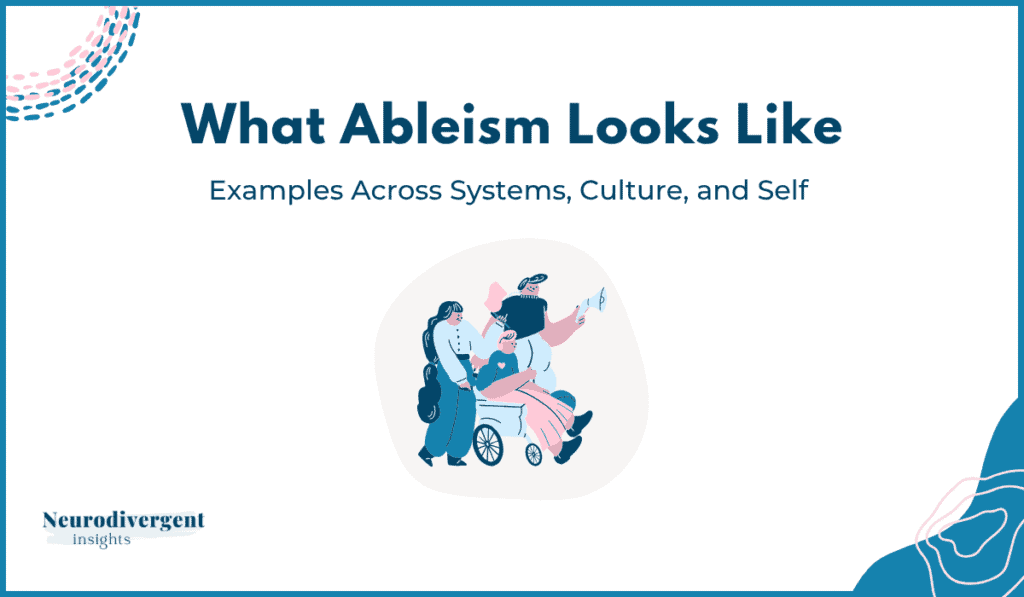
You probably encounter ableism more often than you realize. It’s in the building without the ramp, the coworker who calls you “so inspiring” for doing your grocery shopping, the school that punishes a child for what is clearly sensory overload. But it’s also more sneaky than that. It’s in the voice inside that says I shouldn’t need this much help, I should push through, I shouldn’t be awkward.
Table of Contents
What Is Ableism?
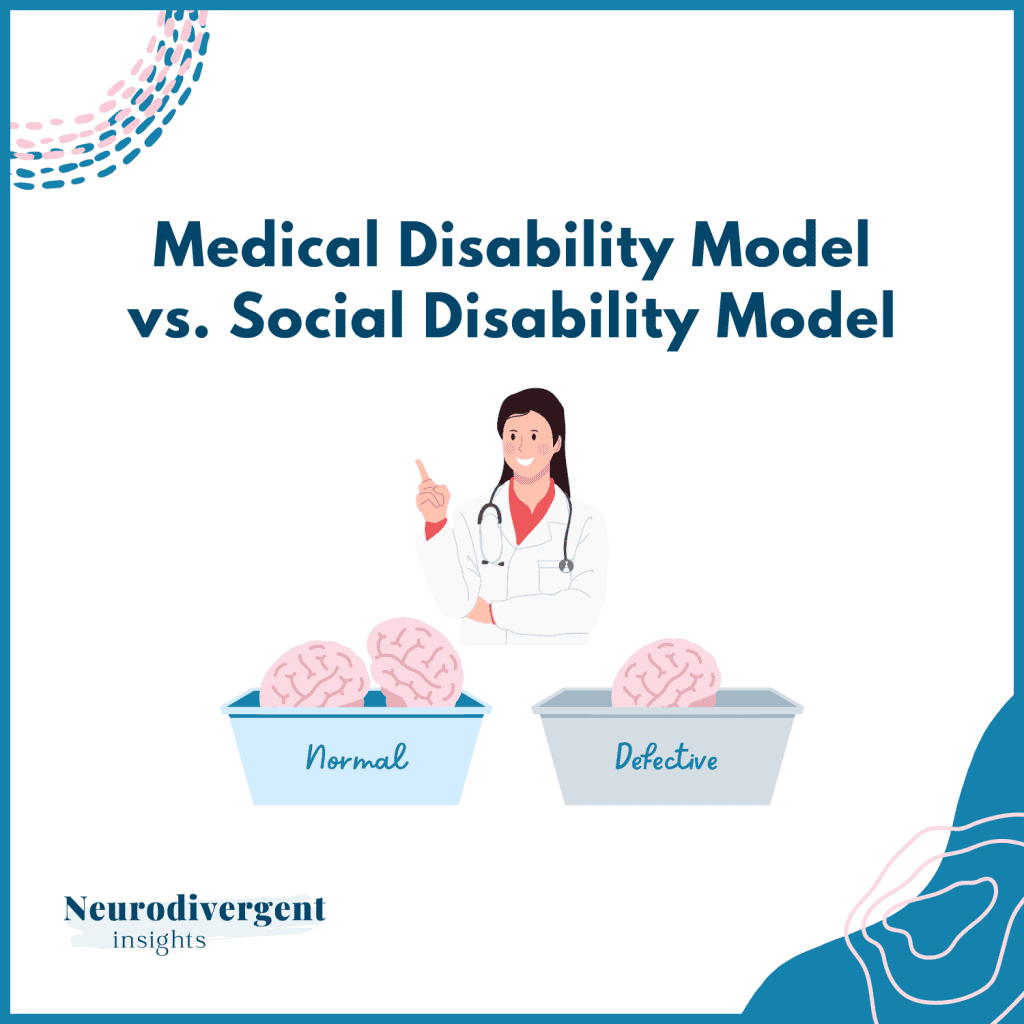
Ableism is what happens when our world is built on the assumption that there’s one “normal” way to have a body, a mind, or a neurotype, and anyone who falls outside of that norm is seen as less capable, less valuable, or in need of fixing. It isn’t one thing. It shows up across multiple layers of life, from the systems we move through to the stories we absorb to the messages that take root inside us.
Ableism doesn’t just hurt feelings; it changes health and survival. Recent public‑health research describes structural ableism as a driver of health inequities, mapping how policies, institutions, and cultural norms devalue disabled, neurodivergent, and chronically ill people. Those forces don’t stop at access to care or income; they seep into people’s inner worlds, shaping mental health, belonging, and self‑worth over time.
Who Does Ableism Affect?
Ableism most directly affects disabled people, including those with physical, sensory, cognitive, and mental health differences. But its impact ripples wider. Families, caregivers, and communities all feel the strain when systems are inaccessible. And because bodies and minds change across a lifetime, most people will experience disability at some point, whether through illness, injury, aging, or fluctuating mental health.
Ableism also affects non-disabled people by narrowing what counts as “normal” or “valuable,” fueling fear of disability, and creating cultures where people hide their needs rather than ask for support. In short: ableism affects all of us, though disabled people bear the heaviest weight.
1. Systemic Ableism: When Structures Exclude

So much of ableism is built into the structures we move through every day: workplaces, schools, healthcare, government systems. These systems are often designed with a narrow picture of who they serve, leaving disabled people excluded. In the U.S., the Americans with Disabilities Act (ADA) provides legal protections, but even with the ADA, gaps in access and enforcement remain.
Examples include:
- Workplaces that require rigid 9-to-5 schedules with no flexibility for fluctuating energy levels, medical needs, or caregiving responsibilities.
- Job interviews that don’t provide questions in advance, over-rely on “likeability” or eye contact, or use unstructured social chats as a measure of competence.
- Schools that punish students for “behavior” instead of recognizing sensory overload, learning differences, or executive functioning struggles.
- Healthcare settings without sensory-friendly spaces, or providers who dismiss a patient’s lived experience.
- Insurance systems that deny coverage for therapies, mobility aids, or supports deemed “non-essential” but that are critical for daily functioning.
- Public transportation and buildings that lack ramps, lifts, captions, Braille, or clear signage.
- Websites, online courses, or digital forms that are not screen-reader accessible.
- Emergency procedures that assume everyone can run, hear alarms, or process directions quickly.
- Voting systems that rely on inaccessible polling places, ballots, or machines.
2. Cultural Ableism: Stories, Narratives, and Representation

It’s common for there to be a lack of representation of disabled bodies and lives. And when we are represented, it’s often in extremes: cast as the villain or the superhero. Both roles strip disabled people of nuance and humanness.
Cultural ableism is woven into the stories and values that shape how disability is seen at a societal level. It influences whose stories get told, how bodies and minds are represented, and what’s considered “ideal” or “normal.”
Examples include:
- Disabled characters in film and TV being portrayed as villains, burdens, or objects of pity.
- Media stories that celebrate “superhuman” disabled athletes for “overcoming” disability, or lean into “superpower” rhetoric, erasing the complexity of living in a disabled body or mind.
- “Cure” narratives that frame disability as a tragedy to be overcome rather than a natural part of human diversity.
- The fitness and wellness industries equating health and worth with thinness, productivity, or athleticism
. - Everyday language like “confined to a wheelchair” or “suffering from autism,” which frames disability in negative terms.
- The scarcity of ordinary, nuanced disabled representation in media and culture, stories where disabled people simply exist as fully human.
3. Interpersonal Ableism: Everyday Interactions and Microaggressions

Ableism also shows up in our everyday interactions, in the assumptions, stereotypes, and small actions that shape how we treat one another. Sometimes it’s overt, like mocking someone’s speech, body, or mobility aid. But often it’s subtle, woven into habits we may not even question.
These moments are sometimes called microaggressions. And while the person giving them may not always intend harm, the impact is still felt. The message of othering is still received. Research on ableist microaggressions has found that these experiences are negatively correlated with mental health, and that people whose disabilities are more visible tend to encounter them more often than those with less visible or invisible disabilities.
Examples include:
- Talking to a disabled adult in a sing-song tone or assuming they can’t make decisions for themselves.
- Assuming someone is less capable overall because they struggle in one area (for example, speaking loudly to a blind person, or assuming a wheelchair user needs help with everything).
- Calling someone “inspirational” just for doing everyday things like grocery shopping.
- Assuming a person with chronic illness is “lazy” if they need extra rest.
- Expecting neurodivergent people to communicate in neurotypical ways, then judging them as “rude” if they don’t.
- Choosing an inaccessible venue for a meeting or event, excluding some participants.
- Assuming someone has to “look disabled” to actually be disabled, dismissing invisible disabilities, chronic pain, or energy-limiting conditions.
- Treating mobility aids as symbols of tragedy rather than tools of freedom and access.
Microaggressions and Phrases to Unlearn
Microaggressions are everyday comments or behaviors that, intentionally or not, reinforce ableist assumptions. They may be tossed out casually, even jokingly, but the impact is real. Here are some of the most common:
- “You don’t look disabled.” Suggests disability must be visible to be valid, erasing invisible disabilities and chronic conditions.
- “We’re all a little ADHD/Autistic.” Minimizes real neurodivergent experiences by equating them with quirks or personality traits.
- “You’re so OCD.” Used casually to describe neatness, this trivializes a serious mental health condition that can be debilitating.
- “Confined to a wheelchair.” Frames a mobility aid as a prison rather than a tool of freedom and access.
- “That’s so lame/crazy/insane.” Uses disability-related terms as insults, reinforcing stigma.
- “You’re so inspiring.” When said about ordinary activities, it reduces disabled people to objects of inspiration for simply living their lives.
- “Can you really work/have kids/live on your own?” Doubts competence or full adulthood simply because someone is disabled.
- “Overcoming disability” praise. Treats disability as the problem rather than the social and systemic barriers that make life harder.
4. Internalized Ableism: When Messages Turn Inward

Perhaps the most disorienting form of ableism is the one that takes root inside. After years of absorbing cultural messages about disability, those messages can seep in and become part of how disabled people see themselves. The external voices of ableism, whether spoken outright or implied, can start to influence our inner voice.
A 2022 qualitative study of disabled young people found that internalized ableism manifested as deep shame, isolation, and persistent feelings of unworthiness and unlovability. The researchers identified shame as a driving force in the internalization of ableism, something that “regulated and disciplined” disabled young people toward self-blame. And a 2025 study of Deaf adults found that internalized ableism specifically predicted depression, while other forms of internalized oppression predicted anxiety.
Examples include:
- Believing you’re a burden if you need accommodations.
- Pushing through pain or exhaustion to appear “normal.”
- Apologizing excessively for existing needs.
- Feeling shame for stimming, using mobility aids, or asking for support.
- Comparing yourself to non-disabled peers and measuring your worth by their standards.
- Hiding or masking disability to avoid judgment.
- Rejecting assistive devices (like hearing aids or wheelchairs) even when they would increase access and freedom.
- Minimizing your struggles with “other people have it worse,” which invalidates your own needs.
- Dismissing your needs as invalid because your functioning fluctuates.
Internalized ableism doesn’t arise on its own. It grows out of the systems, cultural stories, and daily interactions described throughout this article. Recognizing it is often the first step in loosening its grip and beginning to reclaim a sense of worth and belonging.
As I keep coming back to internalized ableism in my own work, I find I have more nuance than I did a few years ago. “Catch the thought, name it, unhook” can still be useful, but it isn’t the whole story. Often these patterns began as adaptive responses to a maladaptive environment — a way to stay safer, blend in, or pre‑empt other people’s shame in an ableist world.
Shame research shows similar dynamics: “If I get there first and shame myself into behaving, other people’s shame might hurt less.” Loosening internalized ableism is more than swapping out a belief; it also means honoring the context those patterns come from and recognizing how they’ve tried to protect us, even as they also cost us.
How Naming Ableism Can Shift Narratives
Ableism isn’t always loud or obvious. It often hides in the expectations, systems, and self-talk running in the background. A 2025 systematic review spanning 30 studies and over 20,000 participants found that ableism negatively affects physical health, mental health, and overall quality of life, and that these effects begin in childhood.
Naming ableism helps us see the invisible walls around us and imagine something different: workplaces, schools, and communities where every kind of body and mind is welcomed as fully human.
How to Be a Better Ally
Challenging ableism starts with noticing it, around us, within us, and in the structures we move through. Being an ally is less about having all the answers and more about showing up with curiosity, openness, and a willingness to unlearn.
Here are a few ways to start:
- Notice your language. Avoid ableist phrases like “crazy,” “lame,” or “you’re so OCD,” and choose words that affirm rather than stigmatize.
- Design for belonging. When hosting events, teaching, or creating resources, assume disabled people are in the room. Access needs are vast, and that can feel overwhelming, but starting small makes a difference. Choose an accessible meeting space, add captions to a video, ask about sensory needs, and build from there.
- Amplify disabled voices. Read, share, and support the work of disabled writers, activists, and creators rather than speaking for them.
- Honor accommodations. Whether in school, work, or community spaces, treat accommodations as basic rights, not special favors.
Additional Resources on Ableism and Disability
If you’d like to keep learning, here are a few resources we recommend:
- Learn more about disability pride, exploring the history and heart of the movement.
- Clinical training: Learn more about how ableism and traumatic invalidation impact the mental health and identity of neurodivergent clients, designed for clinicians and coaches.
- Ologies Podcast: the episode on Disability Sociology with Guinevere Chambers highlights the history of the disability movement, the sociology of disability, and much more.
References and Key Studies
- Lundberg & Chen (2023). Structural ableism in public health and healthcare: a definition and conceptual framework. Lancet Regional Health – Americas.
- Kattari (2020). Ableist microaggressions and the mental health of disabled adults. Community Mental Health Journal.
- Haraldsdóttir, Egilson, & Jóhannsdóttir (2022). Implications of internalised ableism for the health and wellbeing of disabled young people. Sociology of Health & Illness.
- Tomaszewski et al. (2025). Internalized oppression and deaf people’s mental health. Scientific Reports.
- Lindsay et al. (2025). The impact of ableism on the health and well-being of children and youth with disabilities: a systematic review. Disability and Rehabilitation.
Follow-Up Resources
Stay in the Neurodivergent Loop
For ongoing insights and updates, subscribe to the Neurodivergent Insights Newsletter. Each Sunday, I send out fresh thoughts and a roundup of the newest resources on topics related to neurodivergence, mental health, and wellness. My most personal writing is reserved for my newsletter, and subscribers also get access to the newsletter vault (12+ PDFs) when they join.
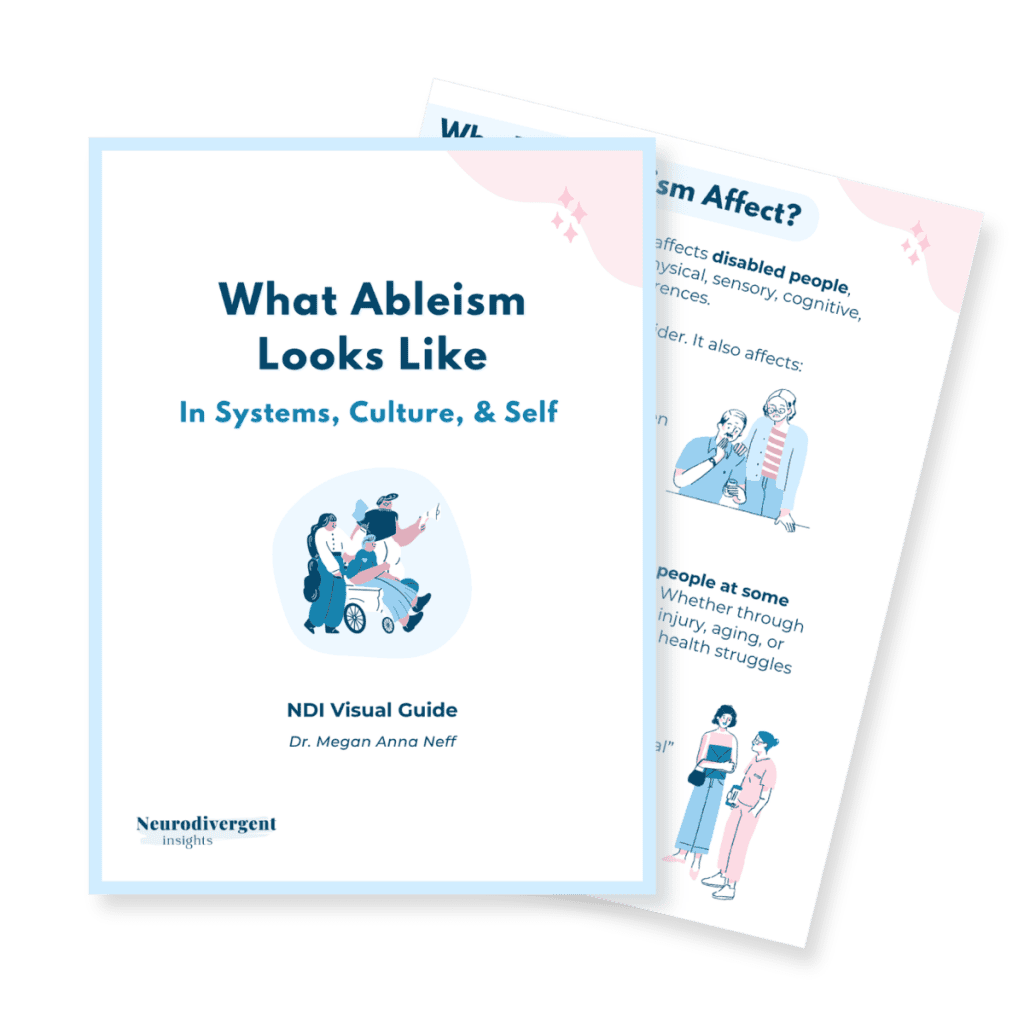
Prefer to engage or share this information visually? Our Free NDI visual Guides are abbreviated, visual-forward highlights of our longer articles.
For ongoing insights and updates, subscribe to the Neurodivergent Insights Newsletter. Each Sunday, I send out fresh thoughts and a roundup of the newest resources on topics related to neurodivergence, mental health, and wellness. My most personal writing is reserved for my newsletter, and subscribers also get access to the newsletter vault (12+ PDFs) when they join.