Many surface-level interventions for ADHD start with something like this question: Have you used a planner? Planners, organizational systems, and many other strategies tossed at ADHD people share one big problem: most of them are built for an importance-based nervous system. They may get some traction while they’re new and shiny, but they fade quickly. To move with intention toward our goals, we need to learn to work with our interest-based nervous system, not against it.
Table of Contents
Interest vs. Importance
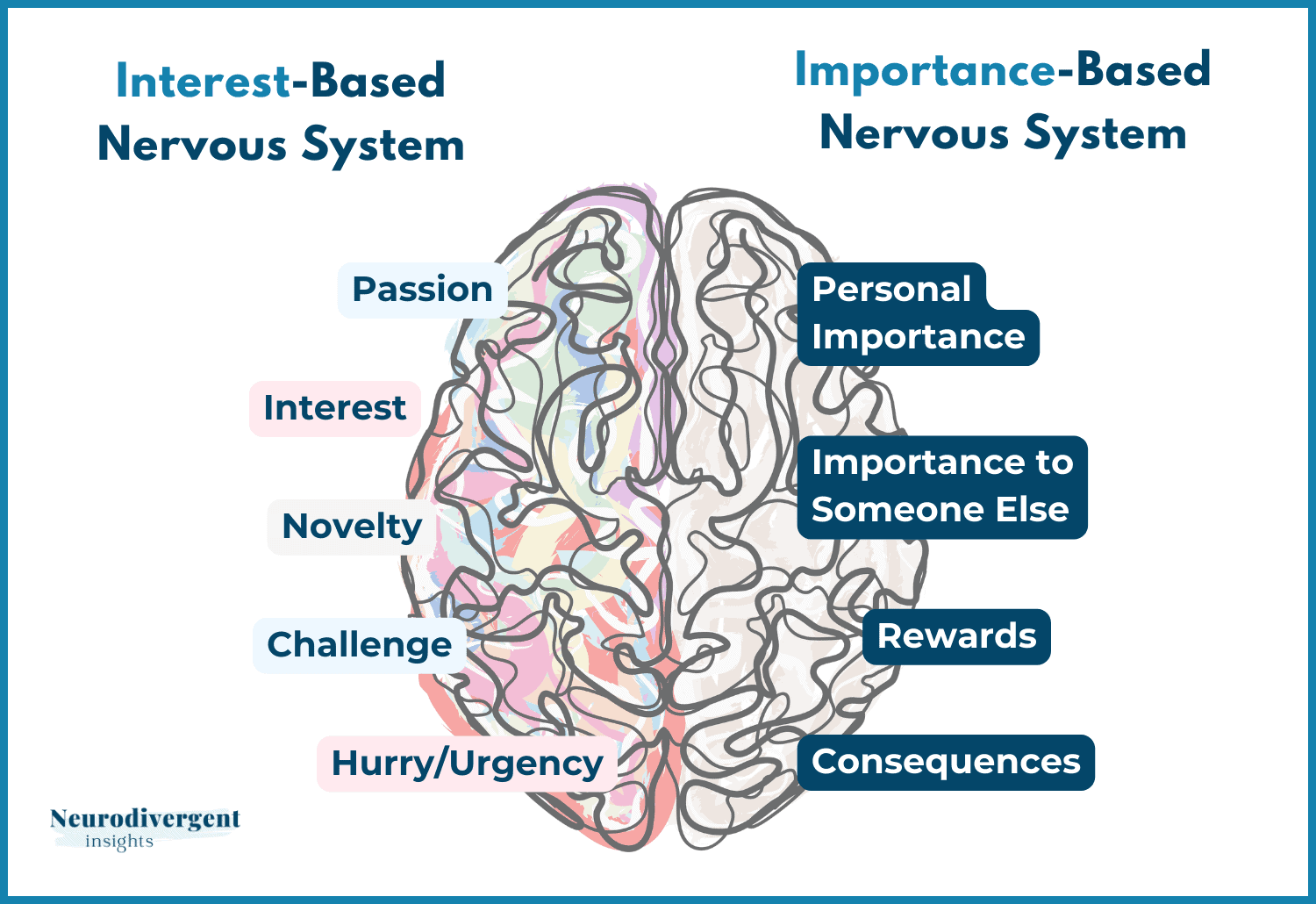
Psychiatrist William Dodson describes the ADHD nervous system as interest-based: we engage most easily with tasks that are interesting, novel, challenging, or urgent, rather than tasks that are simply important. There’s a fuller explanation in The Interest-Based Nervous System and in ADHD Motivation.
Working With Your Interest-Based Nervous System
Most ADHD strategies fail because they are attempts to dress the ADHDer up as neurotypical. Systems and “ADHD hacks” that try to get us to operate in an importance-based mode often leave us more frustrated and defeated. The strategies that help are the ones that work with our system rather than against it.
ImpactParents uses the acronym PINCH as an easy-to-remember version of Dodson’s model: Play (or Passion), Interest, Novelty, Competition (or Cooperation), and Hurry.
Play and Passion
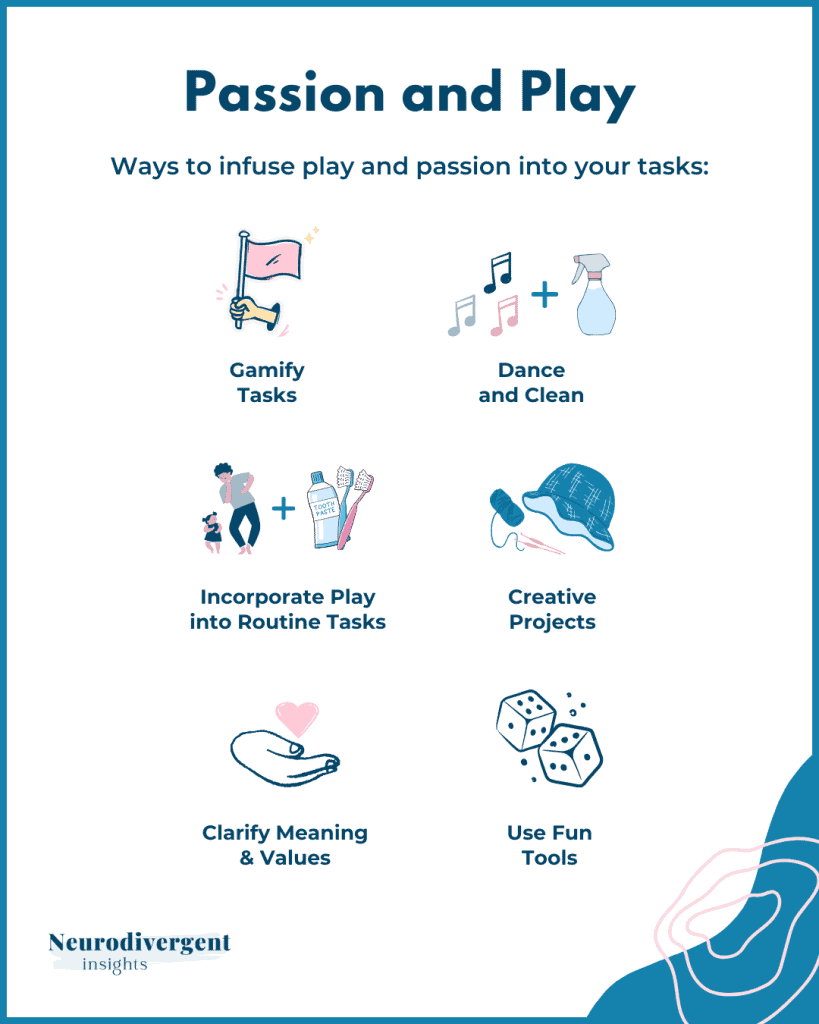
Can you make the task more fun or playful? Or can you connect it to your passions and what matters to you? While I was at Princeton for graduate school, I was taking a hefty history class. Because I’m a visual learner and because I needed play, I started drawing the historical figures as paper dolls. I’d give them props to help me remember historical facts. I’m pretty sure I was the first Princeton graduate student to sit in their prestigious library drawing paper dolls.
Later, when I was studying for my licensing exam to become a psychologist, I turned the material into visuals in Canva to get myself engaged (and to help the concepts stick).
Some ways to bring in play and passion:
- Dance and clean: Put on your favorite music and dance while you clean.
- Creative projects: Use colorful materials or design tools like Canva to make a project more interesting.
- Play in routine tasks: Turn folding laundry into a game by timing yourself and trying to beat your last record.
- Gamify tasks: Give yourself points for each section of a project you finish, and work toward a goal.
- Fun tools: Colorful sticky notes, fancy pens, or unique stationery can make mundane tasks more enjoyable.
- Clarify meaning and values: If you’re unsure what you’re passionate about, try the VIA character strengths assessment or a free values card sort. Then remind yourself how the task connects to your values.
Interest
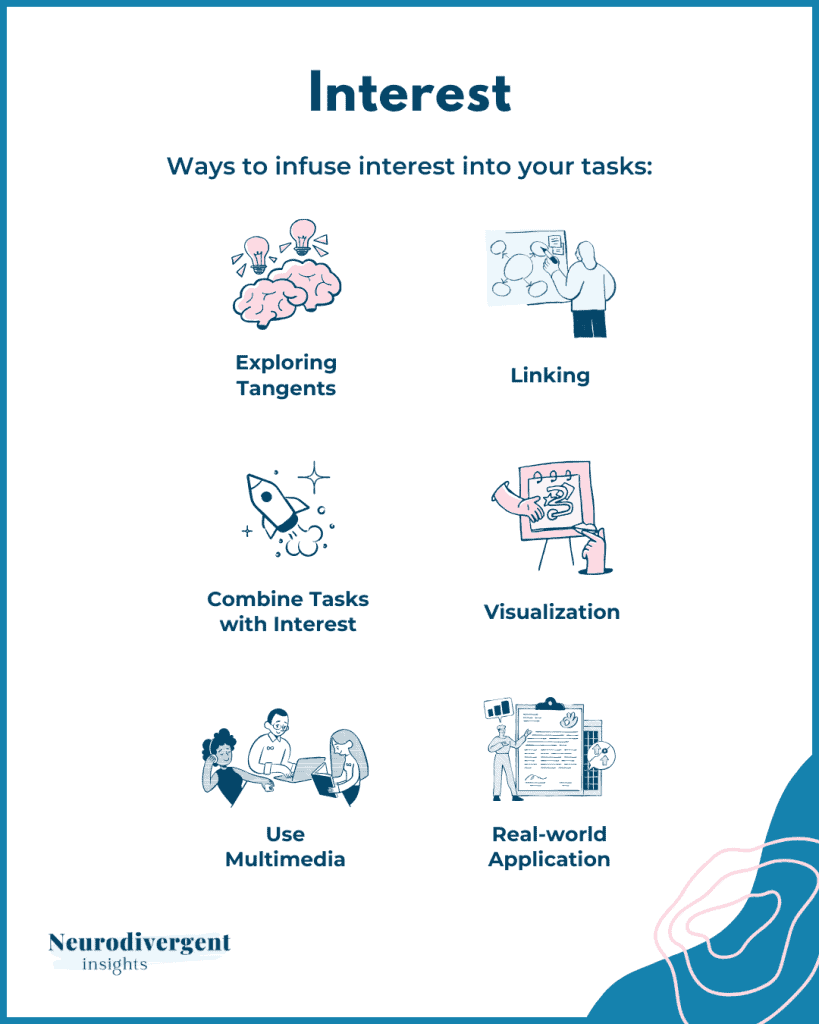
Can you bring interest into the task at hand? This is where my special interest ecosystems and associative brain come in handy. If I can connect what I have to learn to something I’m interested in, I can get engaged more easily.
When I was working on my doctorate in psychology, biology wasn’t innately interesting to me. I was fascinated by learning theory and health psychology, though. So when I was learning bio basics (neurotransmitters and so on), I used my associative brain to think about what they meant for those fields.
Some ways to bring in interest:
- Linking: Use associative thinking to connect the task to a hobby or topic you care about.
- Visualization: Use diagrams, drawings, or mind maps to make the material more visually interesting.
- Everyday applications: Think about how the information applies to problems you’re curious about.
- Multimedia: Bring in videos, podcasts, or interactive formats that interest you.
- Tangents: Let yourself side-quest into related topics that catch your interest.
- Pairing: Pair routine tasks like cooking, cleaning, or exercising with music, audiobooks, or podcasts you enjoy.
Novelty
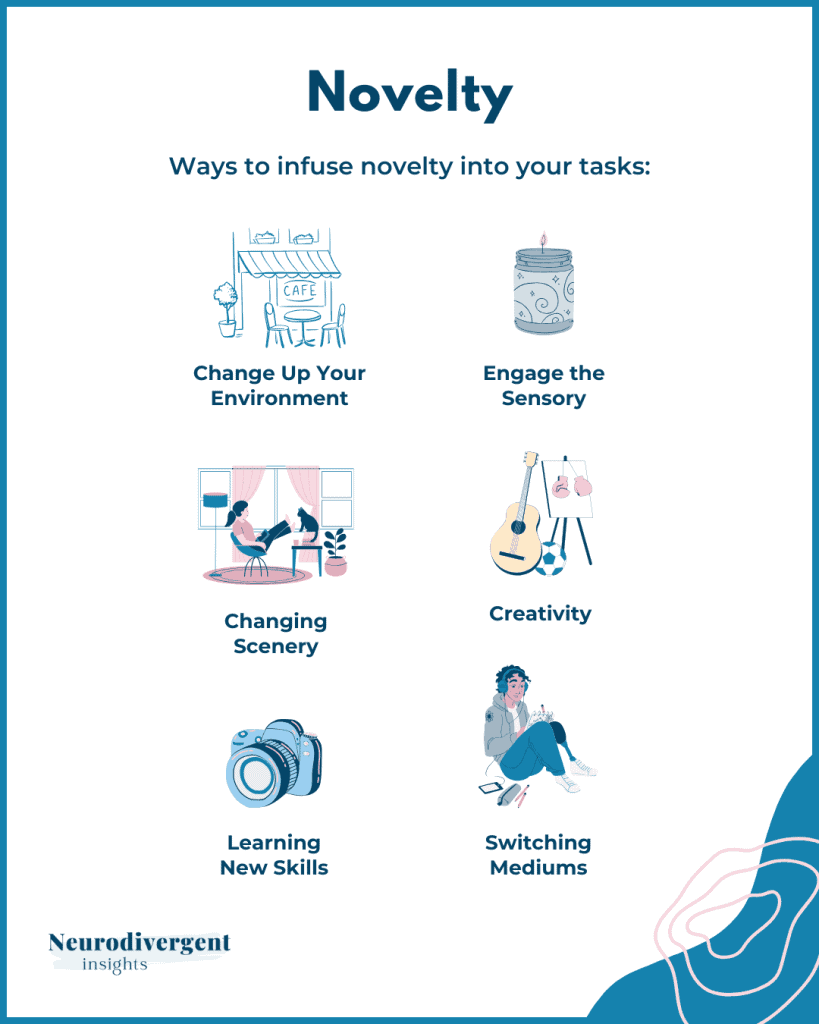
When something is new and exciting, it’s easy for us to engage. This is why “ADHD hacks” and systems often work for about a month before they need replacing. I often rotate through different projects to keep them fresh, which works well when you have a lot of freedom around your schedule.
When I’m struggling to get started on a task, I often begin with the most novel part. For me, that’s the creative part. When writing feels boring, I start by making graphics, and that kickstarts my motivation.
Some ways to bring in novelty:
- Sensory novelty: Struggling with body care? Try new hygiene products with different scents. For studying, try brightly colored pens or new textures.
- Change up your environment: Rearranging your workspace or adding new decorations can make work feel fresh.
- Creativity: Add infographics, illustrations, or mind maps to your work.
- New skills: Try a new software program, a new supportive tool, or a different technique.
- New scenery: Work from a coffee shop, a park, or a different room.
- New collaborators: Working with different people brings in new perspectives.
- Switch mediums: If you usually work on a computer, switch to paper for a while, or the other way around.
Competition and Cooperation
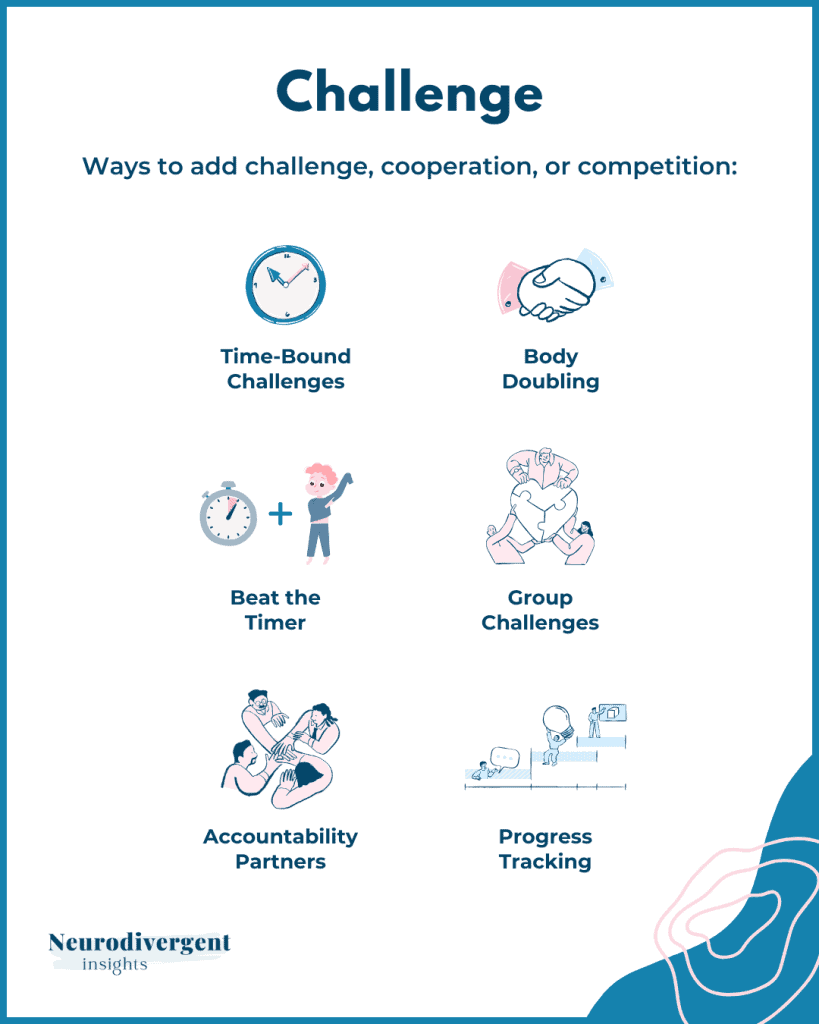
I’m always asking my spouse to compete with me. Unfortunately, he has an importance-based system and isn’t into such shenanigans. So I often resort to self-competitions, like setting a timer to see how many emails I can answer or how much of a room I can clean.
Cooperation and connection can motivate us too. As a child, I couldn’t get myself to clean my room, but when my mom came in and did it with me, I could finally engage. Many of us can do hard things in the presence of a supportive person.
Some ways to bring in competition and cooperation:
- Body doubling: Having someone else present while you work, in person or virtually, is something many ADHDers say helps them start and stay on task.
- Timed challenges: See how much you can get done in 20 minutes, then take a break and switch tasks.
- Beat the timer: Great for hard mornings. See if you (or your child) can get dressed, eat breakfast, and pack a bag before a certain song ends.
- Group challenges: Set shared goals with friends or colleagues and track each other’s progress.
- Accountability partners: Pair up with someone who has similar goals and check in regularly with photos or quick updates.
- Progress tracking: Charts or graphs that show your progress can set up a friendly competition with yourself.
Hurry
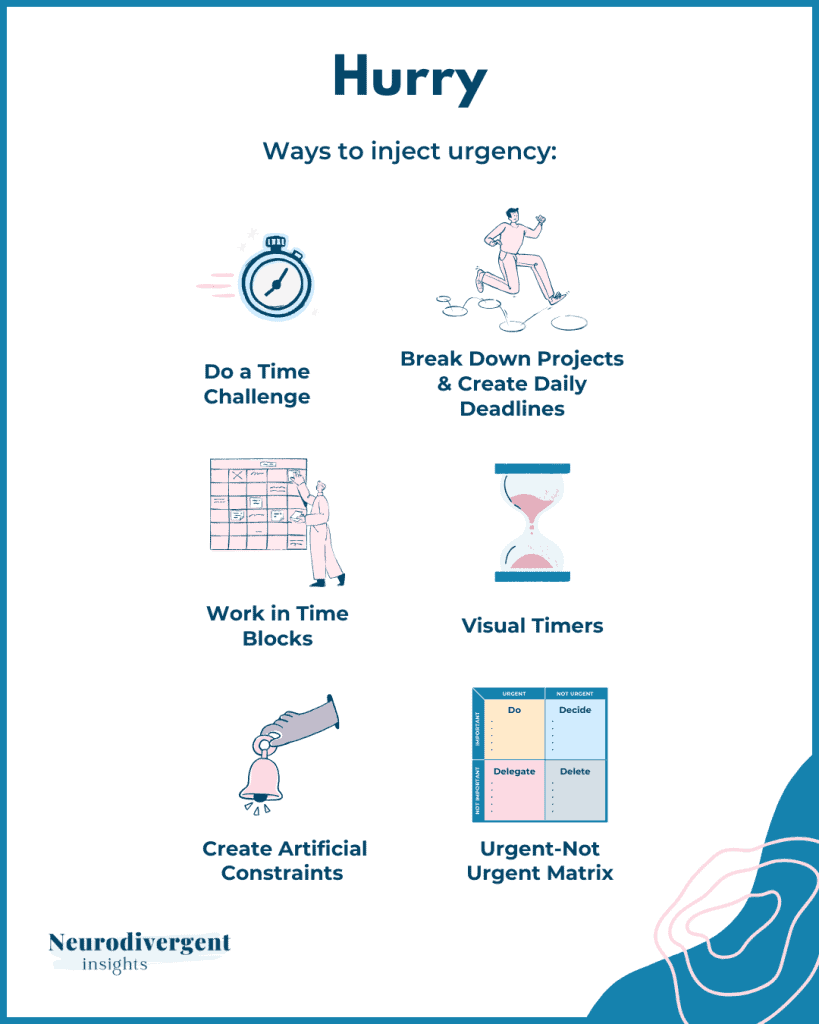
Hurry, the last motivator, works because a deadline can give us a burst of focus. Many of us also notice that running on last-minute pressure leaves us drained, so it helps to lean on the other motivators and save urgency for when we need it.
Some ways to create urgency without overwhelming your system:
- Break down big projects: Split large projects into smaller pieces with daily mini-deadlines.
- Beat the clock: Set a timer and see how much you can do in 15 minutes.
- Time blocks: Schedule set blocks for tasks. Knowing time is limited creates natural urgency.
- Urgent/important matrix: Use the Eisenhower Matrix to sort tasks by urgency and importance.
- Visual timers: Visual timers and countdown clocks make time more tangible, which also helps with time perception.
- Artificial constraints: Give yourself a set amount of time for a task, whatever its complexity.
What the Research Says
The interest-based nervous system is Dodson’s clinical framework, built from his work with ADHD adults. It hasn’t been tested as a research model. Brain research offers some support, though. A 2009 imaging study found differences in the dopamine reward pathway in ADHD adults, and a follow-up study linked those differences to lower motivation scores. Separately, research on novelty has found that new things activate that same reward system. None of this proves the framework, but it fits what many ADHD people describe.
Track Your Motivation
Dodson suggests tracking your motivation. Use your phone or a notebook to jot down when you feel engaged, what you were doing, and the context. After a few weeks, patterns tend to show up. You might notice that cooperation is a huge motivator for you, while novelty and competition aren’t.
A Few Closing Thoughts
Many of us have lost self-trust and a sense of agency after years of force-based approaches to managing our ADHD. Understanding and working with our interest-based nervous system can help us start rebuilding some of that trust.
Dodson encourages ADHD adults to treat managing their engagement as a lifelong practice. Knowing our own motivators, and getting a little creative about bringing them into a task, often does more for us than any planner.
PINCH and ADHD Motivation FAQs
What does PINCH stand for in ADHD?
PINCH stands for Play (or Passion), Interest, Novelty, Competition (or Cooperation), and Hurry. ImpactParents built it as a memory aid for Dr. William Dodson’s interest-based nervous system model.
What is an interest-based nervous system?
It’s Dodson’s description of how many ADHD people engage with tasks. Interest, novelty, challenge, and urgency get us going far more reliably than importance alone.
Is the interest-based nervous system backed by research?
It’s a clinical framework rather than a tested research model. Brain imaging studies on dopamine and motivation in ADHD fit with it, but the framework itself hasn’t been studied directly.
How do I use PINCH to get started on a task?
Pick one motivator to add: make it playful, link it to an interest, start with the most novel part, race a timer or work alongside someone, or set a short deadline.
Additional Resources

The Interest-Based Nervous System What it is and how it shapes ADHD motivation

ADHD Motivation Why “just try harder” does not work

ADHD Attention: Trusting a Mind That Moves How ADHD attention works
Interest-Based Nervous System Workbook Practices for working with your motivation
 Stay in the Neurodivergent Loop
For ongoing insights and updates, subscribe to the Neurodivergent Insights Newsletter. Each Sunday, I send out fresh thoughts and a roundup of the newest resources on topics related to neurodivergence, mental health, and wellness. My most personal writing is reserved for my newsletter, and subscribers also get access to the newsletter vault (12+ PDFs) when they join.
References
Bunzeck, N., & Düzel, E. (2006). Absolute coding of stimulus novelty in the human substantia nigra/VTA. Neuron, 51(3), 369–379. Link
Dodson, W. (n.d.). Secrets of the ADHD brain. ADDitude. Link
Volkow, N. D., Wang, G.-J., Kollins, S. H., et al. (2009). Evaluating dopamine reward pathway in ADHD: Clinical implications. JAMA, 302(10), 1084–1091. Link
Volkow, N. D., Wang, G.-J., Newcorn, J. H., et al. (2011). Motivation deficit in ADHD is associated with dysfunction of the dopamine reward pathway. Molecular Psychiatry, 16(11), 1147–1154. Link