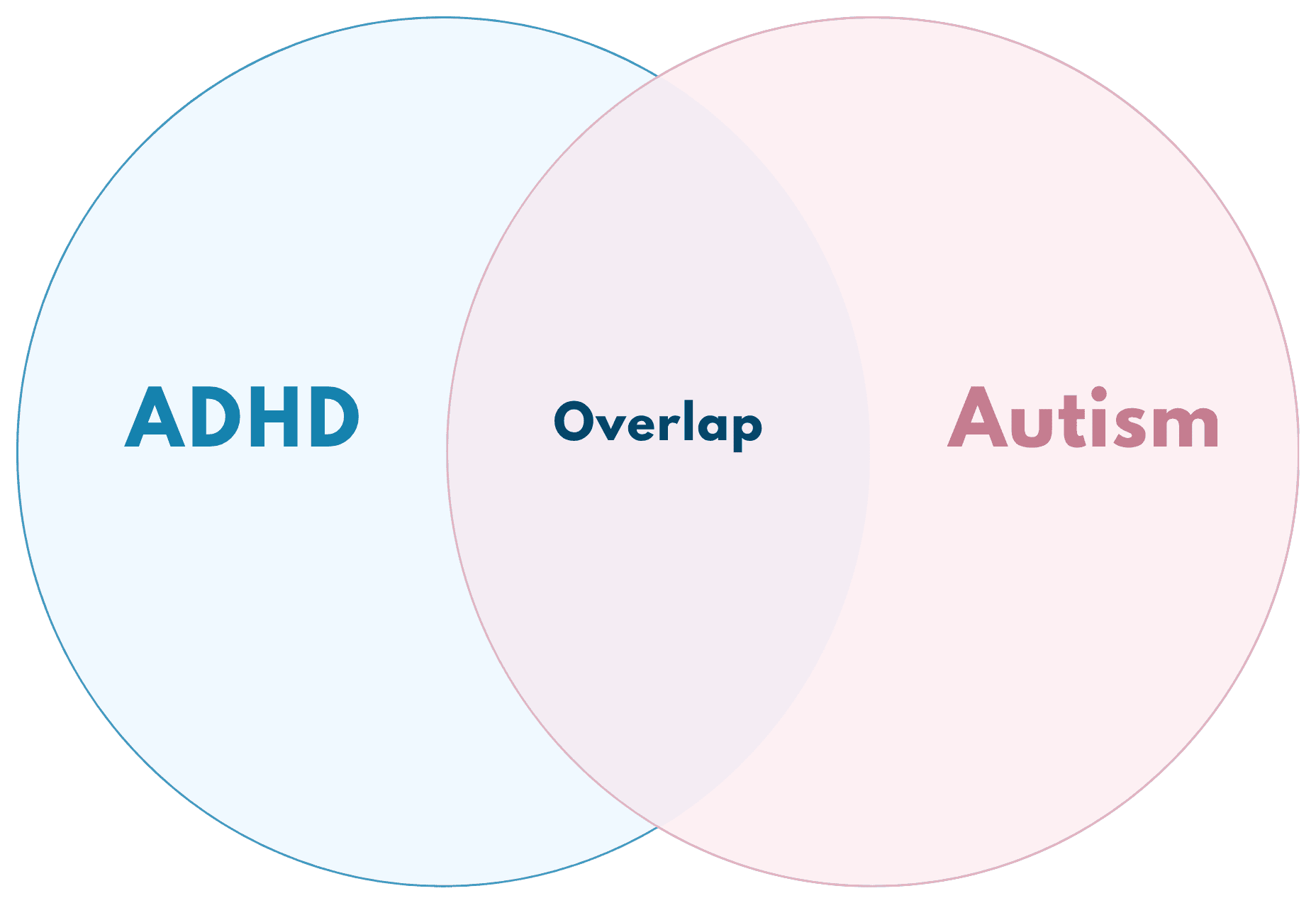
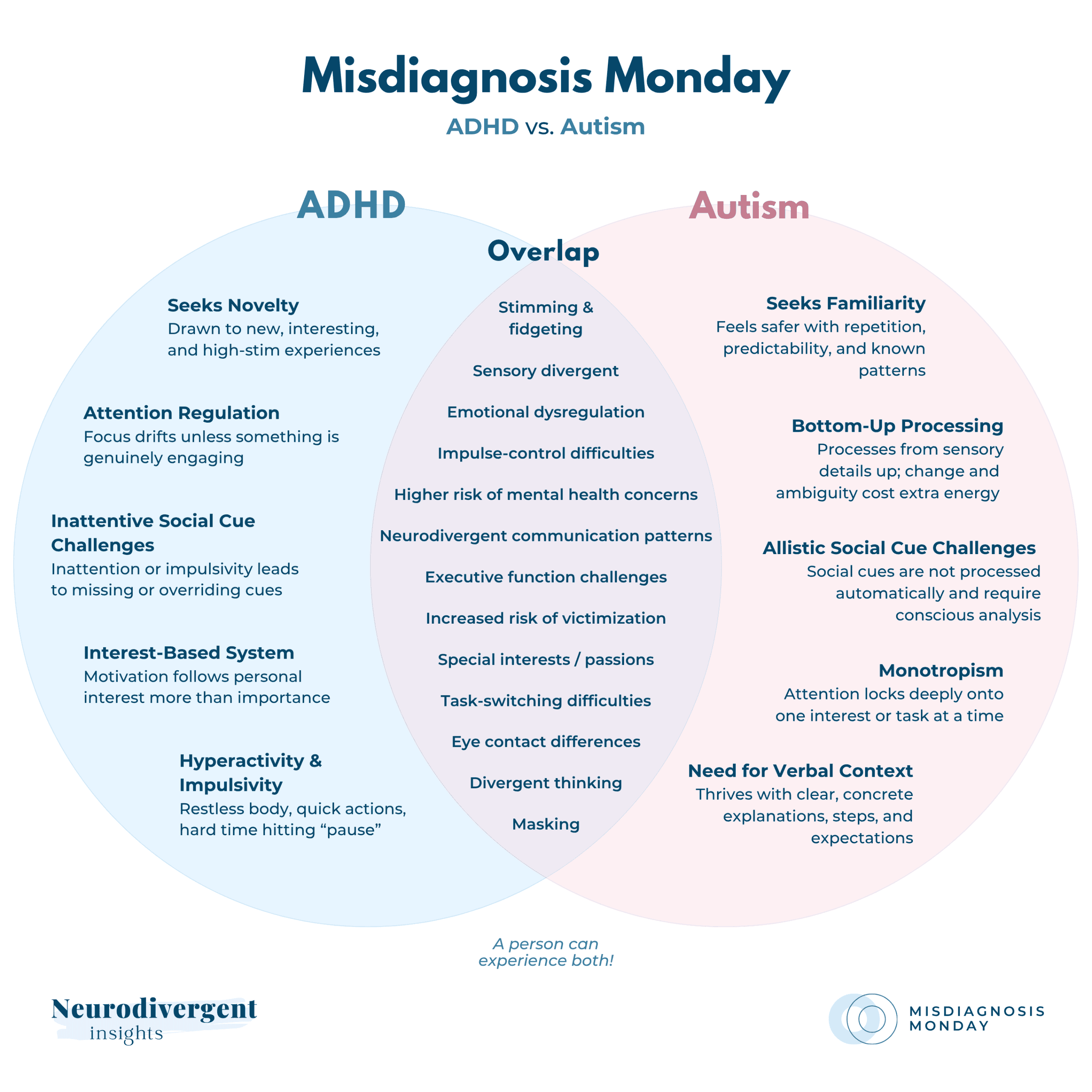
Taking on ADHD and Autism has felt like the most daunting diagram to create in the Misdiagnosis Monday series. I think this feels harder to tease out because I struggle to tease it out in my own mind! Writing it out into neat categories for an article is one thing, but experiencing it in my own brain is quite different.
Is my desk always a mess because of my executive functioning struggles associated with Autism or ADHD? Is the reason my email inbox says 1967 unread emails (most of them spam, but probably some important ones hidden in there) because of ADHD or Autism? Is my impulsivity, failure to close drawers, constant restlessness, tendency to interrupt people or the fact that I’m always looking for my keys, phone, and credit cards my Autism or ADHD?
I believe this speaks to the complexity and messiness that is Autism-ADHD. It turns out that in my state of confusion, I am in good company. Research shows the two can be genuinely hard to tell apart, even for clinicians.
Even with psychological training, when it comes to my lived experience, I struggle to tease out what is what.
Table of Contents
Overview of Autism and ADHD
ADHD and autism overlap a lot, but they’re different. Autism involves differences in social communication with non-autistic people, plus a tendency to regulate through repetition and routine (special interests, stimming, rituals). ADHD involves differences in regulating attention, along with hyperactivity and impulsivity.
Both are common. The CDC’s latest estimate is that about 1 in 31 children are Autistic (2022 data), and about 1 in 9 U.S. children have been diagnosed with ADHD.
Co-Occurring ADHD and Autism: Understanding the Genetics
The understanding of the overlap of ADHD and autism is relatively new. Until recently, if someone with traits of both conditions came in for an assessment, the clinician had to choose which diagnosis fit best. Until the DSM-5 came out in 2013, a diagnosis of autism or Asperger’s took the place of a diagnosis of ADHD (Taurines et al., 2012). Thankfully, both conditions can now be diagnosed in the same person.
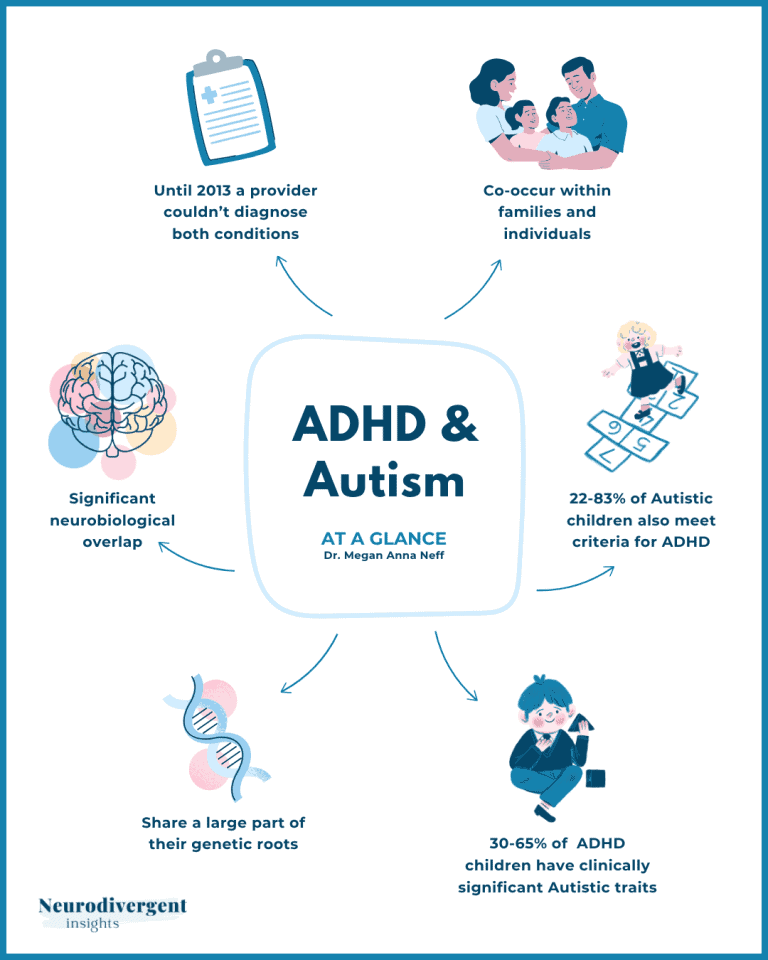
Research shows a large overlap. Studies estimate that 22–83% of Autistic children also meet criteria for ADHD, and 30–65% of ADHD children have significant Autistic traits. Twin, family and DNA studies show the two share a large part of their genetic roots.
Even when someone doesn’t meet criteria for both, it’s common to see more ADHD traits in Autistic people and more Autistic traits in ADHDers. I suspect that “pure ADHD” or “pure autism” is the exception, not the norm.
Genetic Overlap
One leading explanation for why ADHD and autism so often co-occur is shared genetics. Twin and family studies show substantial genetic overlap, and a large 2022 genetic study found the two share a large part of their genetic roots, which may help explain why they run together in individuals and families.
The research also points to a strong neurobiological overlap, this means that there are similarities in the way ADHD and Autistic brains biologically function. Sokolova et al., 2017 suggests biological pathways in attentional control or inattention and task-switching may be a key factor in understanding the genetic similarities between the two.
ADHD and Autistic Trait Overlap
Both are neurodevelopmental conditions that shape attention, executive functioning and sensory processing. Here’s where the traits overlap.
Executive Functioning Differences
Executive functioning challenges are a core feature of ADHD and is also common among Autistic people. These challenges may include difficulty organizing tasks, “out of sight, out of mind”, memory, focus, decision-making, shifting attention, and regulating attention.
Social Differences
Both ADHDers and Autistic people struggle to fit in socially with neurotypical peers and systems, but often for different reasons. For ADHDers, this is related to challenges with regulating attention and impulsivity. For example, we might miss social cues due to inattention, such as not noticing when the other person is bored, or we may struggle to resist the impulse to finish their sentence.
For Autistic people, social difficulties often stem from differences in intuitively picking up on social cues, body language, understanding pretense, and challenges with task switching (since social communication involves considering multiple tasks at one time). For instance, we might find it hard to switch topics when the person we’re talking to does.
Both groups also have distinct ways of connecting, such as through discussions about specific objects or interests and skipping small talk. ADHDers and Autistic people tend to do better in conversations focused on topics of interest, where there is space for divergent processing, allowing for associative leaps and creative thinking.
Interoception Issues
Interoception, often referred to as the “8th sensory system,” is the ability to sense internal signals. This includes signals associated with elimination, hunger, thirst, and emotions. Interoceptive awareness is integral to self-care and emotional regulation because if we struggle to identify emotions or what our body needs, it is more difficult to address those needs until they become urgent.
A person with less sensitive interoceptive awareness will have difficulty registering and responding flexibly to their internal states and emotions. Research points to frequent interoception differences in autism; for ADHD, findings are more mixed.
To read more about interoception issues and neurodivergence, you can see my full article on it here.
Time Perception
Partly because of interoception differences, ADHDers and Autistic people often have time perception challenges.*
Sensory Differences
Sensory differences are very common in both ADHD and Autism and relate to how the brain processes sensory information. Each individual experiences sensory input differently. One person may be sensory sensitive, while another may seek out sensory input.
Sometimes, a person may vacillate between these two extremes or be sensory seeking in one area (like taste and smell) and sensory avoidant in another (like touch and visual). To learn more about the different sensory processing systems, you can check out this article on the eight primary sensory systems.
Hyperactivity/Receiving Comfort from Repetition (stimming)
Using stimming or repetitive movement to self-regulate is common among both Autistic people and ADHDers. Stimming involves repetitive motor movements and is used to regulate sensory input, while fidgeting is a way of releasing excessive energy. Although stimming is common in both groups, it may be more common among Autistic people. Additionally, ADHD fidgeting can often resemble the stimming seen in Autism.
Monotropism, Special Interests and Passions
Hyper-fixation and hyper-focus, particularly around our passions and special interests, are common among both ADHDers and Autistic people. Hyperfocus, as seen in the context of ADHD, can look a lot like hyper-fixation. ADHD passions can resemble Autistic special interests.
This tendency to become pulled into what I call “the vortex” is similar for both Autistic and ADHD people. While ADHDers have an interest-based nervous system, Autistic people have a monotropic brain, which can look similar but also has some distinct differences. Monotropism refers to the natural tendency to have a deep, singular focus on a limited range of interests at any given time, allowing for intense and immersive engagement. For ADHDers, an interest-based nervous system means our attention becomes more intense when working on an area of passion, interest, novelty, and urgency.
Emotional Regulation
Many ADHDers and Autistic people find intense emotions hard to regulate and soothe. Researchers have proposed several contributors, including differences in brain circuitry, interoception, nervous system sensitivity and sensory processing.
Nervous System Sensitivity
ADHDers and Autistic people both have distinct nervous systems that tend to be more sensitive and less flexible. This contributes to difficulties in regulating emotions, more easily flipping into stressed states, and a higher likelihood of developing certain medical conditions. As a result, we often have to be more thoughtful about our nervous system self-care. You can learn more by reading this article on the ADHD and Autistic nervous system: Neurodivergent Insights – Autistic and ADHD Nervous System.
Rejection Sensitive Dysphoria
Rejection Sensitive Dysphoria (RSD) refers to the tendency to experience extreme emotions surrounding perceived rejection, criticism, and possible failure. It is common among both ADHDers and Autistic people. While the term Rejection Sensitive Dysphoria is specific to ADHD literature, heightened sensitivity to rejection is common to both groups. This sensitivity likely arises from a complex interplay of factors, including experiencing negative feedback, social victimization, navigating neurotypical society, and having sensitive nervous systems.
Shared Psycho-Social Risks
In addition to sharing brain circuitry and traits, ADHDers and Autistic people also face shared psycho-social risks and similar experiences.
Addiction
Addiction is common among both ADHDers and Autistic people and may be related to a tendency to self-medicate, self-soothe overactive nervous systems, regulate sensory experiences, or cope with co-occurring depression or anxiety.
For ADHDers, there is a strong link between ADHD and substance use, including alcohol. One review found that approximately 25% of adults and 30% of teens in treatment for alcohol and drug use have ADHD, compared to 2–5% of adults in the general population.
While it was once thought that addiction was rare among Autistic people, this doesn’t appear to be the case. A large Swedish study found that Autistic people without intellectual disability had more than twice the risk of substance-related problems, and the risk was much higher for those who also had ADHD. In a Spectrum feature, journalist Maia Szalavitz described Autistic people using drugs to cope with social stress and sensory sensitivities, along with higher rates of impulsivity-related addictions such as shopping, gambling and internet gaming.
Co-occurring Mental Health Conditions
ADHD and Autism rarely walk alone. Both ADHDers and Autistic people have a higher risk of mental health conditions like depression, anxiety, bipolar disorder, OCD and PTSD. In one study, 79% of Autistic adults met the criteria for a psychiatric condition at least once in their life. ADHD is also very common among children in psychiatric care; one review noted rates often exceed 50%.
Mood Disorders
In adults, depression is common among ADHDers, though estimates vary widely. In one outpatient study, about 17% of adults in psychiatric care for non-psychotic conditions had ADHD, compared with about 5% of a non-clinical group. Bipolar disorder is also common among both Autistic and ADHD people. While the precise overlap is difficult to determine, you can read more about ADHD and bipolar here and autism and bipolar here.
OCD
Both ADHDers and Autistic people have higher rates of obsessive-compulsive disorder (OCD). Some research suggests overlapping brain circuitry across all three conditions.
- About 1 in 6 people with OCD also have ADHD. Going the other way, a 2025 meta-analysis of ADHD children and teens estimated that about 4% had OCD. You can read more about ADHD and OCD here.
- Autism and OCD also overlap. A population-based study in Denmark found familial links between the two: people diagnosed with autism were twice as likely to be diagnosed with OCD later in life, and people diagnosed with OCD were four times as likely to be diagnosed with autism later in life. You can read more about autism and OCD here.
Self-Harm and Suicidality
Self-harm behavior and suicidality are alarmingly high among both ADHDers and Autistic people. The risk is likely amplified among those with other marginalized identities. Self-harm may be an attempt to regulate sensory load or manage difficult emotions.
For girls with ADHD, self-harm rates are particularly concerning. Girls often internalize many of their ADHD traits, which can lead to higher rates of self-harm. In a study that followed girls with ADHD into early adulthood, 51% of those with the combined presentation had self-injured, compared with 19% of girls without ADHD, and 22% had attempted suicide, compared with 6%.
In a Finnish birth-cohort study, adolescents with ADHD reported more deliberate self-harm (69% vs. 32%) and more suicidal ideation (57% vs. 28%) than adolescents without ADHD. A 2014 review found a consistent link between ADHD and self-harm across studies.
For Autistic people, risk is also elevated. A large Danish study found Autistic people were more than three times as likely to attempt suicide, with higher risk among Autistic women and among those with other psychiatric conditions.
Eating Disorders
Both ADHDers and Autistic people are more likely to experience eating disorders. In a five-year study, girls with ADHD were 3.6 times more likely to develop an eating disorder than girls without ADHD (16% vs. 5%). A large U.S. study also linked ADHD with both binge/purge and restrictive eating.
For autism, around 1 in 4 people with anorexia show elevated autistic traits. This is likely an undercount, since autism is often missed in women.
Many Autistic and ADHD people also experience Avoidant/Restrictive Food Intake Disorder (ARFID), which is commonly misdiagnosed as anorexia or other eating disorders.
Victimization
Both ADHDers and Autistic people experience high rates of peer victimization, with even higher rates among those with additional marginalized identities.
ADHD and Victimization
One study found a link between ADHD and peer victimization, and another found that ADHD traits, particularly hyperactivity-impulsivity, were linked with a higher risk of being victimized by peers.
Autism and Victimization
Research suggests that Autistic women and gender-expansive people are more likely to be survivors of violent victimization. People who exploit others may target trust, literal thinking and difficulty spotting manipulation. In one small study of 87 adults, Autistic adults were 7.3 times more likely to report sexual assault by a peer before age 18.
Shared Social Identities
Gender and Sexual Diversity
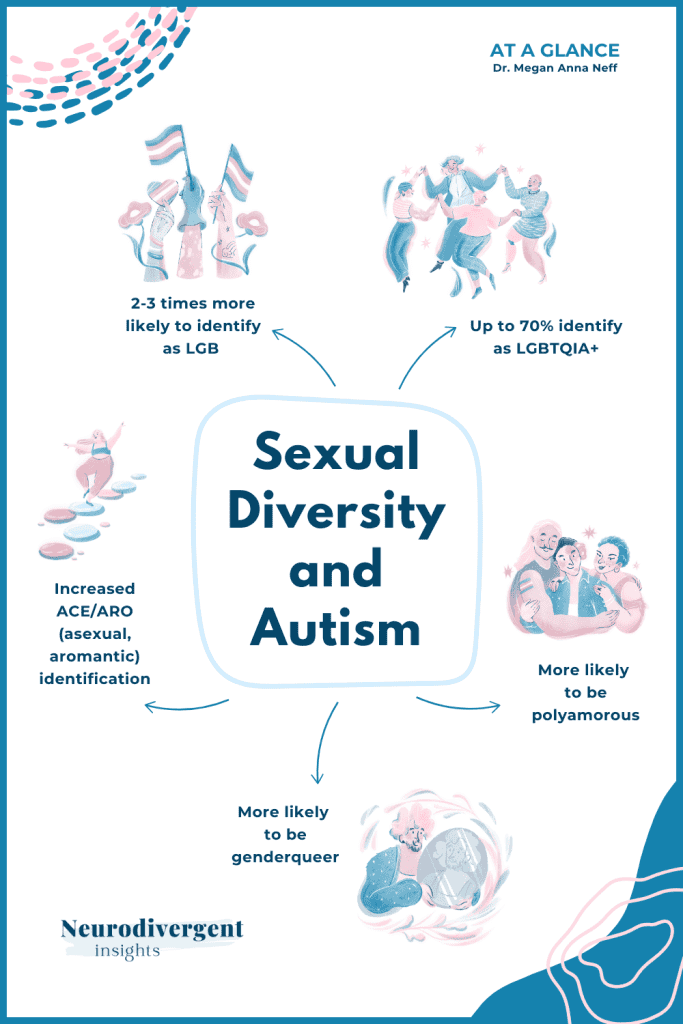
ADHDers and Autistic people are more likely than neurotypical people to be gender expansive or to identify as LGBTQ+.
Gender Diversity
Autistic and ADHD people are more likely than neurotypical people to be gender expansive, and gender-expansive people are more likely to be ADHDers or Autistic. Transgender and gender-diverse people are 3 to 6 times more likely to be Autistic. In one study of children and teens, parents reported a wish to be another gender 7.59 times more often among Autistic kids and 6.64 times more often among ADHD kids.
Sexual Diversity
Similar patterns show up for sexual identity. Research suggests Autistic people, especially Autistic women, are more likely than non-autistic people to identify as LGBTQ+ (see also this study).
Neurominority
Both groups have similar experiences as they navigate the world as neurominorities. This means that the systems they navigate, such as school, work, and healthcare, are not built with them in mind, and they often experience various barriers in accessing these systems. These experiences as neurominorities contribute to stress and can be compounded by other intersecting identities the person has.
Is It Autism or ADHD? How to Spot the Difference
Given the overlap and possibility that the person has both ADHD and Autistic traits, it can be difficult to pick out which is which. Here are some considerations to take into account when diagnosing a suspected ADHD/Autistic client.
For a more in depth overview of this information, consider checking out our Autism vs. ADHD E-book.
Social Differences
To differentiate Criteria A of Autism (social difficulties), it’s essential to understand the nature of these difficulties, as the social challenges in both conditions can appear similar. Here are some things to consider:
Underlying Mechanisms
ADHD: Difficulty socializing is often connected to impulsivity and inattention (Sokolova et al., 2017). ADHDers can read social cues when they are able to focus.
Autism: Social challenges are linked to difficulty interpreting allistic social cues. Autistic people often have inherent difficulty with this, relying more on their prefrontal cortex and analytical skills to navigate social interactions.
Key Questions to Ask
Is the difficulty in socializing due to trouble focusing, or is the person relying on analytical skills to interpret social cues?
If you’re unsure, consider administering the Camouflaging Autistic Traits Questionnaire (CAT-Q) and be sure to ask about masking.
Social Motivation
On average, ADHDers tend to have more social motivation than Autistic people.
Assess How the Person Navigates Disruptions to Routine
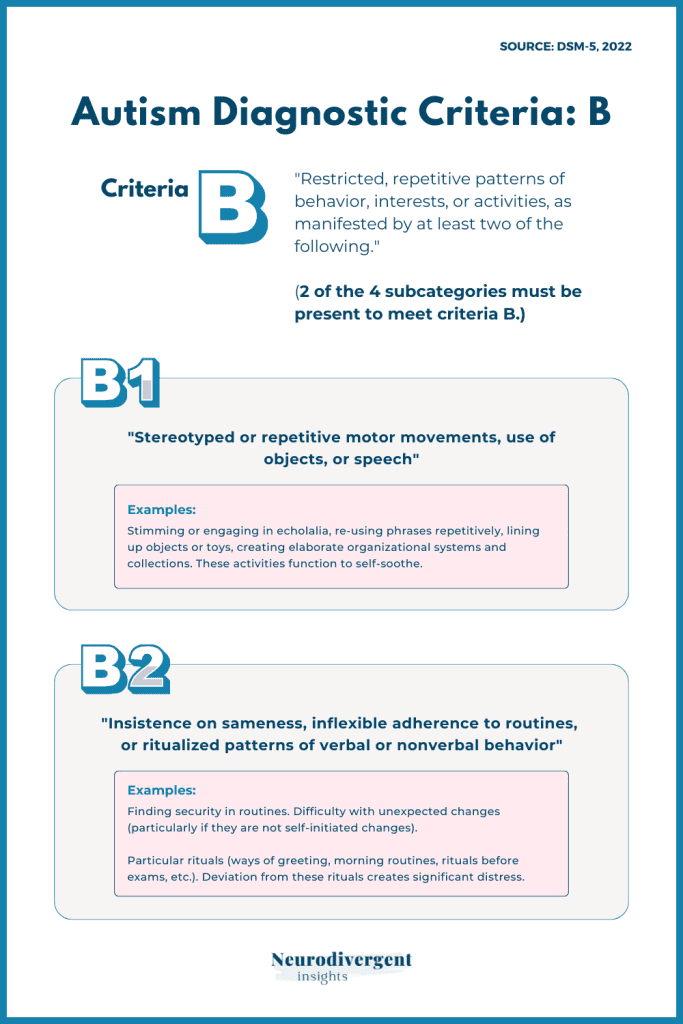
Many of the items in Criteria B for Autism can resemble ADHD traits, such as sensory sensitivities, special interests (which can look like hyper-fixation), and repetitive movements (which can look like hyperactivity). One key factor distinguishing Autism from ADHD is how the person adapts to change (Criteria B, item 2).
To understand this better, consider observing how a person copes with unexpected alterations to their routine. It’s essential to differentiate between self-initiated changes (where the person decides to modify their own routine) versus externally imposed changes (those that are unexpected or forced upon them).
For Autistic people, unanticipated alterations stemming from external sources often lead to intense emotional responses, including heightened irritability, anxiety, and stress. Therefore, gauging a person’s response to disruptions can provide valuable insight into their unique neurodivergent profile.
Repetitive Behaviors vs. Hyperactive
Repetitive behaviors can sometimes be mistaken for hyperactivity. Differentiating between the two requires an understanding of the underlying function and the person’s internal experience (Sokolova et al., 2017).
Understanding the Differences
Repetitive Behaviors (Autism):
Function: Often serve as a way to self-soothe, regulate sensory input, or cope with anxiety.
Examples: Hand flapping, rocking, swaying, pacing, spinning objects, or repeating phrases.
Internal Experience: These behaviors provide comfort and a sense of control, especially in overwhelming or unfamiliar situations. They are typically consistent and predictable.
Hyperactivity (ADHD):
Function: Often a manifestation of an overactive nervous system, an inability to stay still, or the need to release excess energy.
Examples: Fidgeting, tapping, running around, or interrupting conversations.
Internal Experience: These behaviors are driven by a need for stimulation and are usually more impulsive and less predictable.
Key Questions to Ask
Purpose of the Behavior:
Does the behavior seem to help the individual calm down and focus (more indicative of repetitive behaviors)?
Or does it seem to be a spontaneous, uncontrolled release of energy (more indicative of hyperactivity)?
Context of the Behavior:
Does the behavior occur in response to specific triggers, such as stress or sensory overload (repetitive behaviors)?
Or does it happen more consistently across various situations without clear triggers (hyperactivity)?
Duration and Consistency:
Are the behaviors more consistent and ritualistic, happening in a specific and repetitive manner (repetitive behaviors)?
Or are they more sporadic and variable, often changing in form and frequency (hyperactivity)?
Interview Tips
Ask Direct Questions: Inquire about the person’s experience and the reasons behind their behaviors. For example, “Do you find that doing this helps you feel calmer?” or “Do you do this because you feel like you have too much energy?”
By understanding the subjective experience and underlying motivation, you can better distinguish between repetitive behaviors and hyperactivity.
Rule out ADHD and Autism
When conducting assessments for either ADHD or Autism, it is essential to include routine screeners for both conditions. Autism screeners are often overlooked in ADHD assessments, despite the substantial overlap between Autism and ADHD. When I did ADHD assessments, I always included:
Autism-Spectrum Quotient (AQ)
Ritvo Autism Asperger Diagnostic Scale (RAADS)
Camouflaging Autistic Traits Questionnaire (CAT-Q)
Screening for both helps catch Autistic traits that an ADHD-only assessment can miss.
Similarly, when conducting an Autism assessment, routinely including ADHD screeners like the Adult ADHD Self-Report Scale (ASRS-5) ensures that both conditions are being considered.
ADHD and Autism Screeners
Autism Screeners
To learn more about these screeners and to access them in one place, check out this roundup of autism screeners. Here are the ones I used:
Autism Spectrum Quotient (AQ): A measure of autistic traits in adults.
Aspie Quiz: A self-assessment tool designed to identify autistic traits.
Alexithymia Questionnaire: Although not technically an autism screener, this questionnaire assesses alexithymia, which is common among Autistics.
Ritvo Autism Asperger Diagnostic Scale-Revised (RAADS-R): A self-report questionnaire designed to identify adult Autistics who may “escape diagnosis” due to a subclinical level presentation.
Adult Repetitive Behaviors Questionnaire-2 (RBQ-2A): A self-administered questionnaire that measures restricted and repetitive behaviors in adults.
Camouflaging Autistic Traits Questionnaire (CAT-Q): A self-report measure of social camouflaging behaviors in adults. It may be used to identify Autistic people who do not currently meet diagnostic criteria due to their ability to mask their autistic traits.
ADHD Screeners
For ADHD, see this roundup of ADHD screeners.
ADHD v Autism FAQs
What is the difference between ADHD and autism?
ADHD and autism are both classified as neurodevelopmental conditions, often referred to in the community simply as “neurotypes.” While they do share some surface-level similarities, they have different underlying mechanisms. ADHD is essentially a difference in how arousal and attention are regulated, which can show up as attentional differences, hyperactivity and impulsivity and executive functioning challenges. Autism is characterized by a monotropic brain style (attention that funnels deeply into fewer channels) and sensory processing differences which can show up as social-communication challenges (difficulty with small talk, group conversation and back and forth flow). Autistic people regulate through repetition, routine and deep interests and our neurology struggles with unexpected changes. The confusing part is how much surface overlap exists, for example executive functioning struggles, sensory differences, difficulties with school or work, emotional intensity, and social difficulty show up in both.
Can you have both ADHD and autism?
Yes. Before the DSM-5 came out in 2013, clinicians had to choose one diagnosis or the other, which means the research and clinicians are still catching up. It also means many people may have been diagnosed with one but not the other. Both can now be diagnosed together, and while the prevalence rates are hard to nail down, it appears to be relatively common for both to occur within the same person. The community shorthand for the combination is AuDHD.
How much do ADHD and autism overlap?
Substantially. Studies estimate that 22 to 83 percent of Autistic children also meet criteria for ADHD, and 30 to 65 percent of ADHD children show significant Autistic traits. Twin, family and DNA studies show the two share a large part of their genetic roots. Those ranges are wide because the research is still young, so we want to hold the exact numbers loosely. We break the numbers down further in our deep dive on the ADHD and autism overlap.
Is it stimming or ADHD hyperactivity?
These two behaviors can look very similar; to tease them apart it’s helpful to ask what the movement is doing for you. Stimming tends to soothe and regulate sensory input, and it’s often consistent and rhythmic (for example rocking, hand-flapping, pacing, listening to the same song on repeat). ADHD hyperactive movement tends to discharge excess energy, and it’s more spontaneous and less repetitive: fidgeting, tapping, shifting. The same behavior can serve either function (or both, if you’re AuDHD), so the function, not the movement itself, is the useful thing to pay attention to.
What's the difference between ADHD hyperfocus and an Autistic special interest?
Both involve losing hours to something you love, but one describes an action, the other a way of being oriented in the world. ADHD runs on an interest-based nervous system: hyperfocus locks onto whatever is novel, urgent, or interesting right now, and may burn through it quickly. Hyperfocus is the activity. The monotropic Autistic brain tends to go deep on a smaller number of interests and stay there, sometimes for years (monotropism describes the architecture of the brain). If you have both, you get to experience both, and they often overlap and layer. We map this distinction in more detail in our article on special interests vs. hyperfixated interests.
Can ADHD be mistaken for autism, or autism for ADHD?
Yes, sometimes, or kind of. While a full misdiagnosis of ADHD being mistaken for autism or autism for ADHD is likely rare, it is common (when both are present) to experience something called diagnostic overshadowing. This is when the traits of the undiagnosed condition get attributed to the already-diagnosed one, so the second is missed. This is especially common in adults, women, and anyone who masks. Because the surface traits overlap so heavily, a clinician who only screens for one condition can find it and stop looking. This is one reason assessments ideally screen for both: either one can hide the other.
How can you tell whether social difficulties come from ADHD or autism?
It is helpful to look at the mechanism. ADHDers typically can read social cues but miss them through inattention or talk over them through impulsivity; when they’re focused, the cues land. For Autistic people, interpreting neurotypical social and context cues doesn’t come automatically, so many rely on deliberate, analytical processing instead.
Is there a test for ADHD and autism?
There are screeners, which are a useful starting point but not a diagnosis. For autism, the AQ, RAADS-R, and CAT-Q (which measures masking) are commonly used; ADHD has its own set of rating scales. A high score is a reason to pursue a full assessment with someone experienced in both conditions, since each one can mask the other.
Additional Resources
If you’ve read this far, you’re likely either an adult exploring the possibility of Autism, ADHD, or both, or a clinician looking to expand your knowledge. If so, welcome to my digital ecosystem. Understanding Autism, ADHD, and non-stereotypical presentations, as well as neurodivergent wellness, is a special interest of mine. If you’re just starting out, it can be hard to know where to dive in. Here are some resources for future learning.
This post contains affiliate links. If you buy through them, we may earn a small commission at no extra cost to you. We only link to things we use or trust.

Books for Assessment: Is This Autism?, Is This Autism? A Companion Guide for Diagnosing, The Adult Autism Assessment Handbook and Assessment of Autism in Females and Nuanced Presentations: Integrating Research into Practice. For clinicians working with ADHD/Autism you can check out my book recommendations for Neurodivergent Clinicians.

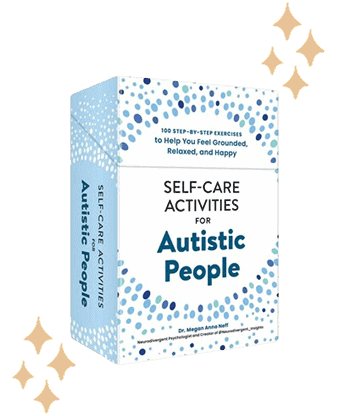
Books for Neurodivergent Adults: Autism reads: Divergent Minds, Self-Care for Autistic People, Is This Autism?, Unmasking Autism and Neurotribes. ADHD focused: How to ADHD, Self-Care for People with ADHD, How to Keep House While Drowning: A Gentle Approach to Cleaning and Organizing and Outside the Box.

Podcasts: Divergent Conversations (I co-host this podcast with a fellow auDHD mental health therapist), The Neurodivergent Women Podcast and The Squarepeg Podcast.
 Stay in the Neurodivergent Loop
For ongoing insights and updates, subscribe to the Neurodivergent Insights Newsletter. Each Sunday, I send out fresh thoughts and a roundup of the newest resources on topics related to neurodivergence, mental health, and wellness. My most personal writing is reserved for my newsletter, and subscribers also get access to the newsletter vault (12+ PDFs) when they join.
References
*Footnote: Interoception and ADHD have more mixed results: Kutscheidt et al. found impairment of interoception among ADHDers, Wiersema and Godefroid, 2018 found interoception remained intact in the context of ADHD)
*The Blind community has requested that the ADHD community refrain from using the term “time blindness.” Some suggested alternatives include: time agnosia or time perception challenges
Almeida Montes, L. G., Hernández García, A. O., & Ricardo-Garcell, J. (2007). ADHD Prevalence Adult Outpatients With Nonpsychotic Psychiatric Illnesses. Journal of Attention Disorders, 11(2), 150–156. https://doi.org/10.1177/1087054707304428
Biederman, J.; Ball, S.W.; Monuteaux, M.C.; Surman, C.B. MD; Johnson, J.L; Zeitlin, S (2007). Are Girls with ADHD at Risk for Eating Disorders? Results from a Controlled, Five-Year Prospective Study. Journal of Developmental & Behavioral Pediatrics. 28(4). https://doi.org/10.1097/DBP.0b013e3180327917
Bleck, J.R., DeBate, R.D. & Olivardia, R. The Comorbidity of ADHD and Eating Disorders in a Nationally Representative Sample. J Behav Health Serv Res 42, 437–451 (2015). https://doi.org/10.1007/s11414-014-9422-y
Butwicka, A., Långström, N., Larsson, H. et al. Increased Risk for Substance Use-Related Problems in Autism Spectrum Disorders: A Population-Based Cohort Study. J Autism Dev Disord 47, 80–89 (2017). https://doi.org/10.1007/s10803-016-2914-2
Dewinter, J., De Graaf, H., & Begeer, S. (2017). Sexual Orientation, Gender Identity, and Romantic Relationships in Adolescents and Adults with Autism Spectrum Disorder. Journal of autism and developmental disorders, 47(9), 2927–2934. https://doi.org/10.1007/s10803-017-3199-9
George, R., & Stokes, M. A. (2018). Gender identity and sexual orientation in autism spectrum disorder. Autism : the international journal of research and practice, 22(8), 970–982. https://doi.org/10.1177/1362361317714587
Hinshaw SP, Owens EB, Zalecki C, Huggins SP, Montenegro-Nevado AJ, Schrodek E, Swanson EN: Prospective follow-up of girls with attention-deficit/hyperactivity disorder into early adulthood: continuing impairment includes elevated risk for suicide attempts and self-injury. J Consult Clin Psychol. 2012, 80: 1041-1051.
Humphrey JL, Storch EA, Geffken GR. Peer victimization in children with attention-deficit hyperactivity disorder. J Child Health Care. 2007 Sep;11(3):248-60. doi: 10.1177/1367493507079571. PMID: 17709359.
Hurtig T, Taanila A, Moilanen I, Nordström T, Ebeling H: Suicidal and self-harm behaviour associated with adolescent attention deficit hyperactivity disorder-A study in the Northern Finland Birth Cohort 1986. Nord J Psychiat. 2012, 66: 320-328. 10.3109/08039488.2011.644806.
Kutscheidt, K., Dresler, T., Hudak, J. et al. Interoceptive awareness in patients with attention-deficit/hyperactivity disorder (ADHD). ADHD Atten Def Hyp Disord 11, 395–401 (2019). https://doi.org/10.1007/s12402-019-00299-3
Leitner Y. (2014). The co-occurrence of autism and attention deficit hyperactivity disorder in children – what do we know?. Frontiers in human neuroscience, 8, 268. https://doi.org/10.3389/fnhum.2014.00268
Lever, A. G., & Geurts, H. M. (2016). Psychiatric Co-occurring Symptoms and Disorders in Young, Middle-Aged, and Older Adults with Autism Spectrum Disorder. Journal of autism and developmental disorders, 46(6), 1916–1930. https://doi.org/10.1007/s10803-016-2722-8
McIntosh, D., Kutcher, S., Binder, C., Levitt, A., Fallu, A., & Rosenbluth, M. (2009). Adult ADHD and comorbid depression: A consensus-derived diagnostic algorithm for ADHD. Neuropsychiatric disease and treatment, 5, 137–150. https://doi.org/10.2147/ndt.s4720
Papadopoulos, A., Seguin, D., Correa, S. et al. Peer victimization and the association with hippocampal development and working memory in children with ADHD and typically-developing children. Sci Rep 11, 16411 (2021). https://doi.org/10.1038/s41598-021-95582-7
Sokolova, E. ., Sluiter-Oerlemans, A. ., Rommelse, N. N. ., Groot, P., Hartman, C. ., Glennon, J. ., Claassen, T., Heskes, T., & Buitelaar, J. . (2017). A Causal and Mediation Analysis of the Comorbidity Between Attention Deficit Hyperactivity Disorder (ADHD) and Autism Spectrum Disorder (ASD). Journal of Autism and Developmental Disorders, 47(6), 1595–1604. https://doi.org/10.1007/s10803-017-3083-7
Smith, B. H., Molina, B., & Pelham, W. E., Jr. (2002). The Clinically Meaningful Link Between Alcohol Use and Attention Deficit Hyperactivity Disorder. Alcohol Research & Health, 26(2), 122–129.
Strang, J. F. et al. Increased gender variance in autism spectrum disorders and attention deficit hyperactivity disorder. Arch. Sex. Behav.43, 1525–1533 (2014). DOI: https://pubmed.ncbi.nlm.nih.gov/24619651/
Szalavitz, Maia (2017). Autism’s hidden habit. Spectrum Deep Dive. Retrieved at: https://www.spectrumnews.org/features/deep-dive/autisms-hidden-habit/
Taurines, R., Schwenck, C., Westerwald, E. et al. ADHD and autism: differential diagnosis or overlapping traits? A selective review. ADHD Atten Def Hyp Disord 4, 115–139 (2012). https://doi.org/10.1007/s12402-012-0086-2
Wiersema JR, Godefroid E (2018) Interoceptive awareness in attention deficit hyperactivity disorder. PLoS ONE 13(10): e0205221. https://doi.org/10.1371/journal. pone.0205221
Westwood, H., Tchanturia, K. Autism Spectrum Disorder in Anorexia Nervosa: An Updated Literature Review. Curr Psychiatry Rep 19, 41 (2017). https://doi.org/10.1007/s11920-017-0791-9
Vicario, C. M., Nitsche, M. A., Salehinejad, M. A., Avanzino, L., & Martino, G. (2020). Time processing, interoception, and insula activation: a mini-review on clinical disorders. Frontiers in Psychology, 11, 1893.