If you’re reading this, chances are you or someone you care about is dealing with Autistic burnout and wondering how to start the process of Autistic burnout recovery. Trust me; I’ve been there. I know what a grueling road this can be. As an Autistic person, I understand burnout from personal experience. As a Psychologist, I understand the toll it can take on a person’s mental health and well-being. Burnout often comes after years of over-functioning and over-straining our bodies, so recovery doesn’t happen overnight.
With planning, intentionality, self-care, and creative thinking, we can create a more sustainable life for ourselves. When I think of Autistic burnout recovery, I think of it in two phases:
1) Recovering from the immediate burnout
2) Building a life that reduces the risk of future burnout episodes
What is Autistic Burnout?
Autistic burnout is a state of physical, emotional, and mental exhaustion. Autistic burnout is distinct from other forms of burnout and is characterized by the following three characteristics:
Chronic exhaustion
Pervasive physical, cognitive and social fatigue
Reduced tolerance to stimulus
Noise, light, and social contact become harder to tolerate or tune out.
Loss of skills
Many of our executive functioning skills will worsen during burnout. We may struggle with speaking, attention, regulating attention, and other cognitive functions.
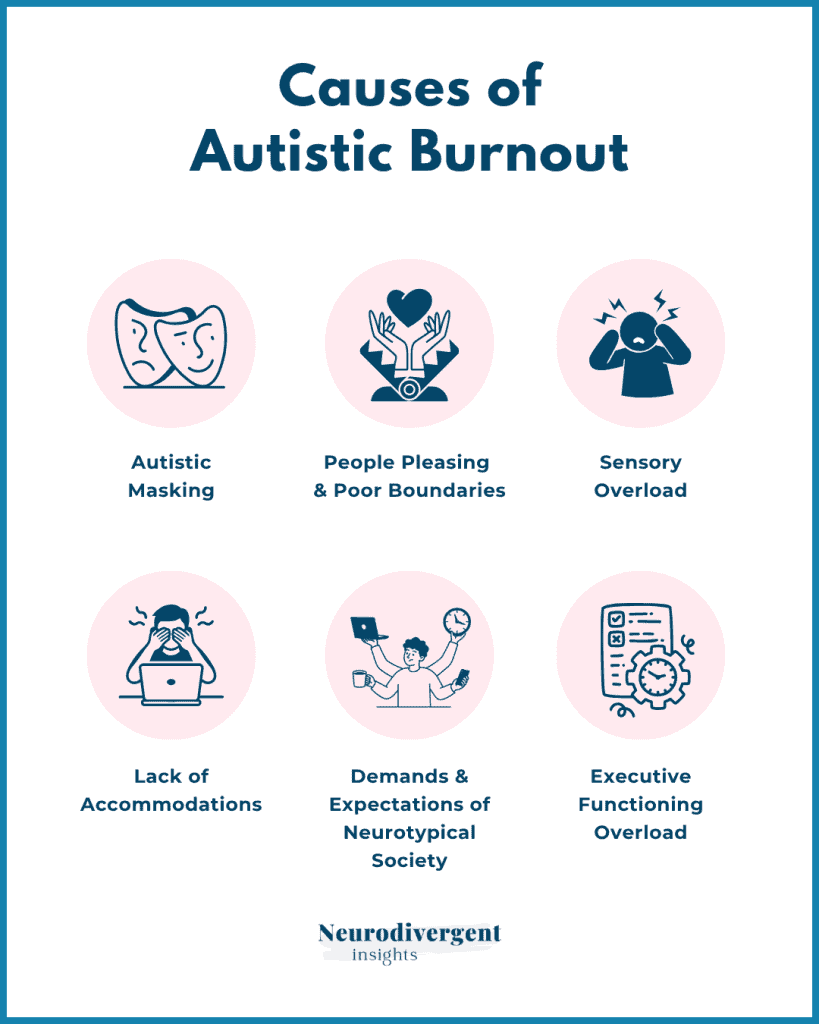
Causes of Autistic Burnout
Some common causes of Autistic burnout include:
1
Masking
Constantly monitoring and adjusting how we come across takes enormous energy, and over time it drains our reserves.
2
People-pleasing and poor boundaries
Saying yes when we need to say no keeps us running past our limits.
3
Sensory overload
Autistic people are often more sensitive to sensory stimuli, such as loud noises or bright lights. Prolonged periods of sensory overload can tax our nervous system, reducing our capacity and increasing the likelihood of burnout.
4
Lack of support and accommodations
Many Autistic people face barriers to receiving a formal diagnosis and obtaining accommodations, leading to a lack of support and contributing to feelings of overwhelm and burnout.
5
Demands and expectations of a neurotypical world
Autistic people often experience daily activities as more stressful than non-autistic people. Routine disruptions, allistic social rules, and the demands of work and school can be exhausting, and following those rules often comes at a high cognitive cost. We may also struggle to advocate for our needs at school or work, which adds to the frustration and exhaustion.
6
Executive functioning overload
After prolonged periods of having our executive functioning taxed, many of us can experience burnout and loss of executive functioning skills.
Burnout usually comes from a mix of these, and the mix is different for each of us. Knowing your specific causes helps you plan for recovery and prevention. I go deeper in What Causes Autistic Burnout.
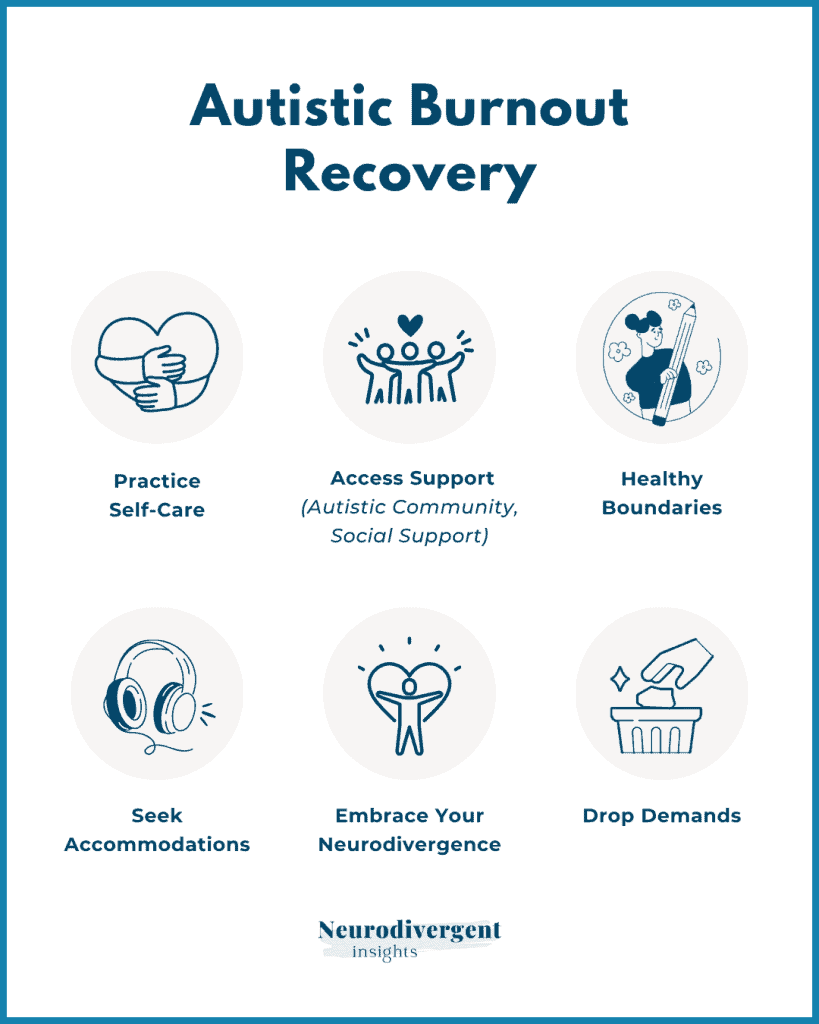
Autistic Burnout Recovery
This is the part of the article where I wish I could offer you an “easy three-step process” to GUARANTEE your burnout recovery in six weeks. But I can’t do that. There are no quick fixes. If you’ve spent the last several years over-compensating, ignoring your sensory needs, and over-functioning, burnout recovery will not happen overnight. One of the hardest parts about Autistic burnout recovery is patience. We need gentleness and patience with ourselves (and the process).
Reconsider "Normal"
Autistic burnout is not something we can easily “bounce back” from. The idea of bouncing back implies that our burnout is a temporary situation, and once we recover, we return to our normal lives. However, for many Autistic people, it is the demands and challenges of their normal lives that contribute to burnout. Recovering from Autistic burnout often requires a significant overhaul of one’s life, including reevaluating one’s values and creating a more sustainable way of living.
Immediate Recovery
Immediate recovery involves practices that help you regain energy from the immediate burnout cycle you find yourself in. This involves incorporating things like rest, reducing sensory input, self-care, creating healthy boundaries, and nourishing practices. Recovery can take all shapes and sizes. For some, it will look like significant time resting and sleeping. For others, it may involve eating the same foods repeatedly. Or it may look like spending time with your special interests.
Sustained Recovery
The second phase is sustained recovery. This often involves a more systemic and structural look at your life. Deep recovery involves addressing patterns and parts of us that are more deeply baked in. This often involves structural and personality changes (things like breaking out of perpetual people-pleasing, reconsidering our relationship to food, alcohol, health, movement, sleep, work, and your sensory environment).
Autistic Burnout Recovery Tips
Several of the tips come directly from Autistic people who were interviewed for Dora Raymaker and colleagues’ 2020 study on Autistic burnout. And then I’ve included several of my own tips. That’s a lot, so don’t try them all at once. I encourage you to consider implementing the ones you are drawn to and leave the rest. When building a burnout recovery plan, sometimes less is more!
What Autistic Adults Say Helps
In Raymaker’s interviews, Autistic adults identified the following themes as helpful in their burnout recovery.
Acceptance and Access to Social Support
Accessing individual and community support, peer support, attending to Autistic needs, and time spent unmasking. Advocating for and receiving reasonable accommodations.
Leaning into Autistic Strengths
Drawing on Autistic strengths and special interests.
Formal Supports
Mental health supports, time off, breaks, and the ability to socially withdraw.
Reducing Load
Reducing activities, setting boundaries, and asking for help.
Self-Advocacy and Health
Focusing on a healthy lifestyle, receiving an Autism diagnosis.
Self-Knowledge
Understanding patterns and triggers and making strategic decisions to be preventative.
Engagement with the Autistic Community
Engagement with the Autistic community can help a person name and validate their experience of burnout
Dr. Neff's Burnout Recovery Tips
Here are my recommended practices to support your recovery process:
- Practice boundaries and drop unnecessary demands
Protect your time and energy by saying no to non-essential activities or commitments. It’s important to prioritize your own well-being and not take on too much. - Find alternative ways to express yourself.
Many Autistic people have other ways of expressing emotions. Writing, art, making a collage, writing a poem, or finding music that matches your mood are just a few examples of alternative ways of expressing yourself. - Don’t let the routine go.
In burnout, we’re tempted to let the routine go altogether. However, routines are soothing to our nervous systems because they tell us what to expect. It doesn’t have to be rigorous, but it will be helpful to have a few anchor points during the day. - Engage in activities that are soothing to your senses
Find gentle and soothing ways to move your body. - Spend time in nature
Nature is particularly restorative for Autistic people. If you have access, take time to go and sit by a lake, the ocean, or a beautiful meadow, or simply listen to nature sounds. - Seek support
Don’t be afraid to talk to someone about how you’re feeling. This could be a therapist, counselor, or someone you trust in the Autistic community.
Building Your Personal Autistic Burnout Recovery Plan
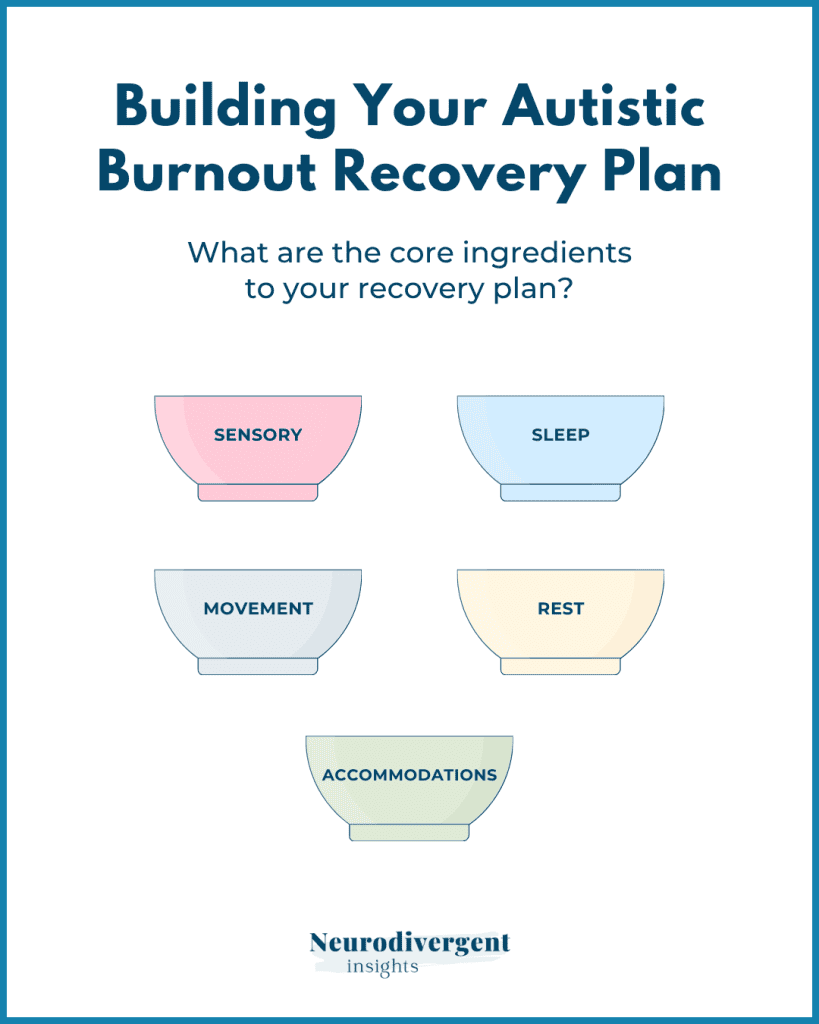
When building your recovery plan, it is helpful to think about the core ingredients. Remember that every person will have different core ingredients to their recovery plan. The following paragraphs consider some ingredients or pillars that may be a part of your recovery plan.
Sensory
Where can you reduce your sensory load? Are there light fixtures you can swap out? Can you create a sensory detox space in your home? Are you using weighted blankets, noise blockers, or compression clothing? Can you remove irritants (perfumes, chemical smells, bright lights) from your primary residence? These things may sound small, but they add up!
Given that our sensory system is on high alert during burnout, finding ways to block unnecessary sensory input can go a long way.
Many of us learned to “power through” sensory discomfort, sometimes so well we stopped noticing it and became disconnected from our bodies. However, these irritants contribute to burnout and benefit from being addressed.
Sleep
Vital Behaviors
Vital behaviors are activities that bring you joy and energize you. These are likely related to your special interests, or they might be related to repetitive physical movements that feel soothing to you (swinging, rhythmic dancing, skating, rocking, etc.). Be sure to create space for activities that restore and energize you.
Movement
Finding movement that feels enjoyable, pleasurable, and restorative is vital. This may involve repetitive movement or movement that provides proprioceptive input (like swinging, weightlifting, or more). Just keep in mind that your body is recovering, so you want to be gentle with your movement routine.
Drop Demands
Do a “demand inventory” of your life and consider if there are any non-essential demands you can drop for a while. If you regularly cook, can you do more microwave foods, takeout, or meal delivery subscriptions for a while? Can you develop a uniform you wear every day/week and drop the demand of needing to pick out your clothing? Are there work demands or parenting demands you can drop? If you are a parent, consider ways of supporting your children by dropping some daily demands for them, from bringing them water to tying their shoes for them.
Rest
I can’t emphasize this one enough: Prioritizing rest is vital for your recovery. Autistic burnout is a physical response to your body, mind, and nervous system being perpetually overloaded. You need rest and lots of it! This may look like focusing on your sleep, napping, or spending time with your special interest. Try to focus on rest that feels restorative. Binge-watching TV may feel restful but likely not restorative. Consider reading or listening to a book related to a special interest or engaging in activities you experience as soothing to your sensory system.
Accommodations
Now is the time to take a serious look at what accommodations are in place and what could be added. If you are working on setting up work accommodations, JAN is a great resource (note: scroll to the bottom of their page and click through to see ideas of accommodations you can ask for).
For many people, the first step in accessing accommodations is to figure out what your body needs. Spend time scanning your environment and considering what the irritants are and what would support you. If you struggle to know what you need because of interoception issues, consider starting with activities that increase interoceptive awareness.
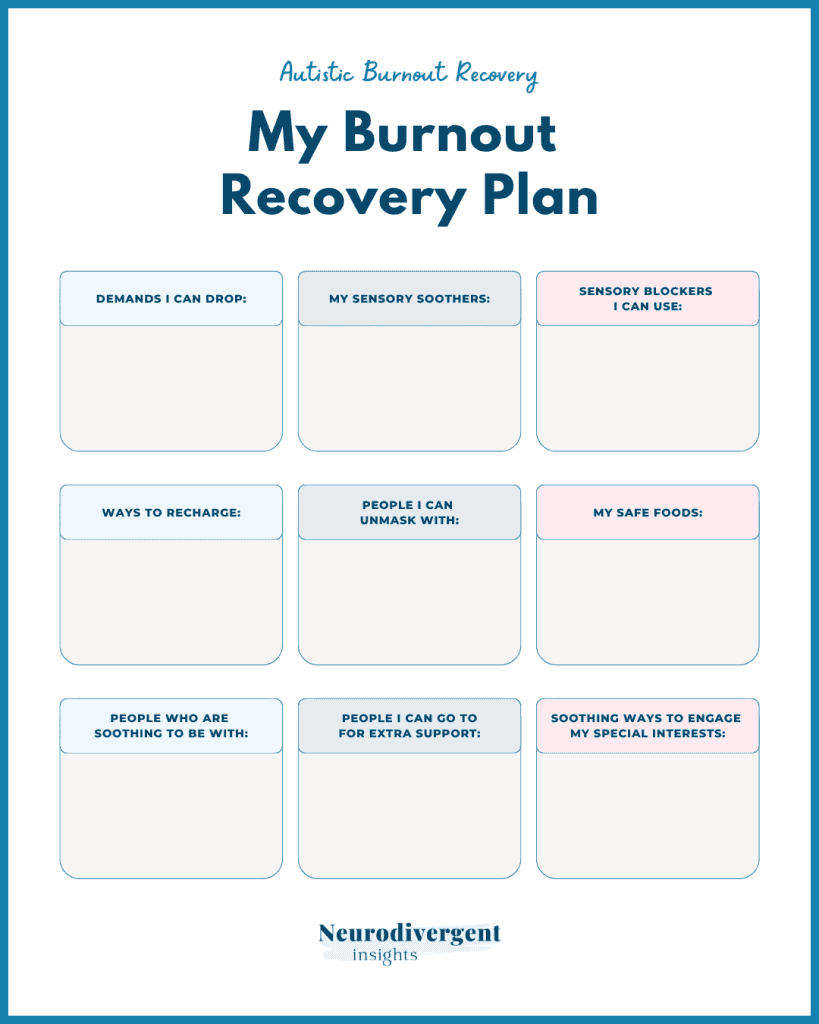
Creating a Recovery Plan: Bringing it All Together
On a piece of paper, write down your core ingredients or pillars that feed into your recovery plan. Then, create action steps and small goals under each of these pillars.
For example, under “Rest,” you may write, “focus on going to bed every night by 10 pm” or “talk to my doctor about medication support for sleep.”
Under “Drop Demands,” take note of any demands you can possibly drop and how you will do that, and so on.
You can find fillable worksheets to help build an Autistic burnout recovery plan in the Autistic Burnout Workbook, or you can simply do this on a plain piece of paper.
Preventing Autistic Burnout
A final word about Autistic burnout recovery: preventing Autistic burnout is the best strategy. Self-knowledge is key for this: knowing your triggers and identifying early signs of burnout. For some people, early signs will include increased sensitivity to sensory input; for others, it will be depersonalization and detachment.
Being able to identify early signs of burnout can help inform you that it’s time to remove yourself from the situation and arrange some sensory downtime. Self-knowledge can also help you to plan travel, trips, and daily rhythms in such a way that builds in sensory detox/downtime.
Deep Recovery
What I refer to as “Deep Recovery” is the deep psychological work involved in unmasking and learning to relate to the world differently. Masking gets baked into our psyches and is deeper than simply mimicking scripts and body postures. This can result in becoming a perpetual people-pleaser. Masking and people-pleasing make it hard to maintain healthy boundaries, and we often run ourselves ragged, hustling for worth. These deeper issues often have to be addressed when we set out to build a more sustainable life.
And so if you are a high-masking Autistic person or recovering from late-in-life Autistic burnout, you may need more than rest and added accommodations. You may need to restructure your identity as you incorporate your neurodivergent identity. For many, it is not until burnout that we discover our autism. And so your burnout may be the first time you recognize that your life simply isn’t working. You may discover you are driving yourself into the ground trying to function in an allistic world, and it’s not working.
If this is your experience, your recovery may also include 1) addressing internalized ableism and 2) creating space for grief.
Addressing Internalized Ableism
Internalized ableism refers to our beliefs and prejudices that come from living in an ableist society. These beliefs often form our expectations about ourselves. For example, “I should be able to work a 40-hour work week” or “I shouldn’t need accommodations.”
Our internalized ableism drives many of our unrealistic expectations of ourselves. We are holding ourselves to an allistic “normal” while not honoring our unique sensory, communication, and bodily needs. We will continue to run ourselves ragged until we address our ableism (and expectations)!
Internalized ableism often drives people-pleasing tendencies, which can make it difficult to create and maintain healthy boundaries. If we perpetually define our identity based on how pleased others are with us, we will remain stuck in the frantic loop of over-performing and burnout. There are many ways to engage in this depth work: reading, journaling, writing, connecting with other Autistic people, processing with trusted others, or working with a therapist or coach.
Autistic Burnout Recovery Involves Grief Work
Grief work goes hand in hand with addressing internalized ableism. As we address our ableism, we also encounter our limits. It’s okay to grieve your limits. In order to accept new ones, you need to grieve what you are losing.
To accept our limits, we have to grieve the idea of ourselves we are releasing. After my Autistic discovery, I realized my chronic fatigue symptoms would never magically disappear. I realized I would always live in a body that needed more rest and was limited by its sensory needs. I grieved what this meant for me. The careers I would no longer be pursuing, and the ways this limited my social world and my role as a parent.
I needed to grieve the image I had of myself to embrace who I was.
Summary: Autistic Burnout Recovery
Autistic burnout recovery is slow, and it rarely follows a straight line. Start with one or two ingredients from your plan, and add more as your energy returns.
For many of us, burnout is also a signal that something in how we’ve been living needs to change. Making room for grief and gently questioning old expectations can be part of recovery too.
Autistic Burnout Recovery FAQs
Additional Resources
This post contains affiliate links. If you buy through them, we may earn a small commission at no extra cost to you. We only link to things we use or trust.
For ongoing insights and updates, subscribe to the Neurodivergent Insights Newsletter. Each Sunday, I send out fresh thoughts and a roundup of the newest resources on topics related to neurodivergence, mental health, and wellness. My most personal writing is reserved for my newsletter, and subscribers also get access to the newsletter vault (12+ PDFs) when they join.
References
Raymaker, D. M., Teo, A. R., Steckler, N. A., Lentz, B., Scharer, M., Delos Santos, A., Kapp, S. K., Hunter, M., Joyce, A., & Nicolaidis, C. (2020). “Having all of your internal resources exhausted beyond measure and being left with no clean-up crew”: Defining autistic burnout. Autism in Adulthood, 2(2), 132–143. https://doi.org/10.1089/aut.2019.0079






 Stay in the Neurodivergent Loop