The mental health world can feel overly mysterious, which adds anxiety and stress for many of us. I believe the diagnostic process should be as understandable as possible. Like many neurodivergent people, unless a thing is visual, I have a hard time understanding it, so this post walks through the DSM-5 criteria for autism in pictures. (The ADHD criteria get the same treatment here.)
This is for education only. It isn’t a substitute for medical advice or meant to be used as a diagnostic tool.
A word on language. I use direct language from the DSM. Much of that language is deficit-based and pathologizing. It doesn’t mean I agree with all the wording (in fact, I don’t!). I include it so you can see what is actually in the manual. Where the DSM says “deficits,” I’ve put “differences” next to it.
What do A, B, C (and so on) mean? The DSM groups criteria into lettered buckets. A person doesn’t need every trait listed under each one, but every lettered criterion (A through E) needs to be met for an autism diagnosis.
What about people outside the US? The DSM-5 is published by the American Psychiatric Association. Its autism criteria are broadly similar to the ICD-11, which many countries use. The 2022 text revision (DSM-5-TR) made one clarifying change: Criterion A now reads “as manifested by all of the following,” which makes clear that all three parts are required.
Table of Contents
What Are the DSM-5 Criteria for Autism?
To meet the criteria for autism, five buckets of diagnostic criteria must be met (A through E). The ones we spend the most time with are Criteria A and B. Criterion A broadly speaks to social, communication, and relationship differences, while Criterion B speaks to routine, structure, repetition, special interests, and sensory differences. The other criteria help differentiate autism from other conditions.
Both A and B can be met “currently or by history.” Traits that were clearer earlier in life still count, which matters for adults, especially those of us who learned to mask.
Criterion A: Social Communication and Interaction
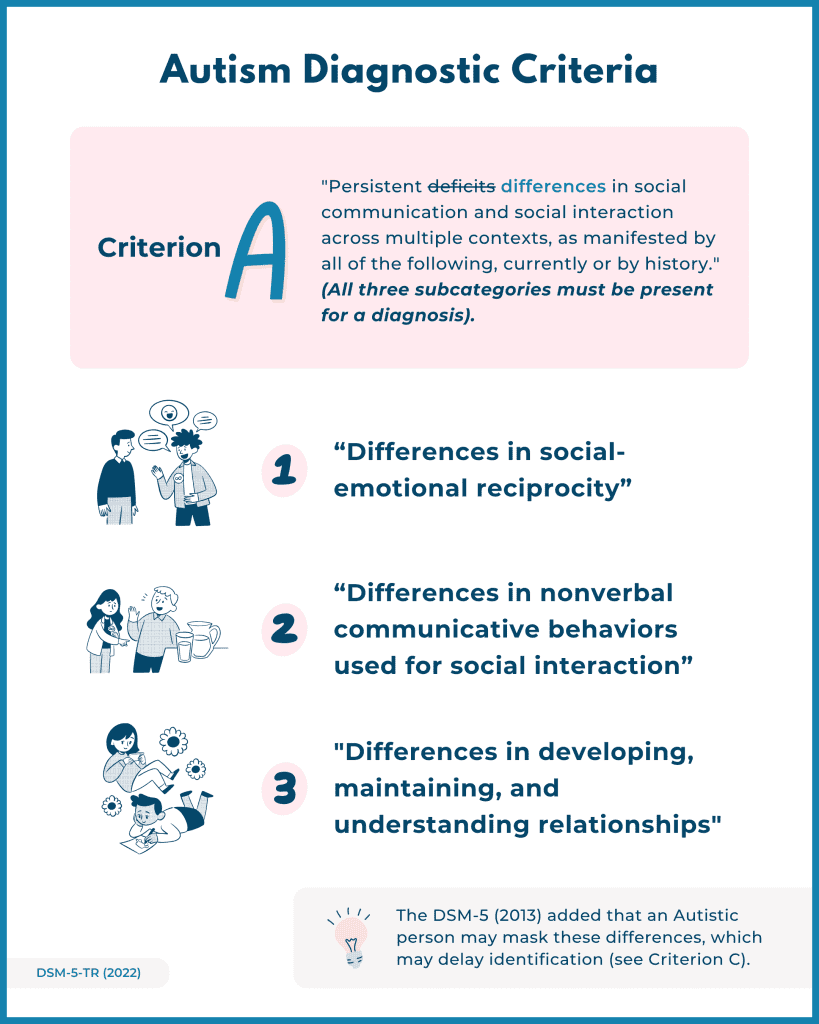
Criterion A has three subcategories, and all three must be met. If a person has two of the three, Criterion A would not be met. The DSM-5-TR language is “Persistent deficits in social communication and social interaction across multiple contexts, as manifested by all of the following, currently or by history.”
“Deficits” (differences) in social-emotional reciprocity
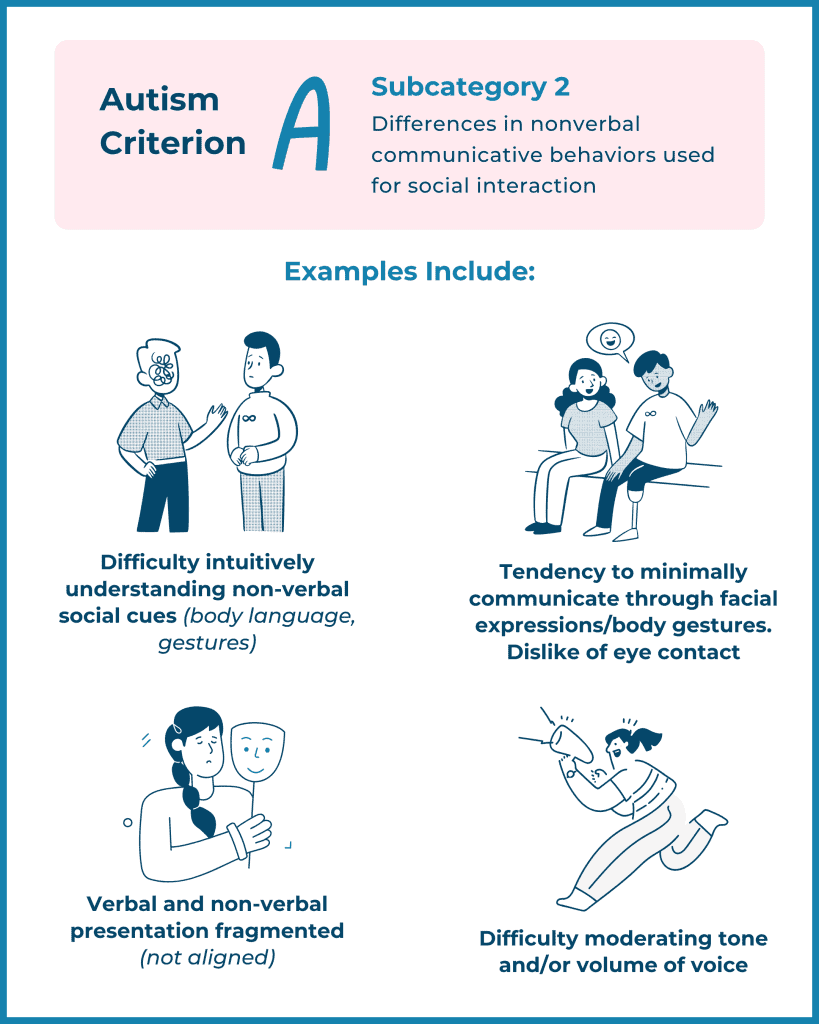
“Deficits” (differences) in nonverbal communicative behaviors used for social interaction
“Deficits” (differences) in developing, maintaining, and understanding relationships
In recent years, much more research has looked at autism in girls, women, gender-diverse people, and racialized people. Our thinking about Criterion A was historically based on white, cisgender boys from affluent families. We are learning how the patterns described in Criterion A may show up in more subtle forms, or be more masked, in many groups. That’s why it is critical that anyone who assesses autism understands how to look for these criteria through a cultural lens (understanding how they may present differently in different cultural groups).
For a fantastic deep dive into how Criteria A (and B) can look different among girls, check out this podcast featuring Dr. Donna Henderson, where she walks through the DSM-5 autism criteria for girls and women. Many of these descriptions also apply to gender-diverse people and many racialized men.
To read more about autism and masking, check out Devon Price’s book Unmasking Autism (affiliate link) and Laura Hull’s academic article, “The Female Autism Phenotype and Camouflaging: A Narrative Review.”
A1: Social-Emotional Reciprocity
Social-emotional reciprocity largely refers to the ability to fluidly and flexibly engage in back-and-forth conversation. There are many reasons this is hard for us. For one, in a casual conversation it is hard to know what to expect, and there are many context cues to pay attention to.
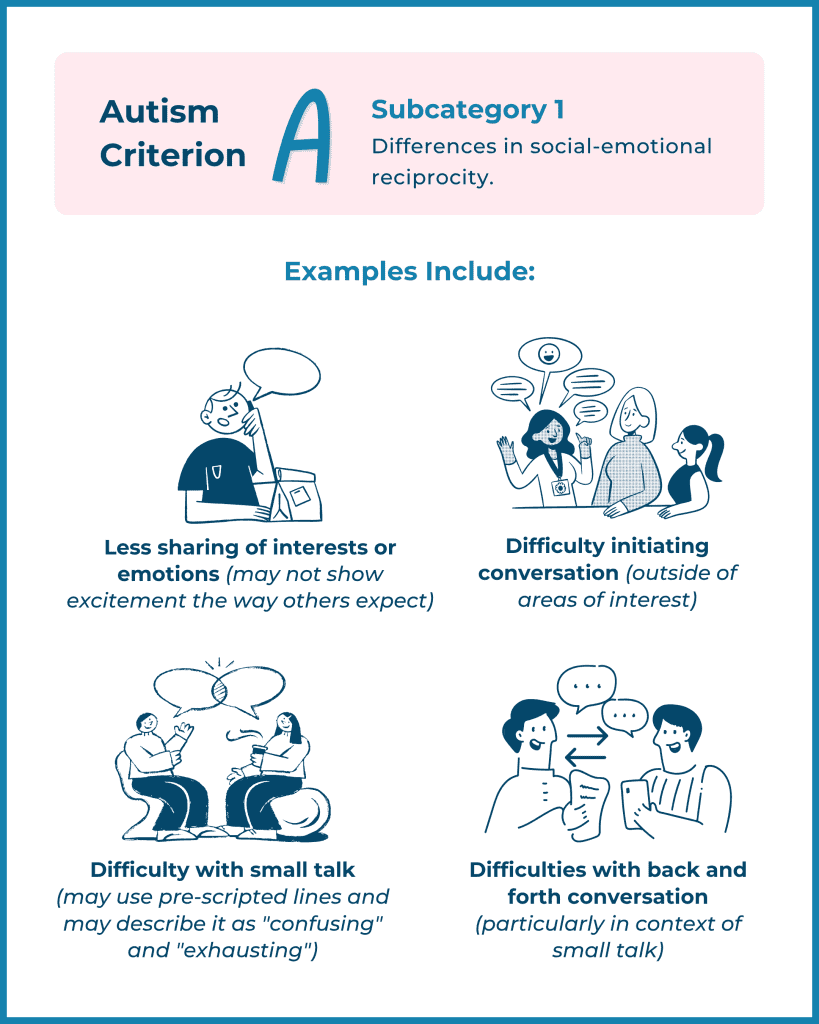
Another reason is that many of us process social information more slowly, especially when our brains are taking in information from many sources at once. Hint: this is precisely what we’re asking our brains to do during a social conversation. During a conversation, we need to 1) focus on the content being discussed, 2) consider our response to the speaker, 3) attend to body language (ours and theirs), 4) pay attention to a person’s energy, 5) focus on not being too distracted by the environment, 6) and more.
This subcategory also captures the difficulty many of us experience in initiating new relationships. Many Autistic people describe dating and flirting as particularly uncomfortable for this reason!
AuDHD people (especially those with hyperactive-impulsive or combined presentations) often initiate more social contact. They may have more trouble picking up on social misses and blunders, but initiating is often easier.
It’s important to note that many of these observed difficulties around reciprocity are no longer present when an Autistic person is talking about an area of shared special interest, or when communicating with other Autistic people. Furthermore, a common way of showing connection and empathy is to connect people’s stories with our own personal stories. Within Autistic-Autistic communication, this tends to be widely understood, while allistic people may interpret it as the Autistic person being self-centered or lacking reciprocity.
A final note on reciprocity: difficulty with reciprocity doesn’t always mean we’re the ones talking or info-dumping! For example, I was always more comfortable in my role as a therapist or mentor. I am more comfortable when creating space for another person, where limited or no reciprocity is expected of me. Throughout my life, people have often commented on my ability to “draw others out.” My conversations often focused on others (I have all kinds of tricks to get and keep the other person talking!). Because this quality was appreciated and didn’t cause anyone problems, no one was concerned that I “lacked reciprocity” in my conversations.
Finally, a person may also script and mask, and these patterns may not be observed until the person is too distressed or fatigued to maintain the social mask. They often become apparent during burnout or times of unmasking.
A2: Nonverbal Communication
Differences in nonverbal communication cover a broad range, from our ability to intuitively perceive and interpret other people’s tone of voice, facial expressions, and body language to our ability to moderate our own! It also includes things like:

Eye contact (many of us find it distracting or uncomfortable, especially when trying to focus on talking)
Difficulty moderating our tone of voice (volume but also affect)
Difficulty coordinating our words with our affect and body posture
Brain-imaging research offers some clues here. In one small study, Monk and colleagues (2010) found that while looking at emotional faces, Autistic participants showed stronger links between the amygdala and a part of the prefrontal cortex involved in regulating emotion, and weaker links between the amygdala and the temporal lobe, which helps identify facial expressions. It’s an early finding (24 participants), but it lines up with what many of us describe: reading faces can take more deliberate effort.
Autistic people who mask a lot may decode facial expressions analytically, which can hide these differences. Similarly, a person may rehearse facial expressions and tone of voice to sound less flat or monotone. Some Autistic people may be quite dramatic in gestures, particularly if they are theater trained or theater is an area of special interest.
A3: Relationships
The last subcategory of Criterion A relates to how we develop friendships, create worlds (imaginative play) with others, and context-shift. Several things go into this, so let’s break it down.

Many of us find it harder to start new friendships. Hull and colleagues’ review suggests Autistic girls and women often have more social motivation than Autistic boys and men, but may find it harder to maintain friendships and to handle conflict. Things like difficulty navigating arguments and all-or-nothing thinking can interfere with keeping friendships going.
Other things that can make friendships hard to maintain have to do with executive functioning, the energy friendships take, and the sensory demands involved. I can maintain friendships with people who are comfortable seeing and/or talking to me every six months to a year. Friendships requiring more maintenance and demand are incredibly difficult for me to maintain.
It should be noted that Criterion A3 doesn’t consider Autistic-Autistic friendship. A fantastic study by Crompton and colleagues (2020) found that Autistic pairs built rapport as easily as non-Autistic pairs, while mixed pairs found it harder. So some of these struggles may ease when we’re with other Autistic people.
Difficulty with imaginative play and group projects is also common. This likely has to do with not knowing what to expect, flexibly (and quickly) changing our minds about how we envisioned a project going, and our mind’s tendency to get fixated on the “right” way of doing the thing. While I didn’t struggle a great deal with imaginative play as a child, I did struggle quite a bit with group projects and found them incredibly taxing to navigate!
Finally, Criterion A3 considers context shifting. This is the ability to shift our tone, language, and general way of being from context to context, such as from the gym to a party to class to the grocery store. Many of us struggle with the idea that there are “certain rules” or “ways to act” in certain situations that then change in other situations. I consider this an extension of our high value of authenticity regardless of context.
Another form of context shifting is relational (for example, how you talk to your child vs. how you talk to your boss). Many of us value humans equally despite authoritarian hierarchies. This means we may talk with our boss the same way we’d talk with a friend, which can sometimes be interpreted as disrespectful and lead to professional issues for many of us. Personally, I’ve always struggled to talk to kids “like kids.” I talk to my kids like mini-adults (aka humans). (Side note: it is always amusing to my whole family when an adult tries to talk to them like a little kid. They look at me with big eyes, like, “Why are they talking to me like I’m stupid?”)
Criterion B: Restricted and Repetitive Patterns
Criterion B broadly speaks to our need for routine, structure, and knowing what to expect, along with our sensory differences. The DSM-5 language reads, “Restricted, repetitive patterns of behavior, interests, or activities, as manifested by at least two of the following, currently or by history.” Criterion A needs all three of its subcategories; Criterion B needs at least two of these four:
“Stereotyped or repetitive motor movements, use of objects, or speech”
“Insistence on sameness, inflexible adherence to routines, or ritualized patterns of verbal or nonverbal behavior”
“Highly restricted, fixated interests that are abnormal in intensity or focus”
“Hyper- or hyporeactivity to sensory input or unusual interest in sensory aspects of the environment”

B1: Repetitive Movements, Objects, or Speech
Criterion B1 includes stimming (repetitive movements, often used to self-soothe, such as hand-flapping, pacing, and other body-based movements). It also includes the repetitive use of similar phrases or words, and echolalia (repeating words or phrases we’ve heard, right away or later).
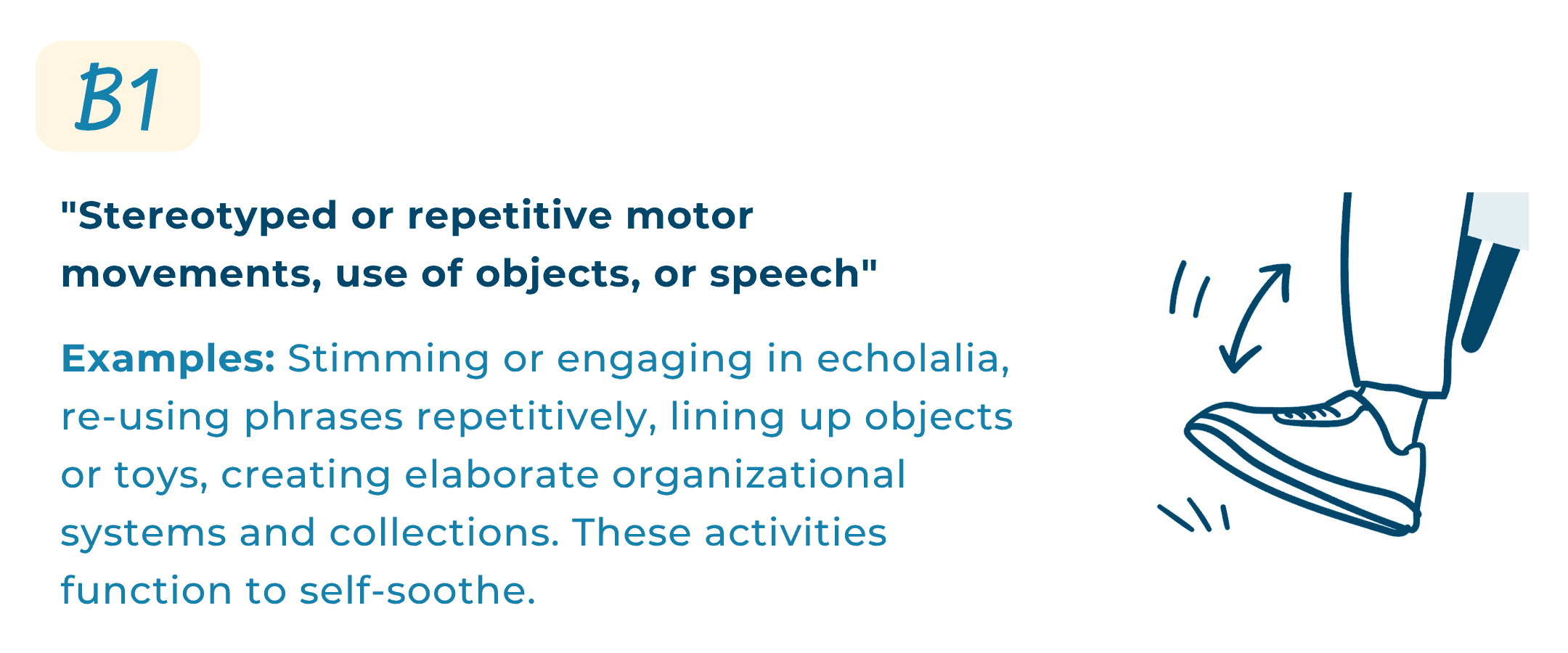
In childhood, it may look like lining up toys and objects or organizing toys by color. In adulthood, it may look like having collections and spending large amounts of time organizing and completing them. These often help us self-soothe and make the world a more predictable place.
B2: Sameness and Routines
Knowing what to expect and having a similar routine is incredibly soothing for Autistic people. We experience a great deal of security in our routines and rituals.
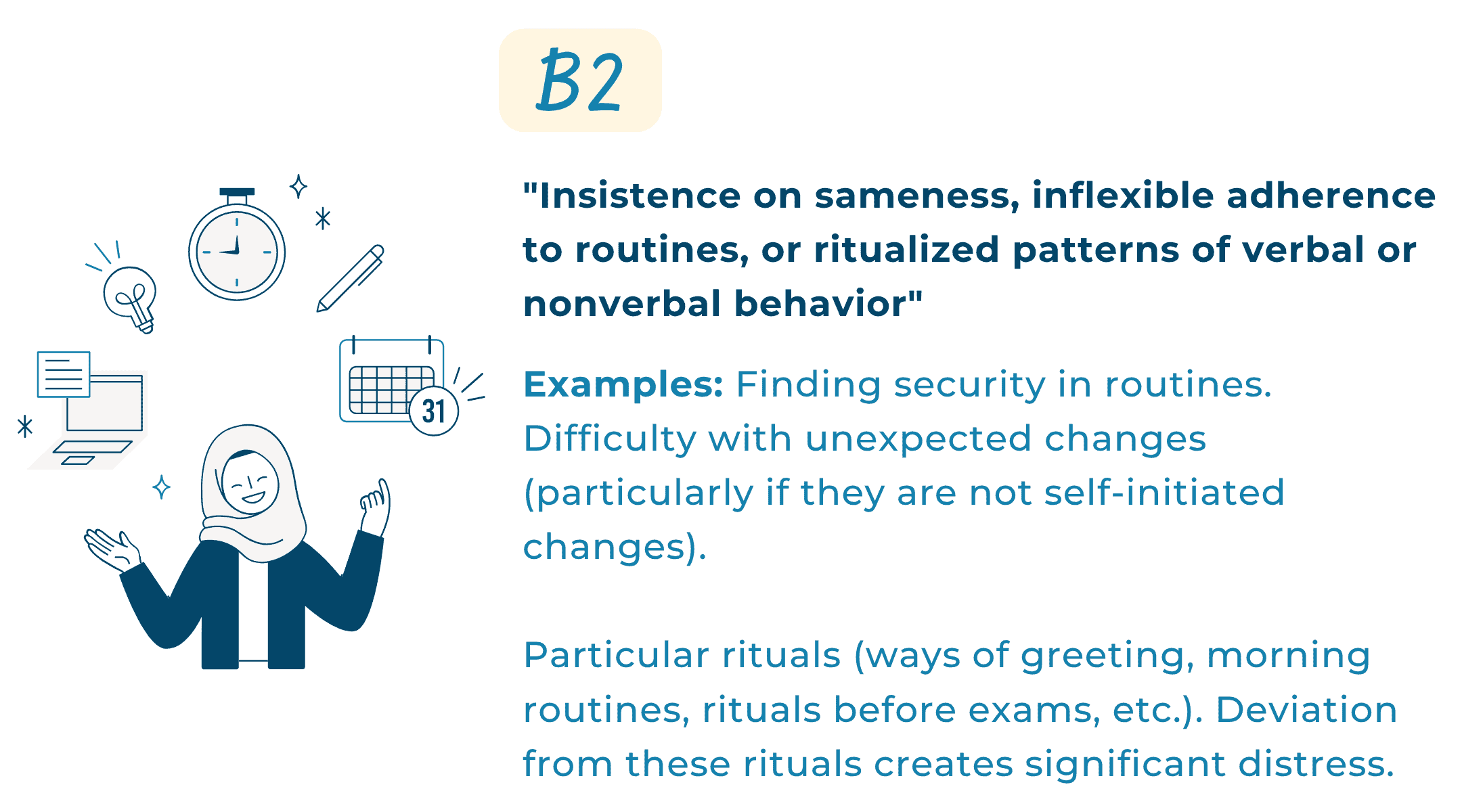
Many of us experience difficulty with unexpected changes (particularly if they are not self-initiated). We may also have particular rituals (ways of greeting, morning routines, rituals before exams, etc.). Deviation from these rituals often creates significant distress.
When ADHD is also present, the person may also seek out new stimuli, new situations, and change. This can mask some of the Autistic preference for routine and/or create a ping-pong effect where the person wants both routine and change. This can create competing needs for AuDHD people that can be challenging to navigate!
B3: Intense, Focused Interests
Criterion B3 speaks to our tendency to have highly specific and passionate interests. We tend to learn A LOT about our areas of interest and love to talk about them, sometimes endearingly referred to as “info-dumping” (well, I consider it endearing; others consider the term insulting).
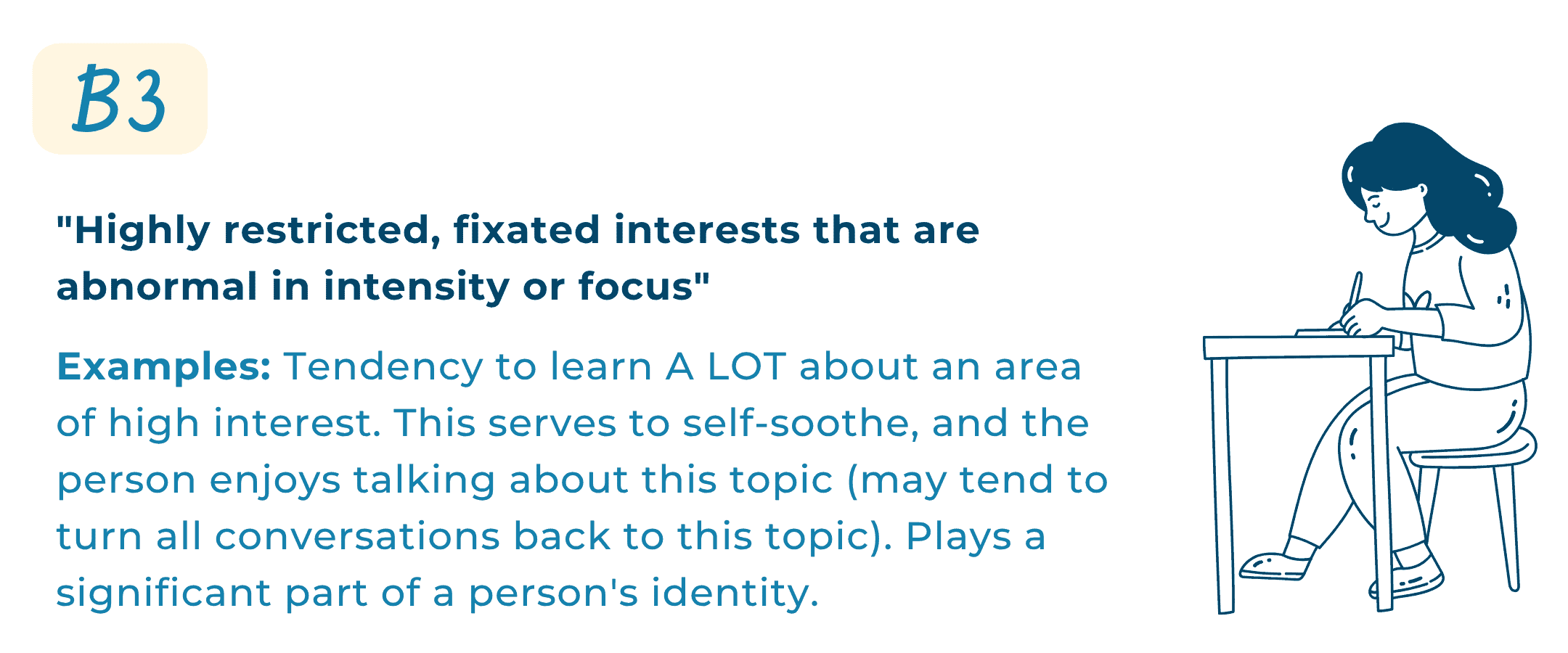
Our special interests are also how we best connect with people. Many of us can more easily make friends (re: Criterion A) when the friendship is based around an area of shared special interest.
Special interests are another area that has often been misunderstood in groups that don’t fit the stereotype. For example, Hull and colleagues note that Autistic girls and women may have interests that more easily blend in, such as animals, fictional characters, or psychology.
Other interests I often saw include religion and theology, identity-based politics and theory (e.g., queer theory), and social justice. When a person’s interest is more culturally acceptable or “functional,” the interest itself may not stand out, but the intensity around it will be notable. The person may constantly listen to podcasts or read books about their interest (or start a website and an Instagram about it!) and will likely enjoy talking about it.
In these cases, it is more important to look at the intensity of the interest rather than the content of the interest.
One final note on special interests: when ADHD is also present, interests may change more rapidly, but the intensity is similar.
B4: Sensory Differences
Most Autistic people have sensory differences, often a mix of over- and under-responsiveness to sensory input.

Examples of sensory sensitivities include difficulty with light, strong smells (particularly chemical smells like perfumes and the added fragrances in cleaning supplies), specific food textures, tags and clothing textures, and touch (particularly light touch). Someone with hypo-sensory responses may have a dulled experience of pain and other sensory input.
Higher sensory sensitivity may also be more common among transgender and gender-diverse people. In a large 2020 study (more than 600,000 people across several datasets), Warrier and colleagues found that transgender and gender-diverse people reported higher sensory sensitivity on average, whether or not they were Autistic.
Criterion B4 also includes “unusual interest in sensory aspects of the environment.” This may mean a high interest in visual patterns (and a tendency to become fixated on them) or a craving for tactile experiences (for example, touching surfaces or smelling objects when entering a room).
Criteria C, D, and E
In the DSM, the last few criteria of a diagnosis typically cover the rule-outs. The same is true here.

Criterion C
Autism is a neurodevelopmental condition (i.e., a neurodivergence). As such, traits are present from early development. The DSM notes that traits may not become fully apparent until social demands exceed a person’s capacities, and that they may be masked by learned strategies later in life. A person may learn to mask Autistic traits early in life and may escape detection until adulthood.
Criterion D
Criterion D requires that the traits cause clinically significant impairment in social, occupational, or other important areas of current functioning. Unlike many DSM diagnoses, distress alone isn’t listed here. For this reason, some psychologists say a person may be Autistic but not meet criteria for an autism diagnosis. For example, a person may have an Autistic neurotype but experience no difficulty related to it, and therefore not identify with Criterion D. This gets a bit into the weeds about what is Autistic neurotype vs. what is autism spectrum disorder. I have mixed feelings about it, but I find it an interesting concept and understand how some Autistic people may prefer to identify this way.
Also note that Criterion D says “or other important areas of functioning.” Mental and emotional health are also areas of functioning! This language leaves it open for a clinician to consider the impact traits have on a person’s emotional and mental well-being. This is critical when assessing Autistic people who mask a lot.
Criterion E
This criterion speaks to the importance of not conflating autism with intellectual disability or global developmental delay. A person may struggle to pick up social cues and struggle socially because of an intellectual disability, but that isn’t autism. Intellectual disability and autism co-occur at high rates, so it can be difficult (and important) to tease out the differences. When both are diagnosed, the DSM asks that social communication be below what would be expected for the person’s general developmental level.
A Few Closing Thoughts
The DSM criteria describe autism mostly from the outside, as observers see it. That’s part of why so many of us, especially those who mask, went unrecognized for years. Knowing what the criteria say can make the process less mysterious.
If you’d like to keep going, my Misdiagnosis Monday series looks at how autism overlaps with, and gets mistaken for, conditions like social anxiety and BPD.
DSM-5 Autism Criteria FAQs
Do you need all three parts of Criterion A for an autism diagnosis?
Yes. The DSM-5-TR clarified that Criterion A is met only when all three subcategories are present: differences in social-emotional reciprocity, in nonverbal communication, and in developing, maintaining, and understanding relationships. Criterion B needs at least two of its four subcategories.
Can adults be diagnosed with autism if no one noticed it in childhood?
Yes. Criteria A and B can be met “currently or by history,” and Criterion C notes that traits may not become fully apparent until social demands exceed a person’s capacities, or may be masked by learned strategies. Many Autistic adults, especially those who mask, are identified later in life.
What are the autism support levels?
The DSM-5 asks clinicians to describe current support needs separately for social communication and for restricted, repetitive behaviors: Level 1 (“requiring support”), Level 2 (“requiring substantial support”), and Level 3 (“requiring very substantial support”). Support needs can change over time and across settings.
What happened to Asperger’s?
The DSM-5 (2013) folded Asperger’s disorder, autistic disorder, and pervasive developmental disorder not otherwise specified (PDD-NOS) into one diagnosis: autism spectrum disorder. People with a well-established DSM-IV diagnosis of any of these are given a diagnosis of autism spectrum disorder. Some people still use the word Asperger’s to describe themselves.
Additional Resources

So You Think You Might Be Autistic or ADHD? Here’s What to Do Next Practical next steps once you start wondering

Identifying the Lost Generation of Autistic Adults For clinicians: a CE training on recognizing autism in adults who were missed

A Review of Autism Screeners for Adults Free screeners and what each one measures
DSM-5 ADHD Criteria: The Full List, Explained in Pictures The ADHD criteria, A through E, in plain language
 Stay in the Neurodivergent Loop
For ongoing insights and updates, subscribe to the Neurodivergent Insights Newsletter. Each Sunday, I send out fresh thoughts and a roundup of the newest resources on topics related to neurodivergence, mental health, and wellness. My most personal writing is reserved for my newsletter, and subscribers also get access to the newsletter vault (12+ PDFs) when they join.
References
American Psychiatric Association. (2013). Diagnostic and statistical manual of mental disorders (5th ed.). https://doi.org/10.1176/appi.books.9780890425596
American Psychiatric Association. (2022). Diagnostic and statistical manual of mental disorders (5th ed., text rev.). https://doi.org/10.1176/appi.books.9780890425787
Crompton, C. J., Sharp, M., Axbey, H., Fletcher-Watson, S., Flynn, E. G., & Ropar, D. (2020). Neurotype-matching, but not being autistic, influences self and observer ratings of interpersonal rapport. Frontiers in Psychology, 11, 586171. https://doi.org/10.3389/fpsyg.2020.586171
Hull, L., Petrides, K. V., & Mandy, W. (2020). The female autism phenotype and camouflaging: A narrative review. Review Journal of Autism and Developmental Disorders, 7(4), 306–317. https://doi.org/10.1007/s40489-020-00197-9
Monk, C. S., et al. (2010). Neural circuitry of emotional face processing in autism spectrum disorders. Journal of Psychiatry & Neuroscience, 35(2), 105–114. https://pmc.ncbi.nlm.nih.gov/articles/PMC2834792/
Warrier, V., et al. (2020). Elevated rates of autism, other neurodevelopmental and psychiatric diagnoses, and autistic traits in transgender and gender-diverse individuals. Nature Communications, 11, 3959. https://doi.org/10.1038/s41467-020-17794-1