“Feelings are not facts” is one of those phrases that can sound dismissive. I don’t mean it that way. Emotions carry information about our needs and experiences. But while emotions contain truth, they don’t always line up with what’s happening.
Separating Emotions from Facts
Sometimes a feeling points us in the wrong direction. Say you meet someone and instantly feel disliked. The feeling can be very convincing, and it may lead you to believe the person has something against you. But the feeling is an interpretation of the moment. The person might simply be preoccupied or having a bad day, for reasons that have nothing to do with you.
When we treat emotions as facts, it can spiral into extra anxiety, stress, and misunderstandings in our relationships.
The Neurodivergent Feedback Loop
Many of us have a history of negative feedback in social interactions, which can leave us quick to internalize and personalize the negative emotions we pick up around us. When someone near us seems upset, we might assume it’s because of something we did. That assumption often grows out of past experiences where we were, often unintentionally, the cause of someone’s reaction, or where we were criticized for not fitting neurotypical expectations. For many of us, this overlaps with rejection sensitivity.
But the assumption isn’t always correct. Sometimes the negativity we sense has nothing to do with us. Because of our history, though, we may believe it does and respond accordingly. This can create a self-fulfilling cycle: we react to the assumed negativity, which can draw actual negative responses from others, which then reinforces the original assumption.
Noticing this pattern makes it easier to read social cues more gently.
Emotions vs. Facts
Telling emotions and facts apart can be hard, especially when a feeling is intense. In the moment, an emotion can feel as solid as a fact.
Emotions

Shaped by our history, body, beliefs, and context
Can shift quickly, sometimes within minutes
Carry information about our needs
Feel convincing, especially when they’re intense
Facts

Things we can observe or check
Stay the same no matter who is looking
Change when new evidence comes in
Don’t depend on how we feel about them
Emotions are worth listening to. They just aren’t the same thing as objective information.
When Anxiety Joins In
Anxiety shapes how we read our emotions. As someone who lives with anxiety, I know how easy it is to fall into an anxiety loop: a cycle of negative thoughts and feelings that plays on repeat. Once we’re in the loop, our interpretation of a situation can start to feel like the absolute truth.
Say a supervisor approaches you with a certain tone. If you read the tone as negative, you might conclude they’re displeased with you. From there, the mind can spiral into worries about incompetence or losing your job, and then into thoughts like “I’m not good enough” or “I am worthless.” None of these thoughts are based on what happened, yet they start to feel undeniably true.
Our nervous system can respond to these loops as though the threat is happening now, which makes the feeling harder to doubt.
When we notice we’re caught in a spiral, it helps to pause and ask: what are the facts here? Sorting what we can observe from the story we’ve built around it can loosen the loop.
Validation and Discernment
For many neurodivergent people, this is tender ground. Many of us spent years being told we were too sensitive, too reactive, or too much. Chronic invalidation like that can shape our self-concept, keep us on high alert, and wear down our ability to trust our own experience. So our quick, anxiety-driven assumptions usually come from somewhere: years of negative feedback, self-criticism, and the alienation of not fitting in with peers. It helps to honor where these reactions come from.
The challenge is taking our feelings seriously without accepting every thought as absolute truth, or “buying the thought.” Buying a thought means taking it as fact without checking it. There’s a hard irony here: when people spent years telling us our feelings were wrong, being asked to question our thoughts can feel like more of the same. That isn’t what this is. Questioning our automatic assumptions takes practice, and it starts from trusting that the feeling makes sense.
What Happens When We Treat Feelings as Facts
When the line between our emotions and what’s happening blurs, it can affect several parts of life:

Decisions
We may make choices based on fear or assumptions rather than what’s in our best interest.

Relationships
Treating our emotional reactions as indisputable truth makes it harder to see the other person’s side, and conversations can turn defensive.

Self-awareness
We can miss what’s underneath a feeling. Emotional reasoning, the habit of concluding something is true because it feels true, can reinforce beliefs we already hold.

Mental health
Persistent negative feelings taken as facts can feed anxiety, low mood, and a sense of hopelessness.
How to Start Separating Emotions from Facts
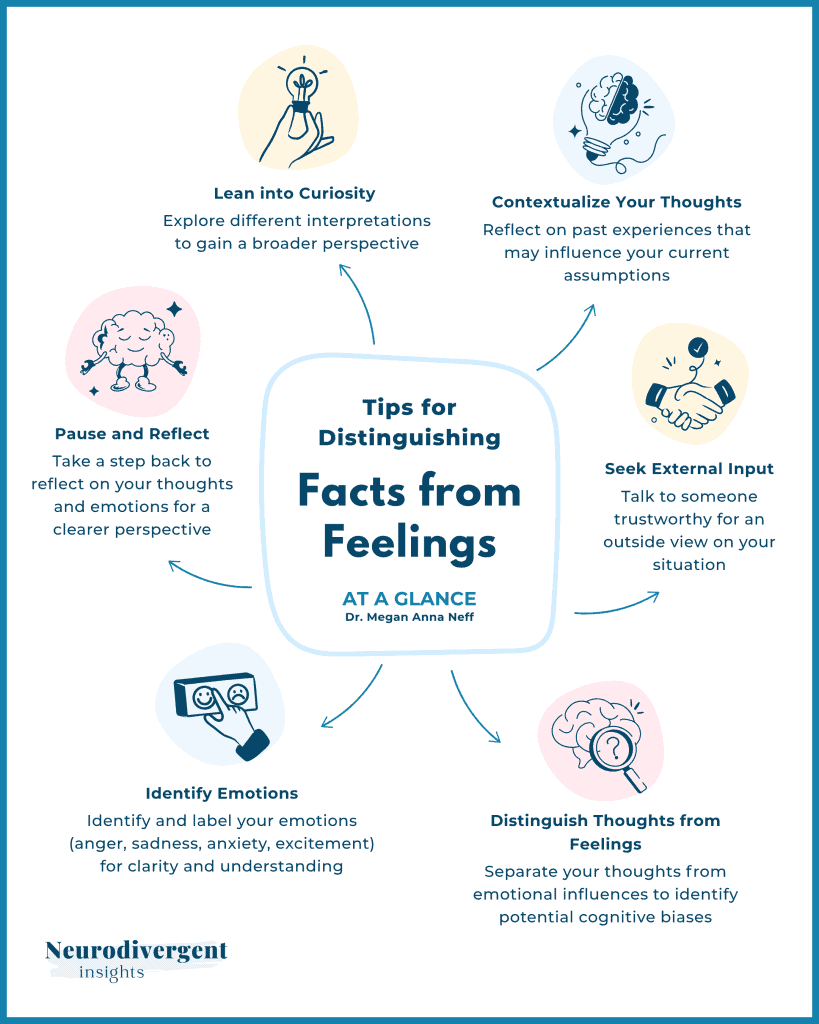
When something feels off, the goal isn’t to push the feeling away, since ignored feelings tend to stick around. It usually works better to get curious about the feeling and what’s feeding it. Here are some strategies that can help:
1
Pause and reflect. Step back and give yourself space to notice your thoughts and emotions.
2
Name the emotion. Are you angry, sad, anxious, excited? Being specific helps. (If naming feelings is hard, alexithymia may be part of the picture.)
3
Separate thoughts from feelings. Notice what you’re feeling and, separately, what you’re thinking about the situation.
4
Contextualize your thoughts. Consider what past experiences might make you more likely to jump to this assumption. This can be a compassionate way to understand why your mind goes to the worst case.
5
Watch for cognitive distortions. Patterns like catastrophizing or all-or-nothing thinking can warp how we see a situation.
6
Look at the evidence. What can you observe that supports the thought? If there isn’t much, the emotion may be shaping your perception.
7
Get curious about other explanations. What else could be going on?
8
Ask someone you trust. An outside view can help you see whether emotions are shaping your judgment.
A Neurodivergent Adaptation
Some of these strategies draw on cognitive behavioral therapy, and they can land differently for neurodivergent people, especially Autistic people. Checking a thought isn’t the same as dismissing your experience.
Some Autistic people describe parts of CBT as feeling like self-gaslighting, because it asks us to question our own perceptions. And sometimes the distressing thought, like feeling rejected, is accurate. So these tools take practice and a gentle touch.
Imagine sifting through sand to find pebbles: we shake out the distorted thoughts to find the facts underneath.
A Few Closing Thoughts
Our emotions are powerful and deeply personal, and they can feel completely true. They still aren’t facts.
For neurodivergent people, learning to validate our experience without falling into the feelings-as-facts trap is a balance we keep practicing. If you’d like to go deeper, What Are Emotions? and Sensory Overload and Emotions are good next steps.
To understand where feelings come from in the first place, see Where Do Emotions Come From? For a body-first way to name them, try the arousal-valence model.
Feelings Are Not Facts FAQs
Additional Resources
For ongoing insights and updates, subscribe to the Neurodivergent Insights Newsletter. Each Sunday, I send out fresh thoughts and a roundup of the newest resources on topics related to neurodivergence, mental health, and wellness. My most personal writing is reserved for my newsletter, and subscribers also get access to the newsletter vault (12+ PDFs) when they join.




 Stay in the Neurodivergent Loop