Table of Contents
When the Holidays Hurt More Than They Shine
Every year, this season arrives with a kind of cultural script: bright lights, warm gatherings, “the happiest time of the year” messaging everywhere. And for so many of us, the gap between our longings and our actual lives becomes sharper.
The holidays have a way of spotlighting this gap. The distance between who we hoped we’d be and where we actually are. Between the family we imagine and the family we have. Between the connection we crave and the clashing sensory or emotional realities that make it complicated.
Different therapies and traditions name this gap in different ways. In psychology, the gap between our ideal self and our real self is often called incongruence, and that gap is understood to be a major source of anxiety and distress. In Buddhist thought, suffering grows in the space between desire and reality. In neurodivergent life, it can feel like wanting closeness while also needing distance, quiet, regulation.
The holidays turn the volume on all of that up. Small talk starts circling around family plans. Movie scenes play all around us with themes of togetherness and repair. But if your relationships are strained, complicated, or painful…that holiday glow can land like a sharp jolt in the body.
Some of us long for connection but don’t have the people we ache for. Some of us have people, but our nervous systems and theirs collide, making the season feel like one long act of bracing.
Some are carrying generational pain, old stories, griefs, and wounds that get louder this time of year.
What makes this especially challenging is that these heavier emotions often arise against the backdrop of what society frames as “the magical holiday season.” There’s a pressure to feel joy, wonder, and connection — but instead, we might feel restless, agitated, or even melancholic.
And at a population level, we know this season is hard on mental health. Coping gets stretched thin. Substance use rises. People feel more alone. Dysfunctional family dynamics pull us back in. Old hurts resurface.
A Conversation About Staying Through the Hardest Minutes
Content note: suicidality
This week on Divergent Conversations, Patrick and I talked about something heavier. We dedicated an episode to unpacking suicide — what suicidal ideation and behavior are, and how we can support ourselves and others. We explore the spikes that rise out of nowhere, the moments when life feels unholdable. It’s a conversation that touches our community at a much higher rate than many people realize.
One of the myths about death by suicide is that it can’t be prevented. But research tells a different story. Many people who die this way make that decision in a moment of unbearable overwhelm. Fifteen minutes. Twenty minutes. A high-risk window where the nervous system is flooded and the self you know disappears behind the crisis. And a devastatingly permanent decision is made.
What is especially painful is knowing that a lot of deaths by suicide happen in an impulsive moment — often a 15 minute window — a temporary emotional surge that can override the baseline self who would never choose this outcome. This is something many people don’t understand about suicide (and of course, not every death fits this pattern). And the holiday season can amplify emotion and increase substance use for many, which can make those vulnerable moments more difficult to navigate.
That 15-minute urge can feel like a wave crashing in — fast, overwhelming, and all-consuming. Having strategies and supports in place, people you can reach out to, or grounding tools you can access in those moments matters. Because often, if someone can weather that initial surge, the nervous system begins to settle, and a more grounded state returns. The risk is in acting from the intensity of the impulse rather than from the steadier self that comes back when the wave recedes.
Safety plans help people get through those minutes. They don’t solve everything. They don’t remove suffering. But they help us stay through the stretch we might not otherwise survive.
And for people who struggle with impulsivity, having tools to survive those fifteen-minute waves can be lifesaving.
Earlier this year, someone asked me why I do the work I do, at the core of it, I do this work to save lives. On one hand, that feels like a grossly grandiose thing to utter. On the other hand, I know how much knowledge, awareness, and identity integration have helped save me.
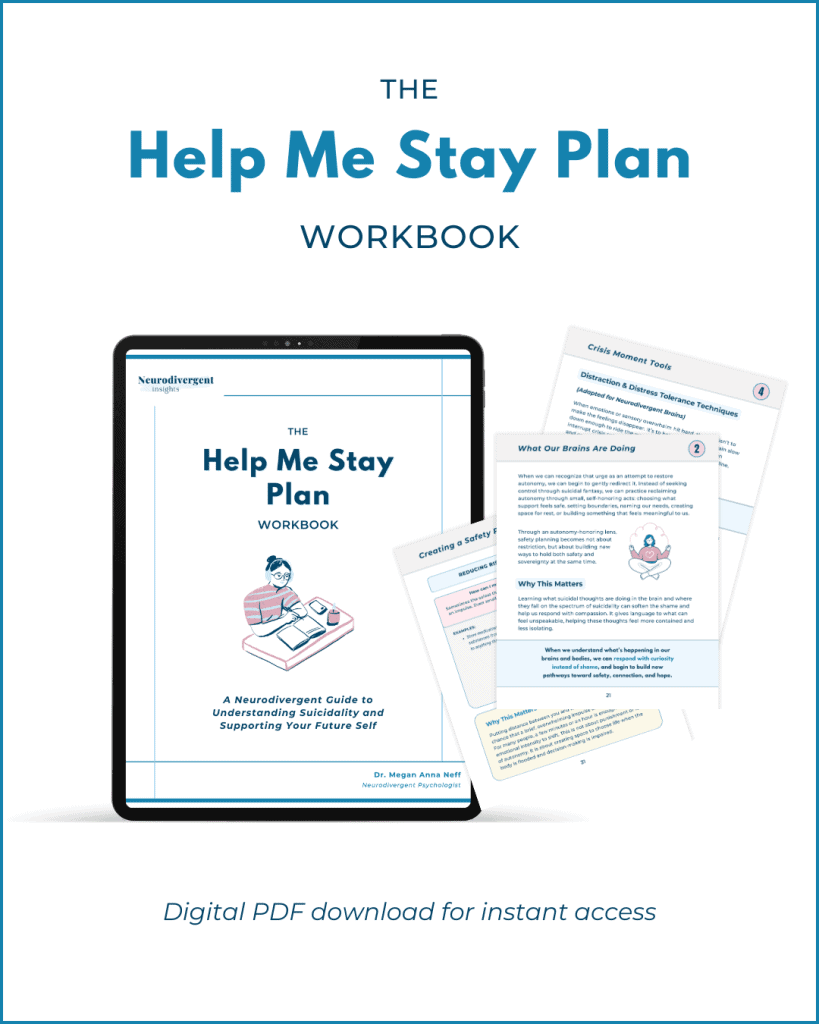
For all of the reasons above, my team and I created a neurodivergent-adapted safety plan. We call it The Help Me Stay Plan. It’s free, printable, and designed with our community in mind, including: sensory overwhelm, shutdowns, impulsivity, high masking, and those rapid emotional spikes that can come with transitions or interpersonal pain.
As we head into a season that can be both beautiful and brutal, I wanted to offer it to you.
If it’s helpful, take it. If someone in your life might need it, please share it. You’re welcome to pass it along to schools, clinicians, clinical training programs, or anyone who could use a neurodivergent-affirming tool like this.
This is a gift from my team to the world, a small act of care for the moments that feel hardest. Creating this resource has meant a lot to us. Putting something into the world that may support even one person who needs it this season is one of the things helping me stay connected to my own humanity right now.
I hope you, too, can find the practices or people or places that help you stay connected to yours.
And if this season is a vulnerable one for you, please know:
You’re not alone in that pain.
You deserve safety, connection, and support.
And you deserve a world that helps you stay.
I hope together we can keep working toward building that world. Little by little.
With warmth,
Megan Anna
Crises Resources & Help me Stay Plan
For a full list of crises resources (US and International), as well as to download the Help Me Stay Plan please see the list of crises support resources here.
Footnote
* While some believe that death by suicide is inevitable and therefore cannot be prevented, research strongly contradicts this belief. Both individual and societal interventions have been shown to reduce suicide risk (CDC; SPRC). The Centers for Disease Control and Prevention affirms that “suicide is preventable,” and that multiple resources exist to support people at risk.
While suicide is not always an impulsive act, for many people the window between decision and action is very short. One study found that 50% of people who attempt suicide report that the time between deciding to act and making the attempt was 10 minutes or less, and about one-quarter report it was under 5 minutes (Harvard T.H. Chan School of Public Health, Means Matter Campaign). These rapid decisions often occur in the midst of acute emotional overwhelm, such as during interpersonal conflict or when substances are involved.
This highlights a critical truth: timely support during high-risk moments can save lives. Dispelling the myth that suicide is always inevitable or predetermined helps us stay focused on evidence-based prevention strategies that reduce harm and support safety.
References
Deisenhammer, E. A., Ing, C. M., Strauss, R., Kemmler, G., Hinterhuber, H., & Weiss, E. M. (2009). The duration of the suicidal process: how much time is left for intervention between consideration and accomplishment of a suicide attempt?. The Journal of clinical psychiatry, 70(1), 19–24.
Hawton, K. (2007). Restricting access to methods of suicide: Rationale and evaluation of this approach to suicide prevention. Crisis: The Journal of Crisis Intervention and Suicide Prevention, 28(Suppl 1), 4–9. https://doi.org/10.1027/0227-5910.28.S1.4
Simon, O. R., Swann, A. C., Powell, K. E., Potter, L. B., Kresnow, M. J., & O’Carroll, P. W. (2001). Characteristics of impulsive suicide attempts and attempters. Suicide & life-threatening behavior, 32(1 Suppl), 49–59. https://doi.org/10.1521/suli.32.1.5.49.24212
Wyder, M., & De Leo, D. (2007). Behind impulsive suicide attempts: indications from a community study. Journal of affective disorders, 104(1-3), 167–173. https://doi.org/10.1016/j.jad.2007.02.015
🗞️ Stay in the Neurodivergent Loop
For ongoing insights and updates, subscribe to the Neurodivergent Insights Newsletter. Each Sunday, I send out fresh thoughts and a roundup of the newest resources on topics related to neurodivergence, mental health, and wellness. My most personal writing is reserved for my newsletter, and subscribers also get access to the newsletter vault (12+ PDFs) when they join.