Rejection Sensitive Dysphoria (RSD) tends to make us perceive slights, even when none were intended, which can strain our ability to maintain healthy connections. I can vividly recall times when RSD made it challenging for me to tackle tough conversations in my romantic relationships. Instead of facing them directly, I would often withdraw. This is common. For others, RSD can lead them to react with anger or become overwhelmed by emotions, making it tough to address difficult topics.
What is Rejection Sensitive Dysphoria?
Rejection Sensitive Dysphoria (RSD) is an intense emotional reaction to rejection or criticism, and it often comes with ADHD. RSD isn’t a formal diagnosis. The term comes from psychiatrist William Dodson, and many people describe physical discomfort as well as emotional distress when they encounter rejection.
Perceived Rejection
With RSD, our brains stay on alert for anything that might resemble rejection. And when our minds are always on watch, they tend to find rejection, even where it isn’t there.
We react to actual rejection and to any perceived hint of it. These hints can be as subtle as a missed smile, a brief greeting, or even the absence of positive feedback.
Consider it like wearing “RSD glasses” that tint our perception with the color of rejection. With these glasses on, we can read exclusion into even the faintest signals.
Imagine this scenario: You ask your partner about their day, and they respond with a short, neutral answer. With RSD, it’s easy to interpret this as rejection (perhaps thinking they’re upset, annoyed, or distancing themselves from you). In reality, they might just be tired or they had a long day without the energy to elaborate.
Over time, this constant vigilance can reinforce our belief that rejection is everywhere.
When you have RSD, the default assumption is often, “It’s me, I’m the problem, it’s me.”
Characteristics of Rejection Sensitive Dysphoria
RSD often shows up in these ways:
Heightened Emotions: RSD amplifies emotions, resulting in reactions that may appear disproportionate.
Swift Emotional Shifts: Rapid mood shifts triggered by perceived rejection.
Physical Sensations: Emotional distress can show up as physical discomfort.
Self-Image Struggles: RSD often leads to lower self-esteem, as people live with recurrent feelings of inadequacy.
Analyzing Social Cues: People with RSD closely scrutinize social cues, at times misinterpreting innocent gestures as signs of rejection.
Emotional Turbulence: RSD can generate emotional storms of sadness, anger, or frustration.
Social Avoidance: Many people living with RSD avoid social interactions for fear of rejection or criticism.
Relational Impact: In relationships, RSD can make it hard to start new relationships, address conflict, or work through disagreements.
Severe Emotional Pain Response to Rejection
The core of RSD is how much rejection hurts. Even the perception of rejection can trigger an overwhelming and distressing emotional response.
Psychiatrist William Dodson writes that this pain is often experienced as a physical “wound,” and that people describe it as if they were “stabbed or punched in the chest.”
Physical Pain Response to Rejection
Many people find it hard to put into words the physical discomfort they experience when confronted with rejection or even the perception of it. Some describe it as like a punch in the stomach or other intense bodily reactions.
Social rejection can activate brain regions involved in physical and emotional pain.
In one study, people going through an unwanted breakup looked at a photo of their ex while thinking about the rejection, and brain areas tied to physical pain became active.
Avoiding Social Situations and Criticism
For people with RSD, the fear of rejection can become a powerful motivator to shy away from social gatherings.
Imagine someone with RSD receiving an invitation to a social event. While others might see it as a regular get-together, for someone with RSD, it can trigger a lot of anxiety. The dread of encountering rejection or criticism often leads people to decline such invitations. The same can happen with dating, to the point of not dating at all or never being the one to ask.
This avoidance is a way to cope. It shields us from the pain of rejection. Unfortunately, it can become a self-perpetuating cycle that feeds isolation.
Challenges of Rejection Sensitive Dysphoria in Relationships
Relationships are hard for everyone, and RSD adds its own layer.
In one large survey, ADHD adults were nearly twice as likely to be divorced (28% compared with 15%).
So, why does this occur? It’s a complex mix of factors, including imbalances in household responsibilities, amplified emotional fluctuations, heightened stress, potential medication side effects, one partner taking on a parental role, and differences in sexual desire. That’s about ADHD as a whole, not RSD alone, but RSD adds to the mix.
ADHD relationship specialist Melissa Orlov argues that denial does more damage than ADHD itself. That’s one reason it helps to get clear about how ADHD and RSD are affecting our relationships. Once we understand ADHD and RSD’s influence, we have more say over how it affects our relationships. Here are some ways RSD can show up in relationships.
Misinterpretation of Intent
RSD can make us likely to misinterpret the intentions of others. Innocent remarks or actions from partners can, when viewed through the lens of heightened sensitivity, feel like rejection or criticism, often leading to unnecessary conflicts. When RSD takes over like this, I refer to these experiences as “RSD narratives” because, during such moments, our minds tend to craft painful stories that often stray far from reality.
What helps: Clear and direct communication. By asking clarifying questions when uncertainty arises and checking whether our interpretations are accurate, we can untangle misunderstandings. This process, which I like to call “relational reality testing,” involves checking your interpretation of an event with the other person involved. When trust is established in the relationship, this practice can help correct the distorted RSD narratives that often play in our minds.
Fear of Rejection
A deep-seated fear of rejection can affect our ability to initiate or maintain relationships. It can lead to avoidance when starting relationships or to defensiveness within existing ones.
What helps: It’s helpful to recognize that the fear of rejection is a common human experience and doesn’t define our worth or ability to connect. Identifying any avoidance patterns and slowly working on them can help loosen the cycle of fear and avoidance.
Avoidance Behaviors
To protect ourselves from perceived rejection, we may avoid confrontations or emotional vulnerability. This can look like ending relationships early, hesitating to enter them in the first place, or avoiding hard conversations within existing relationships.
What helps: One helpful framework for conflict avoidance is Nonviolent Communication (NVC), developed by Marshall Rosenberg. It offers a structured approach to difficult conversations. Gradual exposure, particularly with trusted people, can also build up our tolerance for difficult conversations.
Emotional Intensity
RSD can magnify emotional responses so much that even minor disagreements or misunderstandings escalate into overwhelming emotional turmoil. When our bodies go into the fight-flight-freeze-fawn response, we often lose our ability to communicate well.
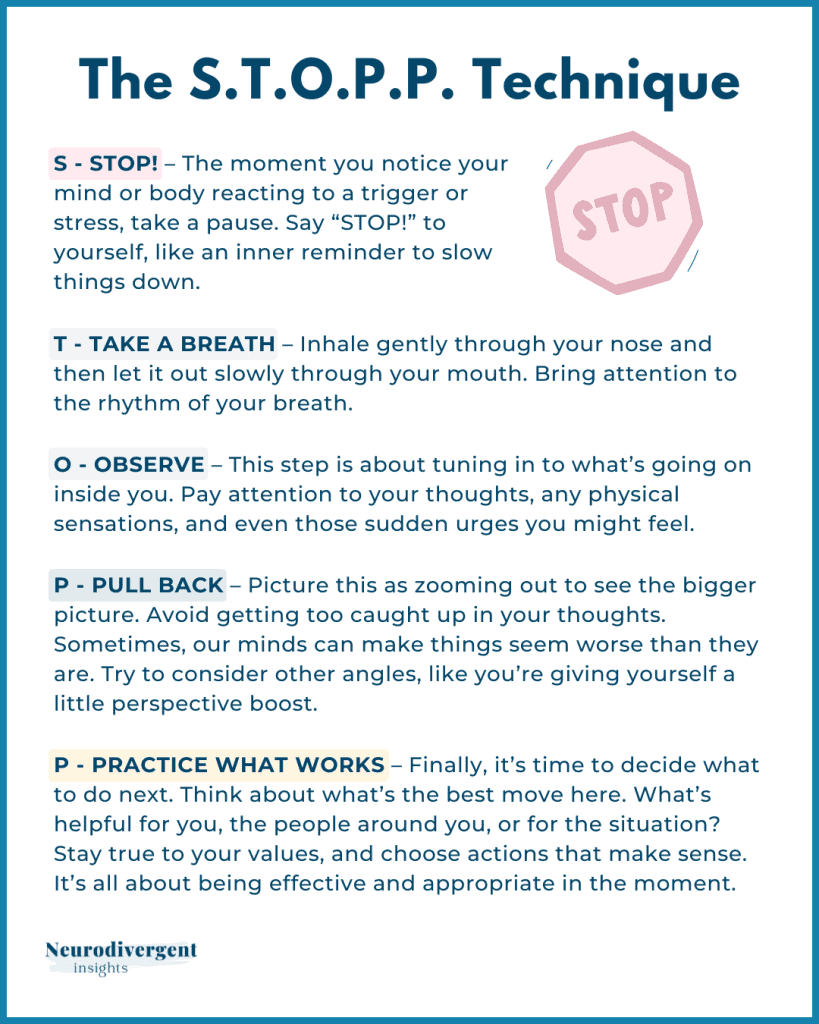
What helps: Mindfulness and self-regulation skills. One I like is STOPP, a CBT skill from Carol Vivyan. It’s an individual tool, but each partner can use it in heated moments:
- S: STOP! Imagine this as your mental brake button. The moment you notice your mind or body reacting to a trigger or stress, take a pause. Say “STOP!” to yourself, like your inner reminder to slow things down.
- T: TAKE A BREATH Inhale gently through your nose and then let it out slowly through your mouth. Feel the rhythm of your breath.
- O: OBSERVE Tune in to what’s going on inside you. Pay attention to your thoughts, any physical sensations, and even those sudden urges you might feel.
- P: PULL BACK Zoom out to see the bigger picture. Sometimes, our minds can make things seem worse than they are. Try to consider other angles.
- P: PRACTICE WHAT WORKS Decide what to do next. What’s helpful for you, for the people around you, or for the situation? Stay true to your values, and choose actions that make sense in the moment.
When we hit minor conflicts, pausing to use STOPP can help us steady ourselves before responding.
Trust Difficulties
RSD can make trust hard. Our struggle with trust can also strain relationships, leading our partners to feel constantly under scrutiny.
What helps: Building trust gradually, within secure and supportive relationships. Start with small, measured steps.
Communication Struggles
Expressing emotions and needs can be hard with RSD, resulting in frequent misunderstandings and unmet emotional needs. We may also avoid hard conversations, allowing issues to pile up over time.
What helps: Start by writing clear and concise statements about your feelings and needs. Consider various communication formats, as many neurodivergent people find written communication easier than verbal exchanges. While face-to-face conversations are ideal for important discussions, it can help to work towards this gradually. You can start communication through letters, voice memos, or notes, among other methods (if you’re prone to fight-flight energy, texting is best avoided, as it can lead to reactive responses and a lack of in-person context). Choose formats that build in a pause between receiving and responding, such as letter writing or email.
In face-to-face conversations, practicing active listening and using check-backs to clarify what you’ve heard can help.
Impact on Self-Esteem
Repetitive experiences of rejection or criticism can gradually chip away at our self-esteem and self-worth. This can leave us more susceptible to settling for unhealthy relationship dynamics, becoming vulnerable to exploitation, seeking partners who validate our identity, or adopting a people-pleasing role that loses our own identity in our partner’s.
What helps: Recognizing the toll that eroded self-esteem can take, and exploring where it comes from. Part of this work is treating ourselves with the same kindness we would offer a close friend. Over time, replacing self-criticism with self-compassion can strengthen our sense of self.
It also helps to understand how self-esteem influences who you’re drawn to and the dynamics that show up in your relationships.
Overcompensation
To avoid rejection, we may overcompensate with people-pleasing. This can lead to emotional exhaustion, a loss of authenticity in relationships, and unhelpful relational patterns that persist over time.
What helps: Psychological work that helps a person take in their own worth, including looking at where the people-pleasing came from. Clear boundaries rooted in self-care help too.
Insecurity
Persistent feelings of insecurity can disrupt the balance of power and trust in relationships. They can also lead to reassurance-seeking, which can increase anxiety and strain the relationship.
What helps: Open and honest conversations about our insecurities. By sharing these feelings and seeking support, both partners can create trust and emotional safety. Be mindful, though, not to fall into reassurance-seeking or confirming loops that can keep the cycle of insecurity going.
Anger and Projection
Another common response to RSD is projection and anger. RSD can trigger such intense emotional experiences that our psychological defense mechanisms, including projection, come into play. When we project, we unconsciously attribute the feelings we cannot tolerate onto others. In the context of RSD, this can unfold as follows: when we feel rejected, we may behave in ways that inadvertently make our partners feel rejected. Going back to the earlier example, if you ask your partner about their day and receive a brief response, you may interpret it as rejection and withdraw, giving minimal responses in return. This inadvertently leads to your partner experiencing the same feelings of rejection.
In response to rejection, a person may react with anger and lash out at their partner. This is a form of projection too, as the partner ends up feeling what the person with RSD finds so intolerable.
What helps: Recognizing projection and addressing underlying psychological defenses often requires in-depth psychological work. Many people find it helpful to work with a therapist to identify these patterns and develop strategies for tolerating difficult emotions (defenses tend to lower when it feels safe to do so). Pinpointing recurring patterns within the relationship can also break the cycle of projection. The EFT (Emotionally Focused Therapy) infinity loop can be a useful tool for identifying and addressing these patterns in a relationship.
Impact on Partner
RSD can affect partners too. Partners may become apprehensive about triggering RSD and start tip-toeing around certain topics, which can wear on their own mental and emotional well-being. This atmosphere of fragility can also get in the way of open and honest communication.
What helps: Talk to your partner openly about RSD and how it affects you. Share resources and personal stories to help them understand what you’re going through. Encourage your partner to express their own feelings and needs. Consider couples therapy as a way to work through the challenges together and support each other. The partner with RSD can work on being able to receive feedback non-defensively, which makes open communication possible.
Difficulty with Boundaries
Finally, people with RSD often struggle to set and keep healthy boundaries because they’re trying to avoid rejection. When we respond to rejection sensitivity by becoming people-pleasers, boundaries can get hard.
What helps: Recognizing that setting a boundary isn’t rejecting the other person; it’s a form of self-care. Once we believe boundaries are healthy and necessary, it gets easier to communicate them clearly. “I” statements can convey feelings and needs without blame or criticism.
How to Manage Rejection Sensitive Dysphoria in Relationships
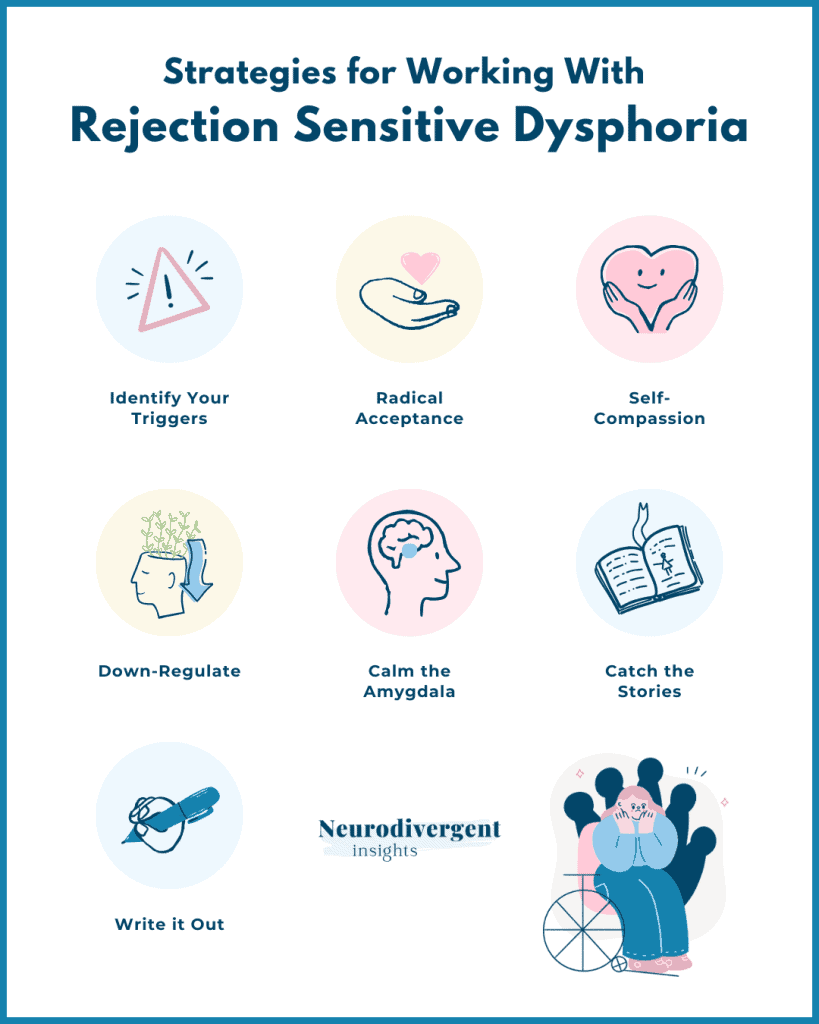
1. Recognize Your Relationship Triggers
Start by identifying what triggers your rejection sensitivity in your relationship. Create a list of situations, thoughts, and dynamics that trigger your RSD. Pay attention to your emotional responses and typical reactions, like seeking reassurance or withdrawing. This self-awareness makes these triggers easier to manage.
2. Catch the Dual Story with the EFT Infinity Loop
In relationships, both you and your partner may have your own narratives and perspectives following an attachment injury. Use the EFT infinity loop to map out and understand both stories. This tool helps you recognize and address these narratives together.
3. Use Journaling for Self-Reflection
Writing down your thoughts and feelings can help you process your emotions and gain clarity. Journaling about your experiences with rejection sensitivity in your relationship can help you gain insight.
4. Support Emotional Regulation
When RSD triggers a stress response, practice supportive techniques to help bring the emotional intensity back down. Practices such as slow breathing, progressive muscle relaxation, and sensory grounding can help calm your nervous system and reduce emotional distress.
5. Share Slow Breathing with Your Partner
Slow breathing can help your body calm down. Share slow breathing with your partner as a calming ritual. Inhale through your nose for a count of 4, hold for 1-2 seconds, and then exhale slowly through your mouth for a count of 6.
6. Try Progressive Muscle Relaxation Together
Invite your partner to join you in progressive muscle relaxation. Starting with your feet and working up, tense and then relax different muscle groups together.
7. Explore Sensory Grounding as a Couple
Identify activities or items that soothe you, such as scents or a warm bath. Encourage your partner to join in and focus on the sensations. Create a list of soothing activities or items to have on hand for both of you during intense emotional moments. Know when to take a “sensory break” when things are getting heated.
8. Practice Communication
Use resources designed for couples, such as exercises in active listening, needs identification, and narrative exploration. Practice in calm moments, not only during conflicts. For instance, practice active listening by asking about each other’s days and reflecting back what you’ve heard your partner say.
9. Self-Compassion and Acceptance
Self-compassion gives us something to offer ourselves when rejection hits. This can be especially helpful when your partner can’t offer compassion, such as during a conflict. Here are eight relationship affirmations you can practice on your own:
RSD and Relationship Affirmations
I am in control of my emotional responses, and I choose love and understanding.
I have the capacity to attract and nurture relationships that contribute to my growth and happiness.
I trust that my vulnerability in relationships is a source of connection and growth.
My worth is not determined by the actions or opinions of others.
I am worthy of love and acceptance, exactly as I am.
I acknowledge my unique qualities, and they are valued in the important relationships in my life.
I am deserving of healthy, loving, and fulfilling relationships.
I trust in my ability to create and maintain meaningful connections.
Rejection Sensitive Dysphoria and Relationship Resources
Books on Communication and Relationships
This post contains affiliate links. If you buy through them, we may earn a small commission at no extra cost to you. We only link to things we use or trust.
Here are a few books that may be helpful:
The ADHD Effect on Marriage: Melissa Orlov’s book is a little dated, but it was named best psychology book of 2010 by ForeWord Reviews and was one of the first books to open the conversation about ADHD and relationships.
Attached: While not directly related to RSD, this book covers attachment theory in romantic partnerships. Given the overlap between rejection sensitivity and insecure attachment, understanding attachment systems can help your relationship when affected by RSD.
ADHD & Us: Written by ADHD couples therapist Anita Robertson, this book takes a non-pathologizing look at how to work with ADHD-related relationship difficulties.
Hold Me Tight: While not tailored to RSD, Sue Johnson’s book uses Emotionally Focused Therapy to help couples identify and address relationship patterns and cycles. Since RSD often feeds unhelpful patterns, this book can be very helpful. It also offers practical exercises for couples at the end of each chapter.
Mating in Captivity: Although not RSD-specific, Esther Perel’s insights on relationships offer a helpful framework for understanding contemporary challenges in marriage and romance.
Other Voices I Trust
Esther Perel offers excellent relationship resources, including her Where Should We Begin? podcast. In this podcast, she conducts live counseling sessions with couples, showing the dynamics at play and her therapeutic thought process. Personally, my favorite relationship resource is Esther Perel. Although not directly addressing RSD, her work helps with relational dynamics and communication, which can help couples with RSD. For self-compassion, Dr. Kristin Neff has self-guided resources and audio recordings.
The Rejection Sensitive Dysphoria Bundle
For more on RSD and how to work with it, see our RSD bundle; it includes a 160-page workbook, a Toolkit, affirmation cards, and RSD journal activities.
Summary
RSD, marked by heightened emotional responses to actual or perceived rejection, can leave us feeling emotionally drained. In relationships, it can lead to misunderstandings, trust issues, communication breakdowns, and emotional turbulence.
Clear communication, trust-building, self-compassion, and boundary-setting can all help. This work takes time.
RSD in Relationships FAQs
Additional Resources
For ongoing insights and updates, subscribe to the Neurodivergent Insights Newsletter. Each Sunday, I send out fresh thoughts and a roundup of the newest resources on topics related to neurodivergence, mental health, and wellness. My most personal writing is reserved for my newsletter, and subscribers also get access to the newsletter vault (12+ PDFs) when they join.
References
Biederman, J., et al. (2006). Functional impairments in adults with self-reports of diagnosed ADHD: A controlled study of 1001 adults in the community. Journal of Clinical Psychiatry.
Dodson, W. (2020, updated 2025). New insights into rejection sensitive dysphoria. ADDitude.
Kross, E., Berman, M. G., Mischel, W., Smith, E. E., & Wager, T. D. (2011). Social rejection shares somatosensory representations with physical pain. Proceedings of the National Academy of Sciences.
Orlov, M. (2013). ADHD doesn’t cause divorce, denial does. Psychology Today.
Vivyan, C. (2009). STOPP. Get Self Help.





 Stay in the Neurodivergent Loop