Rejection sensitivity spirals have been a recurring theme in my life. A comment at work, a glance I couldn’t read, even well-meant feedback could turn into an emotional landmine.
When I came across the term Rejection Sensitive Dysphoria (RSD), I started to see my reactions differently. I wasn’t just “too sensitive.” This was a pattern many ADHD people share. I saw it in my clinical work and in my own life, and understanding it has made it easier to work with.
RSD is an intense emotional reaction to rejection or criticism, actual or perceived. It isn’t a formal diagnosis. Psychiatrist William Dodson popularized the term, and many ADHD adults find it describes something they know well.
Table of Contents
What Is Rejection Sensitivity?
Not everyone has RSD, but everyone is sensitive to rejection to some degree. It’s the flip side of our need to belong. When belonging feels at risk, rejection sensitivity works like an alarm, telling us something in a relationship needs attention.
Attachment theory adds another layer: our early relationships shape how loudly that alarm rings and how we respond when it does.
Rejection Sensitivity Through an Evolutionary Lens
For early humans, belonging to a group meant protection, food, and a better chance of surviving and having children. Being pushed out of the group could be dangerous. Psychologists who study rejection describe the need to belong as one of our most basic needs, one that likely helped early humans survive.
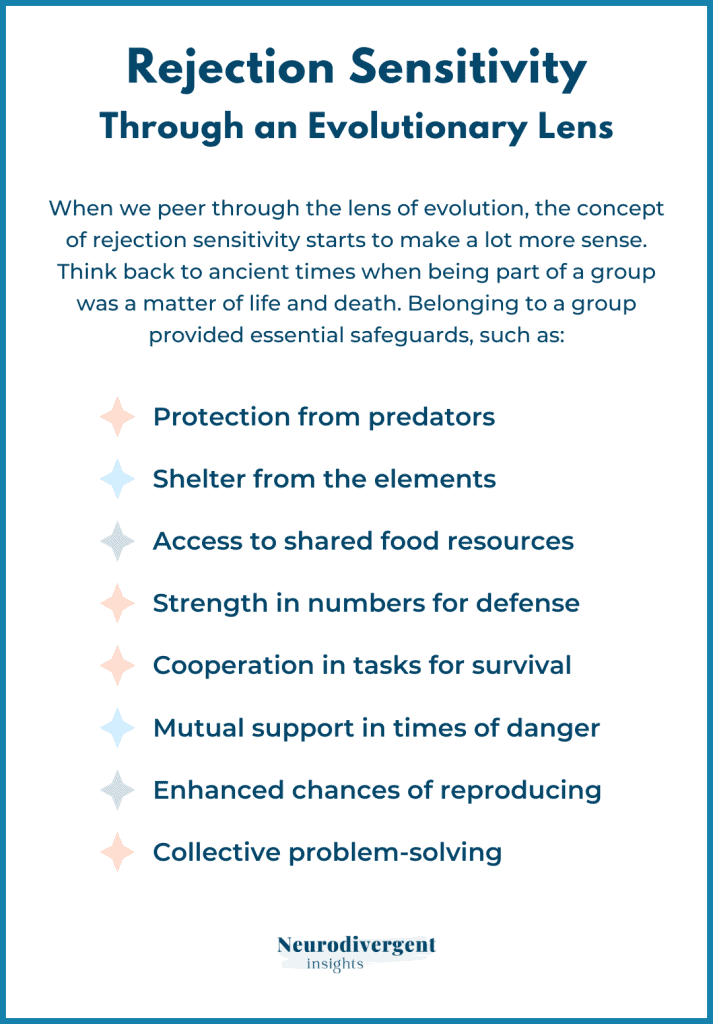
Most of us no longer depend on one small group to survive, but our brains still treat rejection as a threat. That’s part of why it can hurt so much. (I go deeper into this history in Uncovering the Roots and Evolution of Rejection Sensitivity.)
The Rejection Sensitivity Spectrum
We all react to rejection differently. It might show up as hostility, sadness, withdrawal, or even jealousy. Attachment style plays a part too: people with a more avoidant style may pull back, while people with a more anxious style may rush to repair things. People with a secure attachment tend to sit lower on the sensitivity spectrum.
People higher on the spectrum are more easily triggered, often by perceived rejection rather than intended rejection. Psychologists Geraldine Downey and Scott Feldman defined rejection sensitivity as the tendency to “anxiously expect, readily perceive, and overreact to rejection.”
Rejection sensitivity can also ebb and flow over a lifetime. Stress, lack of sleep, and mental health can all turn it up or down.
Those of us with RSD sit at the far end of this spectrum, where the alarm meant to protect our relationships goes off more often and becomes less reliable.
It’s as if someone turned up the volume on ordinary rejection sensitivity.
What Is Rejection Sensitive Dysphoria?
RSD goes further than everyday rejection sensitivity. Dysphoria comes from a Greek word meaning “difficult to bear.” RSD is an extreme, often overwhelming emotional reaction to rejection or criticism, whether or not anyone meant it that way. It can make relationships, work, and daily life much harder.
Dodson has described it this way:
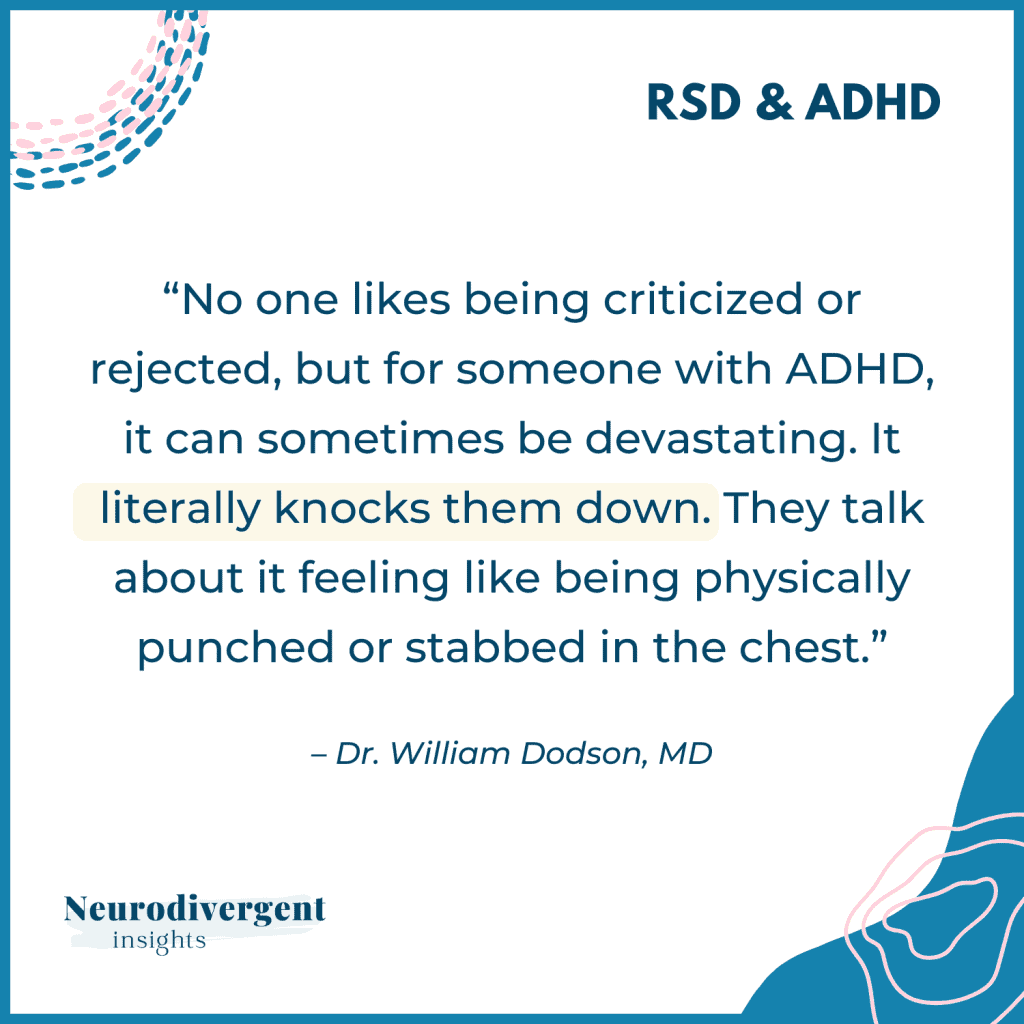
Think of the ache after a breakup, then imagine feeling a version of it after an ordinary conversation.
RSD can also make us perceive rejection where there isn’t any.
Perceived Rejection
With RSD, it’s as if our radar for rejection is turned all the way up. Small things, like a missing “thanks” or a short reply, can register as rejection even when nothing of the sort was meant.
You crack a joke and the other person doesn’t laugh. Maybe they’re distracted, or the joke just didn’t work for them. But you read their silence as rejection.
The more closely we scan for rejection, the more of it we seem to find, which can leave us feeling rejected more often than we are. For many of us, perceived rejection drives a lot of the emotional dysregulation that comes with RSD.
Signs of Rejection Sensitive Dysphoria
RSD can show up in many ways. Common signs include:


Emotional reactions that feel much bigger than the moment
Fast mood shifts after a perceived slight
Physical pain, like a punch to the gut or a tight chest
Ongoing worry about how others see us
A harsh, negative self-image
Reading rejection into neutral social cues
Avoiding social situations
Holding back at work, like not going for a promotion
Taking feedback and criticism very hard
Emotional and Physical Pain
Intense emotional pain is the hallmark of RSD. Even a perceived rejection can hurt far more than ordinary disappointment, and for many of us it hurts physically too.
Many ADHD people describe the pain of rejection as a punch to the gut or another intensely physical reaction.
In one 2011 brain-imaging study, people who had recently gone through an unwanted breakup looked at a photo of their ex, and brain areas involved in the physical sensation of pain became active.
Negative Self-Image
Each perceived rejection can chip away at self-esteem. Lower self-esteem then makes neutral moments easier to read as rejection, and the loop keeps going.
Reading Rejection Into Social Cues
RSD often comes with heightened vigilance for social cues.
Imagine walking into a gathering with your rejection radar finely tuned. A smile that doesn’t linger, a moment of distraction, or an offhand remark can set off a cascade of thoughts, convincing you that you’re being rejected.
Avoiding Rejection and Criticism
Avoidance is one way many of us cope. If an invitation, a performance review, or sharing our work might bring rejection or criticism, staying away can feel safer. It does protect us in the short term. Over time, though, it can shrink our social lives and our chances to grow at work.
RSD in ADHD and Autism
RSD is most often talked about in ADHD, where the term started. Psychiatrist William Dodson estimates that almost everyone with ADHD experiences some rejection sensitivity, and he has written that about a third of his adult patients describe RSD as the most impairing part of their ADHD. These numbers come from his practice rather than research studies. Strong emotional reactions are common in ADHD more broadly.
Autistic people describe it too. In a 2025 interview study, 19 Autistic adults described rejection sensitivity as overwhelming and exhausting, with physical tension and pain, and many traced it to a lifetime of rejection experiences. Research on how common RSD is in either group is still early.
Why might rejection hit neurodivergent people harder? A few factors tend to stack up:
- Many of us have nervous systems that react more strongly to stress.
- All-or-nothing swings are common: deeply connected one moment, completely rejected the next.
- Childhood often brings more rejection, bullying, and social exclusion, which can leave us more sensitive to disconnection.
- Living in a world that doesn’t always accommodate our needs, we may absorb hurtful messages that we’re inadequate or “less than.”
- Feeling different from our peers can deepen the sense of being on the outside.
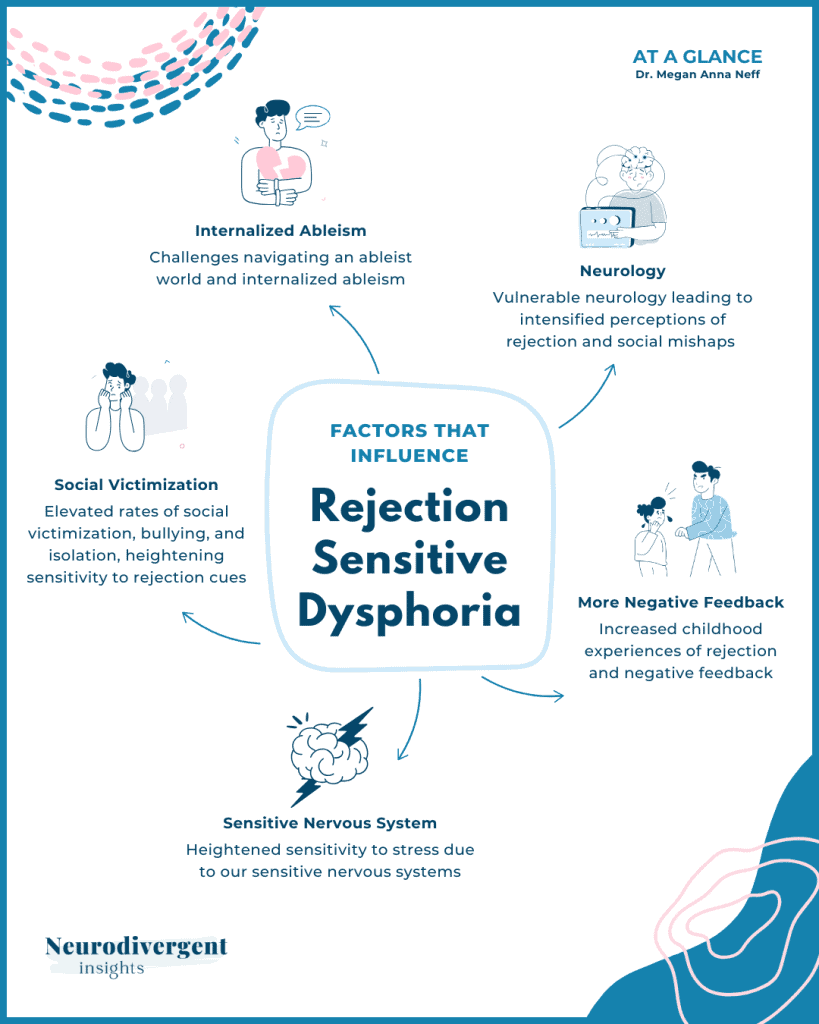
These stack up most in spaces built for neurotypical people.
How RSD Affects Daily Life
RSD can affect many parts of life:
- Emotions. Even a hint of rejection can set off intense distress, which makes emotional regulation harder.
- Relationships. Fear of rejection can lead us to pull back, and big reactions to perceived slights can strain relationships.
- Work and school. Fear of criticism can keep us from sharing ideas or going after opportunities.
- Self-esteem. Over time, constant sensitivity to rejection can wear down how we see ourselves.
- Mental health. The ongoing stress may add to anxiety and depression.
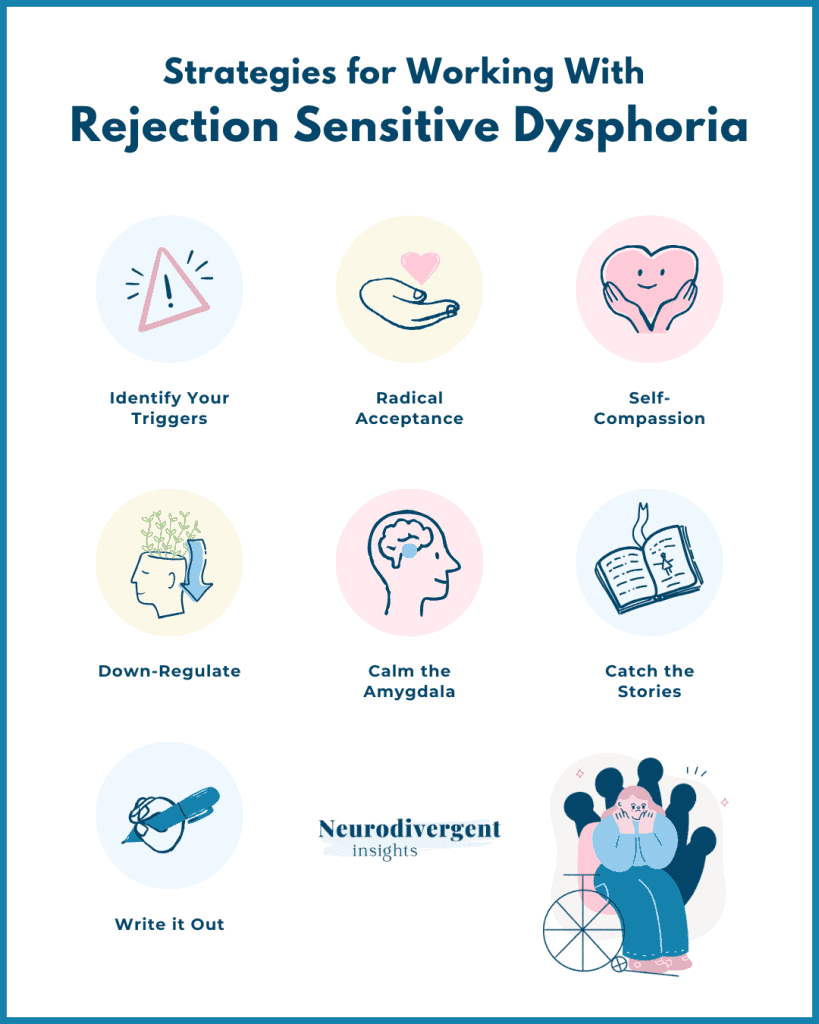
What Helps: 7 Strategies for RSD
These seven practices can help. Think of them as a menu of options: take what interests you and leave the rest.
Identify your triggers. Notice which situations, people, or moments tend to set off a strong reaction. Knowing the pattern makes it easier to respond instead of react.
Practice radical acceptance. Let the feelings be there without judging ourselves for having them.
Offer yourself compassion. RSD often comes with harsh self-talk. Kindness toward ourselves, including small acts of self-care, can loosen that loop.
Down-regulate your nervous system. Rejection can activate both our stress response and our need for connection. Calming practices like slow breathing or movement can help things settle.
Remind your body you’re safe. When rejection hits, the body’s stress response can kick in as if we were in physical danger. Reminding ourselves that we’re not can help us respond more skillfully.
Catch the stories. After a perceived rejection, our minds often spin stories that lead to rumination and self-blame. Noticing a story as it forms gives us a chance to step back from it.
Write it out. Journaling can help us sort through what happened and how we feel about it.
Some people find that ADHD medication, or the non-stimulants guanfacine and clonidine that Dodson describes, takes the edge off RSD. A prescriber who knows ADHD well can talk through options.
For more tools, see Managing Rejection Sensitive Dysphoria: Tools to Support ADHD Brains.
A Few Closing Thoughts
Rejection sensitivity is part of being human, rooted in our need to belong. RSD turns the volume up, and for many neurodivergent people it shapes relationships, work, and how we see ourselves. Go easy on yourself while you figure out which tools help.
If you’d like to go deeper, my RSD workbook has exercises and worksheets for working with RSD. Since you made it to the end, here’s a coupon: use EvolveRSD for $5 off.
Rejection Sensitive Dysphoria FAQs
Is RSD a formal diagnosis?
No. You won’t find RSD in the DSM-5-TR. It’s a term psychiatrist William Dodson popularized to describe the intense emotional pain some people feel after rejection or criticism, whether actual or perceived.
Is RSD only an ADHD thing?
The term comes from ADHD, and that’s where it’s most often discussed. Autistic people describe it too, and in a 2025 interview study, Autistic adults described rejection sensitivity as overwhelming and exhausting.
What does RSD feel like?
Many people describe intense emotional pain after a perceived rejection or criticism, sometimes felt physically, like a punch to the gut. It can also show up as fast mood shifts, a harsh self-image, and avoiding situations where rejection might happen.
Can medication help with RSD?
Some people find it does. Dodson describes using the non-stimulants guanfacine and clonidine, and some people notice their ADHD medication helps too. His estimates come from his practice rather than trials, so talk through options with a prescriber who knows ADHD.
Additional Resources

Managing Rejection Sensitive Dysphoria: Tools to Support ADHD Brains Practices for working with RSD day to day

Rejection Sensitivity vs. RSD: 10 Key Differences How RSD differs from everyday sensitivity to rejection

Rejection Sensitive Dysphoria in Relationships How RSD shows up with partners, and what helps
RSD and Friendships When RSD gets in the way of friendship
 Stay in the Neurodivergent Loop
For ongoing insights and updates, subscribe to the Neurodivergent Insights Newsletter. Each Sunday, I send out fresh thoughts and a roundup of the newest resources on topics related to neurodivergence, mental health, and wellness. My most personal writing is reserved for my newsletter, and subscribers also get access to the newsletter vault (12+ PDFs) when they join.
References
Blader, J. C. (2021). Attention-deficit hyperactivity disorder and the dysregulation of emotion generation and emotional expression. Child and Adolescent Psychiatric Clinics of North America, 30(2), 349–360. https://doi.org/10.1016/j.chc.2020.10.005
Cassata, C. (2022). ADHD and rejection sensitive dysphoria [Interview with W. Dodson]. ADHD Online. https://adhdonline.com/articles/adhd-and-rejection-sensitive-dysphoria/
DeWall, C. N., & Bushman, B. J. (2011). Social acceptance and rejection: The sweet and the bitter. Current Directions in Psychological Science, 20(4), 256–260. https://doi.org/10.1177/0963721411417545
Dodson, W. (n.d.). RSD: Meaning of rejection sensitive dysphoria, ADHD link. ADDitude. https://www.additudemag.com/rejection-sensitive-dysphoria-and-adhd/
Dodson, W. (n.d.). Rejection sensitive dysphoria (RSD): ADHD and emotional dysregulation. ADDitude. https://www.additudemag.com/rejection-sensitive-dysphoria-adhd-emotional-dysregulation/
Dodson, W. Rejection sensitive dysphoria [Podcast interview]. Take Control ADHD, Episode 405. https://takecontroladhd.com/podcast/405
Downey, G., & Feldman, S. I. (1996). Implications of rejection sensitivity for intimate relationships. Journal of Personality and Social Psychology, 70(6), 1327–1343. https://doi.org/10.1037/0022-3514.70.6.1327
Kross, E., Berman, M. G., Mischel, W., Smith, E. E., & Wager, T. D. (2011). Social rejection shares somatosensory representations with physical pain. Proceedings of the National Academy of Sciences, 108(15), 6270–6275. https://doi.org/10.1073/pnas.1102693108
van Asselt, A., Roke, Y., Begeer, S. M., & Scheeren, A. M. (2025). ‘Feeling constantly kicked down’: A qualitative phenomenological study exploring rejection sensitivity in autistic adults. Autism, 29(11), 2703–2714. https://doi.org/10.1177/13623613251376893