Feeling disconnected, foggy, or exhausted one day, and anxious, overwhelmed, and frazzled the next can be a sign of a narrow window of tolerance: our nervous system’s capacity to handle stress while staying engaged and present.
In my clinical work, I saw how understanding and gently expanding the window of tolerance helped people feel more grounded in their daily lives. The idea is especially relevant for neurodivergent people. Many of us have more sensitive sensory and nervous systems, which can leave us with a narrower window and less room before everyday stress tips us out of it. Learning how our own window works is a first step toward building more capacity over time.
Table of Contents
What Is the Window of Tolerance?
The term window of tolerance comes from psychiatrist Dan Siegel, who introduced it in his 1999 book The Developing Mind. It describes a state of nervous system balance where we can stay present, adaptable, and engaged with what’s around us. Inside this window, we can respond to everyday stressors without becoming overwhelmed, and our executive functioning (our ability to plan, focus, and manage tasks) works at its best.
Some therapists prefer to call it the window of creativity.
I like to think of it as a window of authentic engagement, the range where we can show up as ourselves.
Throughout the day, our nervous system naturally shifts between higher and lower arousal. Sometimes the sympathetic nervous system (the “fight or flight” gas pedal) takes the lead, like when we’re exercising or facing a challenge. Other times the parasympathetic nervous system (the “rest and digest” brakes) is more active, like when we’re winding down for sleep. These shifts are normal and necessary. As long as we stay present, grounded, and engaged, we’re within our window.

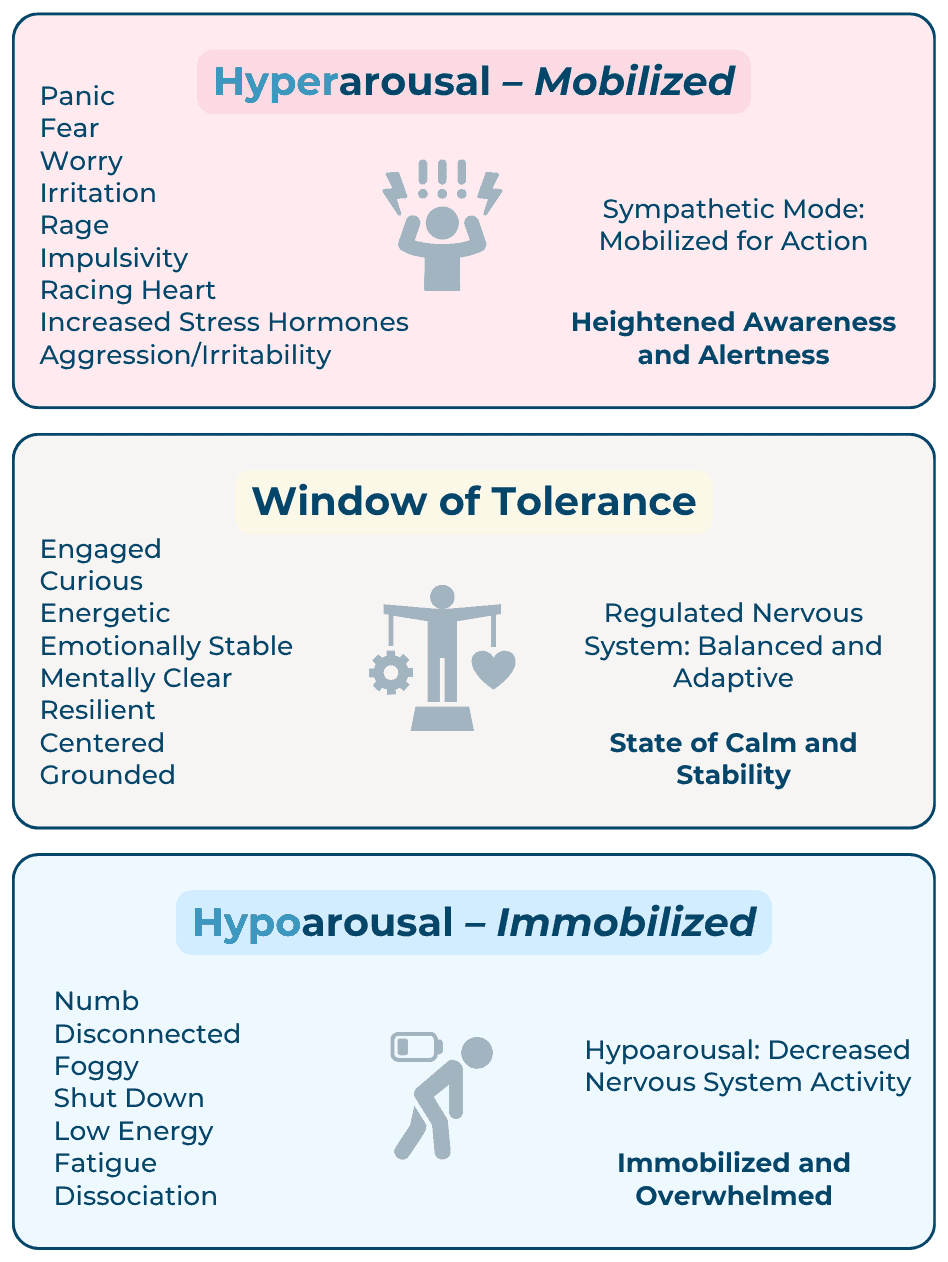
The larger our window, the more we can handle before we become dysregulated. When stress goes beyond what we can manage, we tip out of the window, and it tends to go one of two ways: hyperarousal (revving up) or hypoarousal (shutting down).
The Vagus Nerve and Vagal Tone
If the sympathetic nervous system is the gas pedal, the vagus nerve is a big part of the brakes. It’s the main nerve of the parasympathetic branch, and it helps regulate heart rate, breathing, and digestion. When it’s more active, the heart slows and the body can rest. When it’s less active, the body is more geared toward action and alertness.
Vagal tone describes how well the vagus nerve is doing this job. Higher vagal tone is linked with a more flexible nervous system, one that can meet stress and recover more quickly, which can make it easier to stay present during daily challenges. For more on how this plays out for us, see The Autistic and ADHD Nervous System.
Hyperarousal
Hyperarousal is a state where the sympathetic nervous system takes over and the fight-or-flight response kicks in. The body mobilizes for action, and we may feel anxious, on edge, hypervigilant, or afraid. Physically, this can look like a faster heart rate, rapid and shallow breathing, higher blood pressure, and more stress hormones like adrenaline and cortisol. When we’re stuck here, we may become more argumentative, defensive, panicky, or impulsive.
Hypoarousal
If hyperarousal is the system revving up, hypoarousal is the system shutting down to manage overwhelm. In this state, we might feel depressed, fatigued, foggy, numb, or dissociated. Dissociation is common here: the mind steps back from the present moment as a form of protection. Physically, hypoarousal can bring a slower heart rate and shallower breathing. It can be hard to make decisions, focus, or engage socially, because the body is conserving energy rather than activating.
Hypoarousal is easy to mistake for calm. Autistic clinician and author Finn Gratton calls this faux regulation: looking calm on the surface while being stressed underneath. I go deeper into both states in Hypoarousal vs. Hyperarousal.

What Can Affect the Window of Tolerance?
The size of our window shapes how much stress we can handle before tipping into hyperarousal or hypoarousal. A larger window gives us more room. A smaller one means we tip out more easily.

Trauma is one significant factor. People who have lived through ongoing trauma, especially in childhood, often have a narrower window. When the nervous system spends its formative years under constant stress, it can learn to stay on high alert or to shut down as a way of staying safe.
The Window of Tolerance and Neurodivergence
Neurodivergence can shape the window too. Many Autistic, ADHD, and OCD people have more sensitive sensory and nervous systems, so more of everyday life registers as intense. Add the steady stress of masking and higher rates of adverse experiences, and many of us end up with a narrower window and less room before we tip out of it.
Autistic and ADHD people often have what I call more “rigid nervous systems.” Research points in a similar direction. A 2020 meta-analysis of 34 studies found lower resting heart rate variability (HRV) in Autistic people, and a 2019 meta-analysis found slightly lower HRV in ADHD during tasks, though findings in ADHD are mixed. Lower HRV goes along with lower vagal tone and a less flexible stress response, which can make it easier to become dysregulated, whether that looks like hyperarousal, hypoarousal, or both.
Stress hormones may play a part as well. One study found that Autistic children had a bigger and longer-lasting cortisol response to a stressful medical procedure. When the stress response runs bigger and longer, coming back into our window can take extra time, effort, and support.
Understanding Your Window of Tolerance
To get to know your nervous system, it helps to check in with yourself regularly, a practice sometimes called nervous system mapping. This might mean setting aside a moment once or twice a day to take a breath, scan your body, and notice how you’re feeling.
During a body scan, you might notice slow breathing or fatigue, which can point to hypoarousal. Or you might notice a racing heart or tension, which can point to hyperarousal. If you feel grounded and calm, you’re likely within your window.
Checking in consistently can reveal patterns over time. Personally, I tend to experience hypoarousal when dysregulated, so I might engage in activities that help energize my nervous system, like walking or listening to music. Understanding and tracking these patterns is a helpful first step in gradually expanding your window of tolerance.
This post contains affiliate links. If you buy through them, we may earn a small commission at no extra cost to you. We only link to things we use or trust.
Another way to get to know your window is by tracking heart rate variability (HRV), which reflects how flexibly your heart rate adapts to change. Higher HRV is generally linked with a more flexible stress response. Devices like an Apple Watch or a Fitbit can track HRV. To learn more, see What Is HRV?
How to Widen Your Window of Tolerance
Many tools and practices can help widen the window of tolerance. Psychological work, such as processing trauma and healing attachment wounds, can be foundational. Working directly with the nervous system through specific practices can help too. When introducing new practices, go slowly. Trying one or two exercises consistently for a month before adding more can prevent overwhelm.
Breathwork
Slow, deep breathing can be a simple way to engage the vagus nerve, easing anxiety and helping you feel more grounded. On the flip side, a few quick breaths may give you a boost of energy when you’re feeling flat.
Laughter
Laughter often brings deep belly breathing with it, which may help stimulate the vagus nerve. It’s a gentle reason to make room for the things that make you laugh.
Humming, Chanting, and Singing
The vagus nerve runs past the vocal cords, so using your voice through humming, chanting, or singing may help engage it. One small brain-imaging study found that chanting “om” quieted activity in areas involved in stress and emotion.
Vagal Nerve Stimulators
Some people use a vagal nerve stimulator as part of their regulation toolkit. My personal favorite is the Sensate (use code NeuroInsights for 10% off). Ear-clip devices that send a gentle current through the outer ear, sometimes used with a TENS unit with ear clips, are another option, though research on them is still early.
Exercise and Movement
Fitness and vagal activity are closely linked, and moving your body can help regulate the nervous system. Whether it’s a vigorous walk, some weightlifting, or gentle somatic movement, find what feels good for you. Weightlifting also gives the joints and muscles deep pressure input, which many neurodivergent people find calming.
Mindfulness and Meditation
Mindfulness and meditation may help boost heart rate variability, and when combined with slow breathing, they can engage the vagus nerve.
Omega-3s and Gut Health
Some research links omega-3s to higher heart rate variability, though results aren’t consistent. The vagus nerve also connects the gut and the brain, and researchers are exploring how gut health shapes stress and mood. That research is still early.
Massage
Massage, whether from someone else or self-massage, can be a soothing way to calm the body, and gentle touch may help release oxytocin, the bonding hormone.
Havening
Havening is a self-soothing technique that uses comforting touch. Try cupping your hands on your cheeks or crossing your arms as if giving yourself a hug.
Cold Exposure
Brief cold exposure, like ending your shower with 30 seconds of cold water, may help stimulate vagal activity. In one study, cold applied to the side of the neck raised heart rate variability in healthy adults. Cold can be intense, so go gently, and check with your doctor first if you have heart or circulation concerns.
Relaxation Exercises
Relaxation exercises like progressive muscle relaxation (PMR) or a guided body scan can help bring your body out of a stressed state. They’re good tools to use before bed, in the morning, or whenever you need to recover from stress.
A Few Closing Thoughts
When we’re inside our window of tolerance, we can meet the day with more clarity and presence. When we’re pushed outside it, our nervous system takes over to protect us, sometimes in ways that don’t serve us. Widening the window is slow work, built through noticing our patterns and practicing a few regulating tools over time.
If you’d like a place to start, our Nervous System Workbook has more on understanding your nervous system and expanding your window of tolerance.
Window of Tolerance FAQs
What is the window of tolerance?
The window of tolerance is the range where our nervous system can handle stress while we stay present, engaged, and able to think. The term comes from psychiatrist Dan Siegel.
What happens when you leave your window of tolerance?
We tend to go one of two ways: hyperarousal (anxious, on edge, revved up) or hypoarousal (foggy, numb, shut down). Both are protective responses.
Do neurodivergent people have a smaller window of tolerance?
Many do. More sensitive sensory and nervous systems, the stress of masking, and higher rates of adverse experiences can leave less room before we tip out. Research also finds lower heart rate variability, on average, in Autistic people.
How can you widen your window of tolerance?
Slowly. Getting to know your own patterns helps, along with regulating practices like slow breathing, movement, humming, and soothing touch. Try one or two consistently for a month before adding more.
Additional Resources

The Neurodivergent Nervous System Workbook: worksheets for mapping your nervous system and widening your window

Nervous System & Sensory Comfort: my shop collection of tools I use (affiliate links)

Hypoarousal vs. Hyperarousal: what each state looks and feels like
13 Ways to Reset Your Nervous System: more practical regulation tools
 Stay in the Neurodivergent Loop
For ongoing insights and updates, subscribe to the Neurodivergent Insights Newsletter. Each Sunday, I send out fresh thoughts and a roundup of the newest resources on topics related to neurodivergence, mental health, and wellness. My most personal writing is reserved for my newsletter, and subscribers also get access to the newsletter vault (12+ PDFs) when they join.
References
Bellato, A., Arora, I., Hollis, C., & Groom, M. J. (2020). Is autonomic nervous system function atypical in attention deficit hyperactivity disorder (ADHD)? A systematic review of the evidence. Neuroscience & Biobehavioral Reviews, 108, 182–206.
Cheng, Y.-C., Huang, Y.-C., & Huang, W.-L. (2020). Heart rate variability in individuals with autism spectrum disorders: A meta-analysis. Neuroscience & Biobehavioral Reviews, 118, 463–471.
Christensen, J. H. (2011). Omega-3 polyunsaturated fatty acids and heart rate variability. Frontiers in Physiology, 2, 84.
Gerritsen, R. J. S., & Band, G. P. H. (2018). Breath of life: The respiratory vagal stimulation model of contemplative activity. Frontiers in Human Neuroscience, 12, 397.
Gourine, A. V., & Ackland, G. L. (2019). Cardiac vagus and exercise. Physiology, 34(1), 71–80.
Gratton, F. V. (2019). Supporting transgender autistic youth and adults: A guide for professionals and families. Jessica Kingsley Publishers.
Jungmann, M., Vencatachellum, S., Van Ryckeghem, D., & Vögele, C. (2018). Effects of cold stimulation on cardiac-vagal activation in healthy participants: Randomized controlled trial. JMIR Formative Research, 2(2), e10257.
Kalyani, B. G., Venkatasubramanian, G., Arasappa, R., Rao, N. P., Kalmady, S. V., Behere, R. V., Rao, H., Vasudev, M. K., & Gangadhar, B. N. (2011). Neurohemodynamic correlates of ‘OM’ chanting: A pilot functional magnetic resonance imaging study. International Journal of Yoga, 4(1), 3–6.
Robe, A., Dobrean, A., Cristea, I. A., Păsărelu, C. R., & Predescu, E. (2019). Attention-deficit/hyperactivity disorder and task-related heart rate variability: A systematic review and meta-analysis. Neuroscience & Biobehavioral Reviews, 99, 11–22.
Siegel, D. J. (1999). The developing mind: Toward a neurobiology of interpersonal experience. Guilford Press.
Spratt, E. G., Nicholas, J. S., Brady, K. T., Carpenter, L. A., Hatcher, C. R., Meekins, K. A., Furlanetto, R. W., & Charles, J. M. (2012). Enhanced cortisol response to stress in children in autism. Journal of Autism and Developmental Disorders, 42(1), 75–81.