
Anxious Anxiety
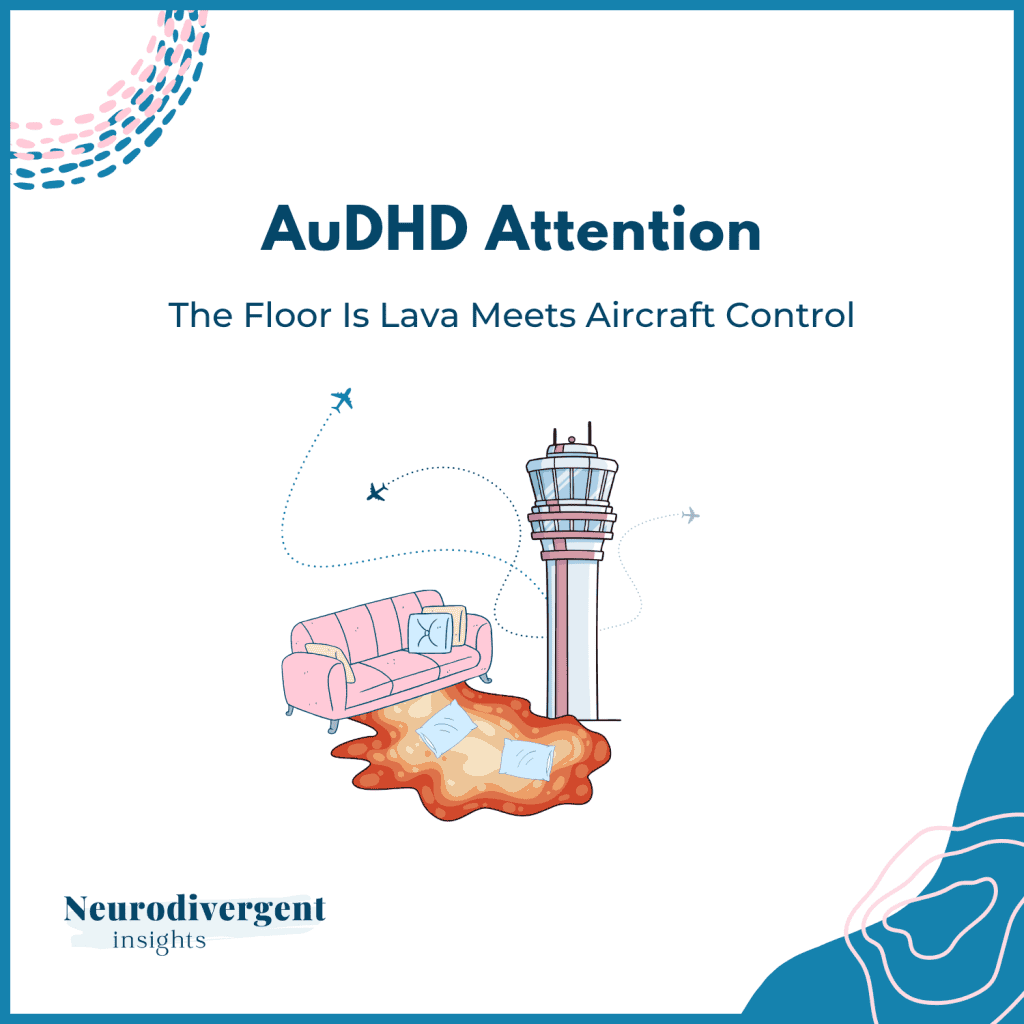
Today’s essay is my final one in this 7-part series I’ve done on attention. I started this attention series because, frankly, I was struggling with my own attention. My mind kept drifting toward content that wasn’t nourishing me, and I could feel myself getting pulled into a hyperfixation that was doing more harm than good. What surprised me was how quickly the writing itself reshaped my attention. The more I learned, the more captivated I became by the sheer complexity and intricacy of attention itself.
I didn’t expect to discover how distinct attention feels inside the Autistic mind and the ADHD mind, or how woven attention is into the fabric of how we experience ourselves and the world.
As I wrap up this series, I wanted to turn toward one last flavor of attention: the kind that emerges when we live with an anxiety condition or OCD. Anxiety disorders are among the most common co-occurring mental health conditions for both ADHD and autism. While OCD is less prevalent overall, it is noticeably more common among Autistic and ADHD people than in the general population.
Table of Contents
Anxious Attention: A Life That Shrinks
When I think about anxious attention, I think about how small and tight the world gets when I’m pulled into its tunnel. It’s not the same pleasant vortex of monotropism. It’s like monotropism has walked into a clown fun house and you’re being forced to stare at distorted threats with no escape.
While I have anxiety that ebbs and flows, the worst was during my postpartum years. I had postpartum anxiety that I didn’t have the language or support for at the time, and my attention often collapsed into threat.
I would drive to the grocery store with my toddler and become convinced on the drive over that a mass casualty event would happen. I’d turn around the car and go home, talk myself down, try again. Even when I finally made it through the doors, my eyes stayed glued to the entrance, I’d scan for exits and I’d get in and out as fast as humanly possible. I likely looked like a terrified human quickly grabbing items and rushing people along to get out of there. Because in my mind, I was in danger, my attention had narrowed to focus on that.
Or noticing a mark on my body that my mind decided meant something catastrophic. My attention would snap to it, everything else feeling like an irrelevant irritant because, obviously, I had to determine whether I was dying this exact moment while frantically googling symptoms.
That’s what anxious attention does — it narrows. It shrinks the world to the one thing your brain has decided it must prevent. My anxious mind monkey hops from tree to tree, and as soon as I’d resolve one tree it would hop to another and I’d become aware of another threat that demanded all of my attention.
The content can be a hundred different things. On the surface my anxious moments can look quite different, but internally the sensation is similar: the world shrinking to a single point, my body bracing, my mind convinced that if it just pays close enough attention it can keep disaster away.
Anxious and OCD Attention
And that’s the thing with anxious and OCD attention: it narrows.
It narrows because the nervous system has shifted into threat mode. It’s doing the job it believes it needs to do. Anxious attention scans for danger, trying to anticipate the thing that might go wrong. The intention is protective.
And here’s the tricky part: anxiety itself is not bad. When we’re truly in danger, we want our attention to sharpen. We want our senses to heighten, our focus to zoom in, our body to orient toward the important cues. This is a life-saving mechanism — one we’re wired to have.
Anxiety becomes pathological or disordered when there’s a mismatch between the alarm and the environment. A metaphor that is commonly used to describe this distinction is the fire alarm:
A healthy fire alarm goes off when there’s real smoke in the house.
Having an anxiety disorder is like having an overly sensitive fire alarm, the kind that is set off when you make pancakes or toast bread.
That’s what it’s like to live with an anxiety condition: you’re in a house where the alarm keeps sounding, even during ordinary, safe moments. And part of why it feels so real is that the brain’s threat system, especially the amygdala, can’t reliably distinguish between actual danger and perceived or imagined danger. When the alarm goes off, your body treats it as a house on fire.
OCD attention is similar, but it carries a different flavor. OCD attention goes a step deeper by turning the spotlight onto the self.
For me, the simplest distinction is this:
Anxious thoughts say: “Something bad is about to happen.” My attention narrows to prevent the outcome.
OCD thoughts say: “I am bad. I am contaminated. I am dangerous.” And then my hypervigilance turns inward, trying to undo or disprove that imagined “badness.”
Anxiety tries to avoid catastrophe; OCD tries to cleanse the self from being the catastrophe.1 Both are forms of narrowed, threat-based attention, just oriented in different directions.
Cognitive Bias And Attention
Once our attention protectively narrows to threat, something else happens almost automatically: the brain leans more heavily on cognitive biases — the mental shortcuts it uses to filter information quickly. These shortcuts aren’t good or bad; they’re simply how our brain prevents overwhelm in a world full of sensory and social data. Without them, we’d be stuck analyzing every detail from scratch.
Sometimes these shortcuts help us. They’re why we can recognize a familiar pattern on the road and brake before we consciously register it. But when our nervous system is already primed for danger, these same shortcuts can mislead us. A neutral text suddenly feels loaded. A small silence feels like rejection. The brain fills in the gaps with the story it already believes.
Under anxiety or OCD, these shortcuts get pulled into the threat response. They start filtering the world in ways that reinforce the fear. This is simply the brain’s attempt to protect us by narrowing in and doubling down.
Types of Cognitive Bias
Several well-known cognitive biases shape what we notice, what we remember, and how we interpret what’s happening when we’re anxious or pulled into OCD loops.
The first is the classic confirmation bias, the tendency to notice only the information that fits the story we’re already holding. A calm brain uses this shortcut to move efficiently through the world; it doesn’t reanalyze every cue from scratch.2 But when our brain is afraid, this shortcut tightens. If the worry is, “I did something wrong,” the mind scans the day for moments that match that fear and quietly filters out anything that contradicts it.
Fear also shapes what we remember. This is sometimes called memory confirmation bias. The anxious mind pulls up the one time something went wrong and ignores the hundreds of times it didn’t.
There’s also attentional bias to threat. This is the automatic pull toward anything that feels dangerous or uncomfortable. You can be in a room full of warmth, and your attention will land on the one person whose expression seems even slightly off. Not because you’re choosing it, but because the brain is trying to anticipate danger before it arrives.
Then there is a bias we talk about less often but feel so deeply: intolerance of uncertainty. This is the part of the mind that wants to be absolutely sure. Sure the stove is off. Sure the door is locked. Sure you didn’t offend someone. Sure the intrusive thought doesn’t mean something about who you are. Anxiety and OCD can tighten around that uncertainty until the brain starts demanding solid answers in places where life simply can’t offer them.
In its desperate attempt to escape uncertainty, the mind sometimes clings to the certainty that the worst will happen, not because it feels good, but because at least it feels known. For an anxious or OCD-wired mind, the ache of “not knowing” can feel more unbearable than the pain of imagining the worst-case scenario. What if they’re leaving me? becomes They are leaving me. The feared outcome doesn’t feel true because it’s logical; it feels true because it offers a strange kind of relief: the relief of a clear answer rather than an uncertain one.
Layered over all of these other biases is the availability bias, where recent or vivid information feels disproportionately meaningful. One alarming news story. One memory of something going wrong once. Suddenly that becomes the centerpiece of the fear, even when the wider context tells a very different story. And these days, the tiny computers in our pockets constantly broadcast global distress, making our availability bias fire almost nonstop.
All of these biases work together to hold the narrowed attention in place. When the nervous system is in threat mode, these shortcuts end up reinforcing the very story that keeps the fire alarm blaring. They make the fear feel convincing, logical, inevitable.
This is why anxious and OCD attention can feel so airtight. The threat response narrows the lens, and the cognitive biases keep it locked in. They weave a world where the fear feels true, even when it doesn’t match what’s actually happening around us.
These biases convince the brain that staying narrow is the safest option. But often the real safety comes from the widening: letting in more context, more cues, more truth than the fear allows. So the work becomes learning how to give myself a little more space, how to zoom out when my brain is busy zooming in.
When Anxiety Zooms In, How Do We Zoom Out?
One of the counter-moves that has helped me is a simple question: If anxiety zooms in, what helps me zoom out?
Not to refute the thoughts. Not to debate them. Whenever I start wrestling with my anxious thoughts, they usually pull me deeper into the tunnel.
Zooming out is different. It’s a widening of the frame, letting in even one additional piece of context.
Sometimes that looks like what I call mindfulness on the go — noticing the script (“this is the part where my brain predicts disaster” or “this is the OCD voice telling me I’m the danger”) and then pivoting my attention toward something neutral or grounding.
The shift that helped me most was moving from trying to change the thoughts to changing my relationship to the thoughts. I still don’t like when they show up, and I definitely don’t do this perfectly, but over time I’ve learned how to unhook from them just enough that they don’t hijack the moment. They still play, like an obnoxious soundtrack in the background, but instead of abandoning everything to follow their storyline, I can usually keep moving toward what matters to me — even while the soundtrack plays.
Zooming out, even an inch at a time, lets me return to a fuller picture of my life … a picture where my values, my support, and my present-moment safety can re-enter the frame.
What Happens To Anxiety In A High-Alert World
That last paragraph would have been a natural place to end this essay. But there’s an itchy thought tugging at me — a question that feels worthy of our attention. And I can feel it rising as I write, especially given the moment we’re living in. It’s a question I want to spend a little time with before we close.
Building on the fire-alarm metaphor: I live in Oregon, which means we’ve had to become familiar with fire seasons. When you drive into forested areas here, you see signs showing the fire danger level. Green means low risk. Yellow and orange mean “pay attention.” Red means “be alert — danger is high.”
During wildfire season, of course I’m going to be paying closer attention to the fire alarm. That’s not disordered anxiety. That’s proportionate attention.
And the truth is, many of us, especially those of us in the states, are living through a kind of metaphorical wildfire season right now. Our collective dashboards are flashing orange and red more often than we’d like. There are terrifying things happening in the world, and some communities are at far greater risk than others. For many people, especially marginalized identities, the world is genuinely less safe.
This is where the distinction between healthy anxiety and an anxiety disorder becomes so important. Healthy anxiety aligns proportionally to the threats around us. When the world is in a high-alert season, it makes sense that our internal fire alarms are more activated.
Many of us are living with nervous systems that are already tightly wound, and we’re doing so in a moment where the external world keeps signaling “high alert.” Of course that affects our attention. Of course we scan more. Of course the alarm feels louder.
None of this individual pathology. It’s the pathology of the world being injected into our bodies. It means your nervous system is trying to navigate a world where the flames feel closer than they used to be.
Locating Safety, Meaning, And Agency In Unsteady Times
The invitation isn’t to silence the alarm or deny the real dangers around us. Maybe the work is learning to notice when the alarm fits the moment we’re in, and when it’s being pulled by old fear, chronic stress, or a nervous system on edge. Maybe it’s about noticing the pockets of present-moment safety and letting ourselves settle there, even briefly. It’s asking, Where, in this moment, is my power? What is within my reach?
Sometimes that looks like taking a concrete step: the wildfire-season equivalent of clearing brush away from the house or packing a go-bag when the danger level is high. And sometimes it’s tending to the quieter internal shifts that help us stay grounded while the world feels unsteady. Maybe it’s opening our door to someone who needs a place to land. Maybe it’s simply letting ourselves connect to a moment of joy or connection amidst the fear.
Zooming out doesn’t ask us to ignore the fires around us. It asks us to widen the frame enough to see the whole landscape: the dangers, yes, but also the supports, the resources, the people who make life matter, and the parts of our lives that still hold meaning and possibility.
Some days that widening is only an inch. But if anxiety zooms us in, maybe reclaiming ourselves begins with zooming out just enough to reconnect to our meaning, our power, our options, so we can stay tethered to what matters, even in seasons when the world is unsteady and flashing high-alert signs everywhere we turn.
How Writing About Attention Changed My Attention
Arriving at the end of this series, I’m struck by how much the writing itself reshaped my attention. I started this whole journey because my own attention felt hijacked, caught in a political hyperfixation that had me checking fire-danger dashboards as if I could predict the future through sheer vigilance. My nervous system was camped out in “high alert,” and it was pulling me away from the parts of my life that are nourishing and meaningful.
Somewhere along the way, that grip loosened. I’ve found myself spending more time with ideas that feel grounding and alive, and less time spiraling into content that drains me.
I didn’t plan for that outcome, but it feels fitting. After weeks of exploring how attention works — what narrows it, what widens it, and how deeply it shapes our inner world — I’m noticing my own attention shifting back toward places of meaning again. And one thing I do know about navigating fire seasons is this: whatever the outcome, staying connected to meaning is what helps us move through them.
Maybe that’s the gentle invitation of this whole series: to keep learning the shape of our attention so we can influence it, even a little, toward the things that help us hold onto our humanity, our aliveness, and our collective sense of meaning.
🗞️ Stay in the Neurodivergent Loop
For ongoing insights and updates, subscribe to the Neurodivergent Insights Newsletter. Each Sunday, I send out fresh thoughts and a roundup of the newest resources on topics related to neurodivergence, mental health, and wellness. My most personal writing is reserved for my newsletter, and subscribers also get access to the newsletter vault (12+ PDFs) when they join.