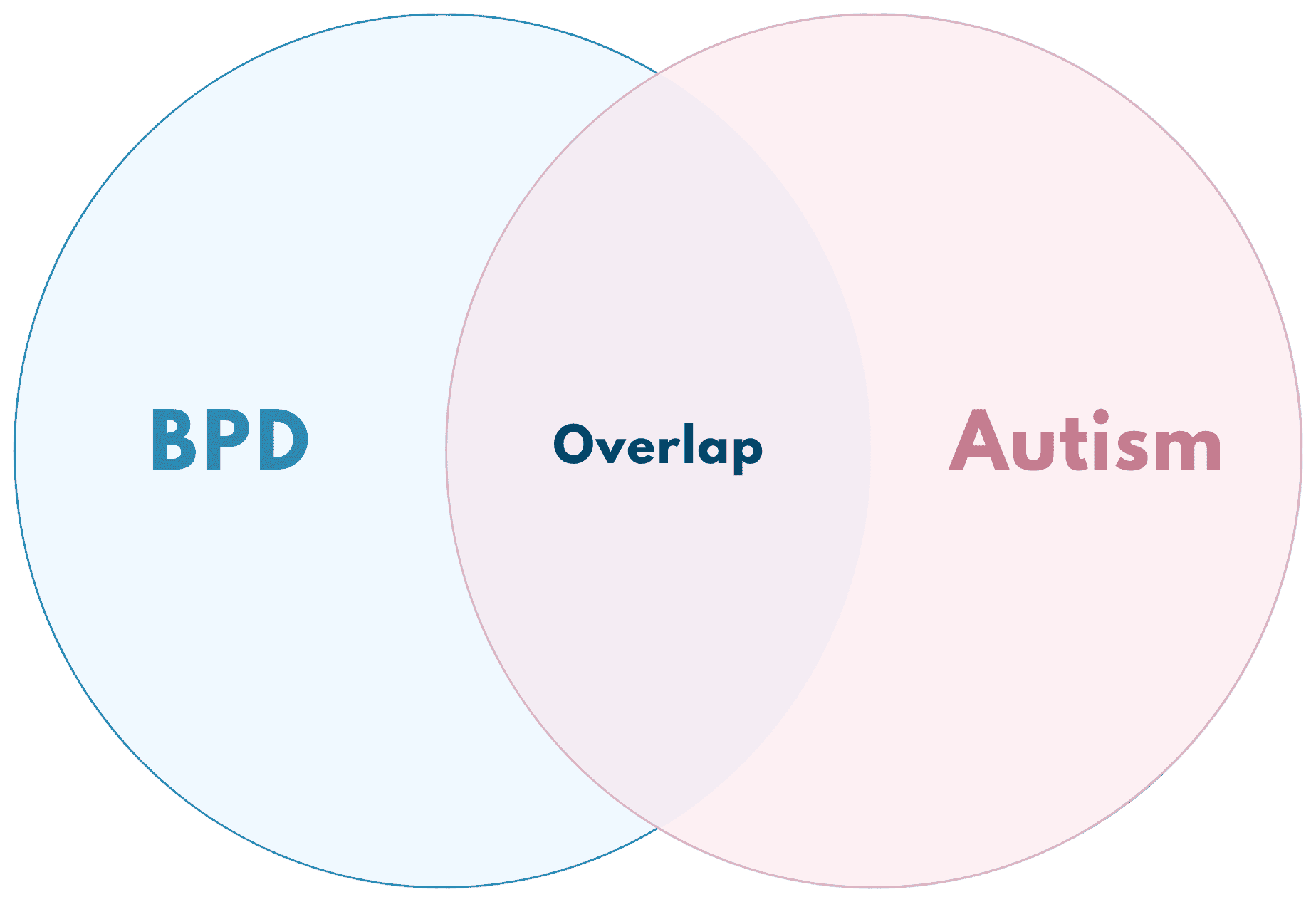
Borderline personality disorder (BPD) and autism might seem like they have little in common, and in some ways that’s true. From the outside, though, they can look a lot alike. Intense emotions, a shaky sense of identity, and relationships that feel hard to hold onto can show up in both, often for very different reasons.
When autism is missed, BPD can become the only lens for understanding a person’s struggles. And because BPD is a heavily stigmatized diagnosis, that lens can shape how clinicians (and the person themselves) understand what’s going on.
Borderline Personality Disorder is a common misdiagnosis for Autistic women and gender-expansive people. Complicating matters, BPD and autism can also co-occur. So a person may be Autistic and have BPD. When the underlying autism is missed, BPD symptoms are likely exacerbated.
Many clinicians are not considering autism when assessing for BPD or other personality disorders. (Personality disorders are long-standing patterns that, for many people, started as ways of coping with painful or invalidating environments.) Whenever a person is being assessed for BPD, I think it is important that autism also be considered, as either occurring alongside the BPD or instead of the BPD.
Table of Contents
How Often Do BPD and Autism Co-Occur?
For autism, the research is thin. One meta-analysis found BPD in about 4% of Autistic samples and autism in about 3% of BPD samples. Given how many Autistic people who mask a lot remain undiagnosed, it is difficult to know the true rate of co-occurring BPD and autism.
Many of us also have more sensitive nervous systems, so hard experiences can hit harder and stay with us longer. Research on autism suggests we may be more vulnerable to developing PTSD after trauma. And we tend to face more of those experiences in the first place, including more victimization, discrimination, and ableism.
Marsha Linehan’s biosocial theory, one of the main models of BPD, describes BPD as developing when high emotional sensitivity meets a chronically invalidating environment. That may be part of why BPD shows up in some Autistic people.
A lot of Autistic people grew up with a sensitive nervous system in environments that didn’t understand it.
Overlapping Autistic and BPD Traits
Much of the confusion comes from what a clinician can see from the outside. The traits below are where the two most often get mixed up.
Sensitivity to Abandonment
Rejection Sensitive Dysphoria is common among Autistic people and ADHDers. Rejection sensitivity is an intense sensitivity to rejection or perceived rejection. In a 2025 qualitative study, Autistic adults described overwhelming, exhausting emotions when anticipating or perceiving rejection. People with RSD often go to great lengths to avoid situations that cause them to feel rejected. They also have strong reactions when they perceive themselves as being rejected. This can look similar to the fear of abandonment seen in BPD.
For more information about Rejection Sensitive Dysphoria and how to cope, see the full workbook here.
A Diffuse Sense of Self
A core feature of BPD is a “diffuse sense of self” or lack of “self-identity,” often resulting from early childhood development/trauma. Autistic people who mask a lot, who learn to socialize through copying/becoming chameleons, can lose touch with their own identity. In one study of camouflaging, Autistic adults described copying socially successful people and feeling they had lost track of who they were.
Chronic Feelings of Emptiness
Chronic emptiness is a core feature of BPD. Clinically, I saw this often among Autistic adults who mask a lot. This may be related to diffuse identity due to social masking. Many Autistic people also experience a sense of emptiness during burnout and when not actively engaged in a task.
Social and Relationship Difficulties
Social interactions & maintaining long-term relationships can be challenging for both groups. However, the core reasons behind the difficulty often have different origins and need to be considered.
Emotional Dysregulation
Emotional dysregulation is a core feature of BPD. Many Autistic people also struggle with emotional regulation, related to differences in how the Autistic brain and nervous system process emotion. Sensory overload and sensory meltdowns can also lead to emotional dysregulation.
Sexual and Gender Identity
People with BPD often describe an unstable sense of self, and identity disturbance in BPD can include shifts in goals, beliefs, and sexual identity.
Autistic people are more likely than non-autistic people to be gender expansive, and gender-expansive people are more likely to be Autistic than cisgender people.
In one large study, people who don’t identify with the sex they were assigned at birth were 3 to 6 times more likely to be Autistic than cisgender people.
Autistic people are also more likely to be non-heterosexual than the general population, according to research summarized by SPARK.
In BPD, research on sexual and gender identity is limited and mixed. In one community study of 835 teens, sexual minority teens scored higher on borderline features than heterosexual teens. A study of 100 women with BPD found none met criteria for gender dysphoria.
These are co-occurrence findings. They don’t mean gender expansiveness is a symptom of autism or BPD. This is a social identity that is more likely to also be present which is another reason they may present similarly clinically.
Depersonalization and Derealization
Depersonalization involves the sensation that a person’s body/self is unreal or altered in a strange way.
Derealization involves the experience of the external world being bizarre, unreal, or dream-like.
Both can be a response to trauma; however, they can also be a response to sensory overload as the body shuts down to keep from taking in more sensory information. Dissociation is common in BPD, affecting about two-thirds of people in some estimates. It can also show up in Autistic people. I write more about this in Autism, ADHD, and Dissociation: Why We Fog Out.
Insecure Attachment Style
In a review of attachment studies, BPD was strongly linked with insecure attachment, most often unresolved, preoccupied, or fearful styles.
Insecure attachment is also common among Autistic people, but it may lean more avoidant. In one study of university students, higher Autistic traits were linked with avoidant attachment but not with anxious attachment.
Certain Autistic behaviors may look like a disorganized attachment. Thus, it can be challenging to identify an Autistic trait vs. a disorganized attachment style.
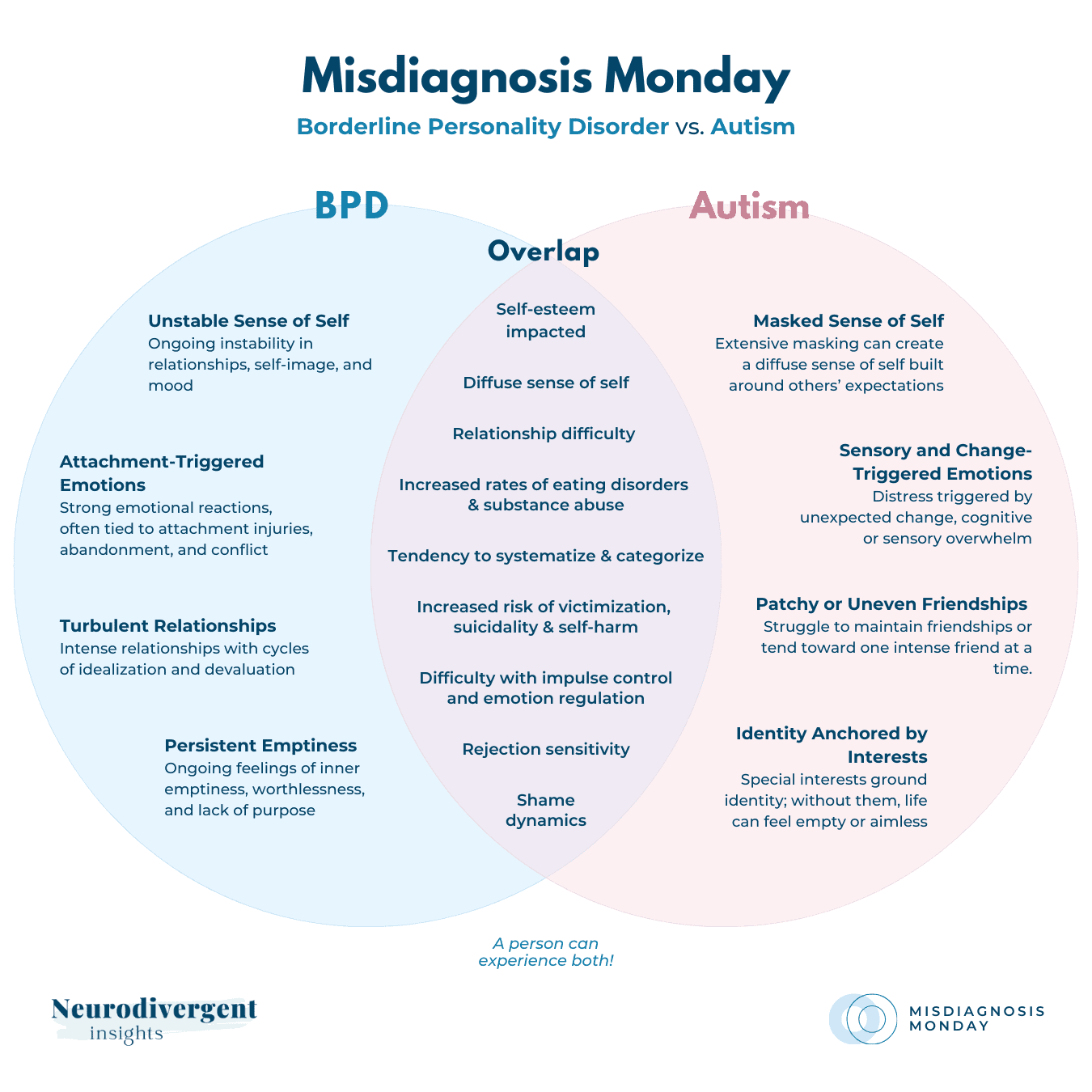
Where BPD and Autism Differ
To tease out the difference between Autistic traits and BPD symptoms, it is important to understand the person’s internal experience. Here are a few places I focused on when assessing.
Criterion B of Autism
While BPD and autism share a lot of overlap, many aspects of Criterion B for autism are distinct from BPD. For example, the presence of special interests, strict adherence to routine, and self-soothing through repetition are distinct Autistic experiences.
Social Differences
While both groups experience social and relationship difficulties, the origins differ. For BPD, they are attachment-based and often revolve around unstable relationships and idealization and devaluation dynamics. For Autistic people, they are related to differences in social initiation, small talk, and allistic communication. Autistic people often do better when socializing with other Autistic people or connecting around shared interests.
Overlapping Risks
This section covers eating disorders, substance use, victimization, suicide, and self-harm. Skip it if that feels like too much right now. We keep a list of neurodivergent-affirming crisis resources.
Substance Use/Addiction
For a long time, it was assumed that substance use problems were low among Autistic people (due to adherence to rules).
Newer research points to the hidden side of addiction in autism. A large study in Sweden found that Autistic people without an intellectual disability were about twice as likely to struggle with substance use problems, and the risk was highest for people who were both Autistic and ADHD. Among Autistic people, drugs are sometimes used to cope with social stress and sensory problems.
Alcohol and drugs can be a way to regulate a nervous system when it is flooded with stress hormones. This can be a common way a person self-soothes following trauma. About half of people with BPD also have a co-occurring substance use disorder, most often involving alcohol.
Victimization
Both groups have elevated risks of victimization. In one large Swedish twin study, Autistic girls had almost three times the risk of coercive sexual victimization in childhood and adolescence. Some risk factors include:
- Challenges in social reasoning
- Missing contextual cues
- A tendency to take things literally
One small study found that Autistic adults were 7.3 times more likely to endorse sexual assault by a peer in childhood.
Suicidality
In Denmark, researchers following more than 35,000 Autistic people found over three times the rate of suicide attempts and suicide compared with non-autistic people. Most of those who attempted or died by suicide also had another psychiatric diagnosis.
Self-Harm
Self-harm is common among both groups. Self-harm more commonly happens in the context of sensory overload for Autistic people. In the context of BPD, it tends to happen around relationship conflict and emotional dysregulation.
One study found that parents reported suicidal and/or self-harm behaviors in nearly 15% of Autistic children ages 7 to 11.
Autistic teenagers are also more likely to engage in self-harm behavior. Self-harm can be in the form of cutting, skin-picking, hair-pulling, and hitting.
Eating Disorders
Both groups have a high percentage of eating disorders (which may work as a way to self-soothe or gain a sense of control). One study found that 21.7% of people with BPD met criteria for anorexia nervosa and 24.1% for bulimia nervosa.
While the rates vary, one review put the average estimate of autism among people diagnosed with anorexia nervosa at about 23%.
Co-occurring Mood Disorders
Both groups have an elevated risk of having co-occurring mood disorders such as depression and anxiety.
According to one study, 79% of Autistic adults met the criteria for a co-occurring psychiatric condition at least once in their life.
Major depressive disorder and PTSD commonly co-occur with BPD. In one study of people hospitalized with BPD, over 90% met criteria for a mood disorder such as depression.
Summary
Autism and borderline personality disorder can co-occur, or they can be misdiagnosed as one another. To the untrained eye, undiagnosed autism can easily look like BPD. To understand the difference, it is important to consider the possibility of autism and to understand the internal experience of the person to tease out Autistic traits from BPD symptoms. To read more about the similarities and differences between autism and BPD, see my ebook here.
BPD vs. Autism FAQs
Can autism be misdiagnosed as BPD?
Yes. BPD is a common misdiagnosis for Autistic people, particularly Autistic women and gender-expansive people. For Autistic people who mask a lot, a diffuse sense of self from masking, sensory overload that looks like angry outbursts, and difficulty with emotions and relationships can all look like BPD. Whenever a person is being assessed for BPD, I think it is important that autism also be considered.
Can you have both autism and BPD?
It’s possible to be Autistic and have BPD, though research on how often this happens is thin. One meta-analysis found BPD in about 4% of Autistic samples. Because many Autistic people are never identified as Autistic, the true rate is hard to know.
What is the difference between BPD and autism?
Some things point more toward autism: special interests, a strong need for routine, and stimming (repetitive movements or sounds that help us regulate). Relationship struggles in BPD tend to be attachment-based, while for Autistic people they are more often tied to differences in social communication. Many Autistic people do better socially with other Autistic people or around shared interests.
Is chronic emptiness a sign of autism or BPD?
It can show up in both, and it is a core feature of BPD. Clinically, I also saw it often among Autistic adults, especially those who masked a lot, and often during burnout or long stretches without something meaningful to do. In autism, it may be related to the diffuse sense of identity that can come with long-term masking.
Additional Resources

Autism or BPD eBook: More on the similarities and differences between autism and BPD.

BPD, ADHD, and Autism: How all three overlap.

BPD DSM Criteria Explained: The nine criteria in pictures.
Rejection Sensitive Dysphoria: Managing RSD.
Autism, ADHD, and Dissociation: Why we fog out.
 Stay in the Neurodivergent Loop
For ongoing insights and updates, subscribe to the Neurodivergent Insights Newsletter. Each Sunday, I send out fresh thoughts and a roundup of the newest resources on topics related to neurodivergence, mental health, and wellness. My most personal writing is reserved for my newsletter, and subscribers also get access to the newsletter vault (12+ PDFs) when they join.
References
Agrawal, H. R., et al. (2004). Attachment studies with borderline patients: A review. Harvard Review of Psychiatry.
Biskin, R. S., & Paris, J. (2012). Diagnosing borderline personality disorder. CMAJ.
Butwicka, A., et al. (2017). Increased risk for substance use-related problems in autism spectrum disorders: A population-based cohort study. Journal of Autism and Developmental Disorders.
Coughlan, B., et al. (2019). Attachment and autism spectrum conditions: Exploring Mary Main’s coding notes. Developmental Child Welfare.
Dudas, R. B., et al. (2017). The overlap between autistic spectrum conditions and borderline personality disorder. PLoS One.
Gallitto, E., & Leth-Steensen, C. (2015). Autistic traits and adult attachment styles. Personality and Individual Differences.
Hull, L., et al. (2017). “Putting on my best normal”: Social camouflaging in adults with autism spectrum conditions. Journal of Autism and Developmental Disorders.
Hunsche, M. C., et al. (2020). Parent-reported rates and clinical correlates of suicidality in children with autism spectrum disorder: A longitudinal study. Journal of Autism and Developmental Disorders.
Kõlves, K., et al. (2021). Assessment of suicidal behaviors among individuals with autism spectrum disorder in Denmark. JAMA Network Open.
Korzekwa, M. I., Dell, P. F., & Pain, C. (2009). Dissociation and borderline personality disorder: An update for clinicians. Current Psychiatry Reports.
Lever, A. G., & Geurts, H. M. (2016). Psychiatric co-occurring symptoms and disorders in young, middle-aged, and older adults with autism spectrum disorder. Journal of Autism and Developmental Disorders.
McKenzie, R., & Dallos, R. (2017). Autism and attachment difficulties: Overlap of symptoms, implications and innovative solutions. Clinical Child Psychology and Psychiatry.
May, T., et al. (2021). Overlap of autism spectrum disorder and borderline personality disorder: A systematic review and meta-analysis. Autism Research.
Ohlsson Gotby, V., et al. (2018). Childhood neurodevelopmental disorders and risk of coercive sexual victimization in childhood and adolescence: A population-based prospective twin study. Journal of Child Psychology and Psychiatry.
Reuter, T. R., et al. (2016). Sexual orientation and borderline personality disorder features in a community sample of adolescents. Journal of Personality Disorders.
Rumball, F., Happé, F., & Grey, N. (2020). Experience of trauma and PTSD symptoms in autistic adults: Risk of PTSD development following DSM-5 and non-DSM-5 traumatic life events. Autism Research.
Singh, D., McMain, S., & Zucker, K. J. (2011). Gender identity and sexual orientation in women with borderline personality disorder. The Journal of Sexual Medicine.
Szalavitz, M. (2017). Autism’s hidden habit. Spectrum.
Trull, T. J., et al. (2018). Borderline personality disorder and substance use disorders: An updated review. Borderline Personality Disorder and Emotion Dysregulation.
van Asselt, A., et al. (2025). ‘Feeling constantly kicked down’: A qualitative phenomenological study exploring rejection sensitivity in autistic adults. Autism.
Warrier, V., et al. (2020). Elevated rates of autism, other neurodevelopmental and psychiatric diagnoses, and autistic traits in transgender and gender-diverse individuals. Nature Communications.
Weiss, J. A., & Fardella, M. A. (2018). Victimization and perpetration experiences of adults with autism. Frontiers in Psychiatry.
Westwood, H., & Tchanturia, K. (2017). Autism spectrum disorder in anorexia nervosa: An updated literature review. Current Psychiatry Reports.
Zanarini, M. C., et al. (1998). Axis I comorbidity of borderline personality disorder. American Journal of Psychiatry.
Zanarini, M. C., et al. (2010). The course of eating disorders in patients with borderline personality disorder: A 10-year follow-up study. International Journal of Eating Disorders.