This is part of an ongoing wellness series, you can find the full collection of articles here.
Are you familiar with Zoomies?
If you’re a pet owner you’ve probably seen this phenomenon. It’s that sudden burst of frantic, joyful energy when an animal runs wildly around for no apparent reason.
The first time I really noticed this was after giving my anxious dog, Elliott, a bath. Once the ordeal was over, he’d sprint through the house at top speed, skidding across floors and ricocheting off furniture. While watching this familiar ritual, I pointed it out to my kids and said, “Look — Elliott is completing the stress cycle!”
This was met with immediate eye rolls. My children have long lost patience with me turning everyday moments into psychology lessons. My youngest is especially quick to say, “Mom… don’t turn this into a psychology thing.” (I’ll let you imagine how fun it is to have me as a mother.)
Still, I can’t quite help myself.
Table of Contents
What the Zoomies Are Really Doing
Animals often get the zoomies after a period of heightened stress or arousal. What looks like random energy is actually purposeful — they’re releasing what their bodies mobilized in response to stress so they can return to their baseline.
In the wild, this happens instinctively. For example, when an animal escapes a predator and reaches safety, it doesn’t sit still and reflect on what just happened. It trembles. Its body shakes off that extra energy. Only then does it return to equilibrium and rest.
That physical discharge helps to complete the stress cycle. It tells the nervous system: the danger has passed.
Why Modern Life Makes Completing the Stress Cycle Hard
In the wild, stressors tend to be acute and time-limited. There’s a clear beginning and end — a threat appears, the body mobilizes, and then the danger passes. The nervous system knows when it’s over. Human nervous systems evolved for that kind of clear beginning-and-end stress. Modern life, however, rarely offers clean stress.
Our stressors are often ongoing, abstract, or never fully “done” — constant notifications, work pressure, caregiving, chronic illness, financial uncertainty. We live with dozens of open loops, slowly dripping stress. Even when nothing immediate is happening, the body may still be carrying stress from earlier in the day. Or the week. Or much longer.
As I write this, I have dozens of unanswered emails, tasks and notifications all vying for my attention. My body responds to that with stress — even though unanswered emails aren’t a true threat. Our nervous systems aren’t especially good at distinguishing between life-threatening stress and modern stress. The stressors keep coming, which means the stress often doesn’t get released. Over time, it builds… and builds… until it’s just there.*
Stress vs. Stressor (Why Stress Lingers in the Body)
For many of us, unresolved stress accumulates in the body. It can show up as anxiety, somatic complaints, or a general sense of being keyed up and on edge.
This is where the distinction between stress and stressor becomes important.
The stressor is the external event — the email, the deadline, the ongoing responsibility, the thing asking for our attention. Stress is what happens inside the body in response. And while stressors may pause, repeat, or never fully resolve, the stress they generate can linger long after the moment has passed.
This is one of the insights that stood out to me most when I read Burnout by Emily and Amelia Nagoski. They name something really important for humans navigating modern life: we don’t have to wait for the stressor to be over in order to address the stress.
Many of our stressors are open loops. Ongoing. Chronic. If we wait for them to be “done” before allowing our bodies to release stress, we may never get there. Some stressors are persistent but not immediately dangerous, like email, admin, or unfinished tasks. Others, including war, violence, and systemic harm, are very real threats, even when we have little power to change them directly. In both cases, the stress doesn’t really end. It stays with us, looping in the background, even when there’s no clear way to resolve it.
Completing the stress cycle, then, isn’t always about fixing or eliminating the stressor. It’s about helping the body discharge what it has mobilized, even when the stressor remains. Learning how to do that intentionally, and regularly is one of the ways we protect our nervous systems.
Completing the Stress Cycle
So if we can’t wait for stressors to end, the question becomes: how does the body actually release stress?
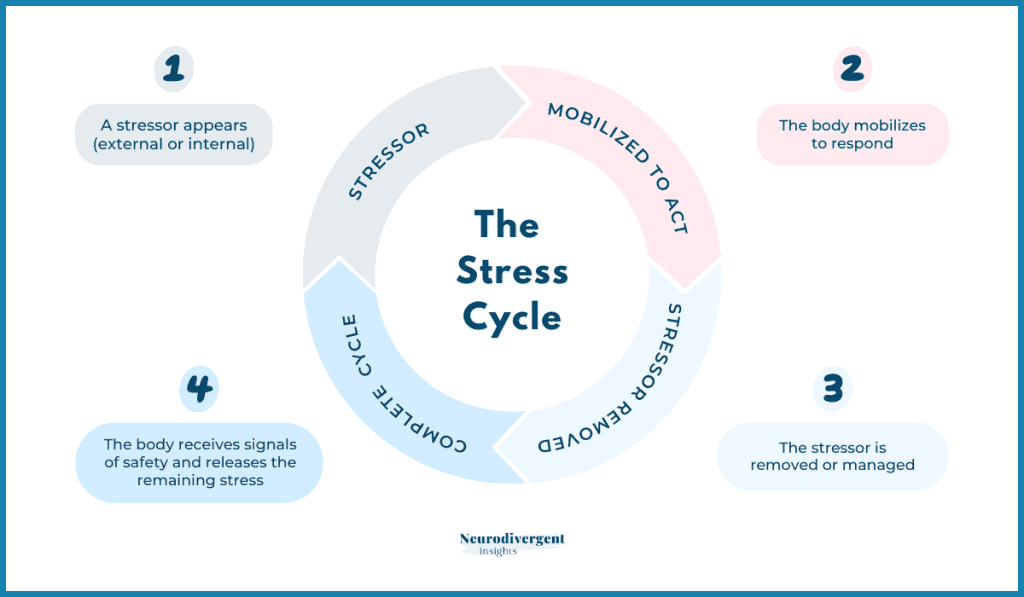
This is where the concept of completing the stress cycle becomes useful. At its core, the idea is simple: stress follows a cycle, and our bodies need signals of safety to fully complete it. The cycle looks like this:
- A stressor appears (external or internal)
- The body mobilizes to respond
- The stressor is removed or managed
- The body receives signals of safety and releases the remaining stress
That final step is crucial — this is how we complete the cycle and release the stress from our bodies, it’s also precisely what is often missing in modern life.
The body doesn’t complete the cycle through insight or willpower alone. It completes it through physical and relational signals of safety.
How those signals often come through:
- connection (being with someone who feels safe)
- rhythm (movement, breath, repetition)
- familiarity (routines, known sensations)
- predictability (a sense of what comes next)
When the body receives enough of these cues, it can finally let go of the stress it’s been holding.
How to Complete the Stress Cycle
Sometimes completing the stress cycle seems obvious — like going for a run or laughing hard with a friend. Other times, it’s a bit more subtle.
For me, it often shows up as pacing after a difficult conversation. Or crying in a hot shower. Or laughing at dark comedy. Or listening to loud music and moving my body. Or listening to a stim song on repeat with weight and vibrations on my body.
The Nagoski sisters suggest spending about 20 minutes a day doing something that helps complete the stress cycle. I like this framing because it’s concrete and doesn’t require remembering it in the moment of stress; instead, it builds moments of release into daily life.
Here are a few practices that can help release stress and complete the cycle:
Through Movement and Release
- Movement — walking, dancing, stretching, pacing or any form of physical motion
- Shaking or stimming — letting the body discharge energy
Emotional Release and Completing the Stress Cycle
- Laughter — genuine laughter helps reset the nervous system
- Crying — many people feel relief afterward because it helps release built-up stress
Signals of Safety: Breath, Pressure, and Connection
- Breathwork — slow, intentional breathing can help cue the nervous system toward safety and activate the parasympathetic nervous system
- Pressure, vibration, or connection — hugging someone you trust, using weighted input, or steady rhythmic sensation
Completing the Stress Cycle During Shutdown
For many neurodivergent people, stress may also show up as shutdown. In shutdown, the nervous system isn’t calm; it’s immobilized. I think of this as stress being frozen in the body.
Frozen stress doesn’t mean the cycle is complete. It means the body needs gentler signals of safety before it can release what it’s holding.
If you tend toward shutdown, the release often needs to be gentler at first. Think thawing rather than forcing release. A grounded walk, soft stretching, or rhythmic stimming can help warm the system before introducing more vigorous movement.
Some supportive starting points might include:
- Gentle movement
- Grounded walking
- Rhythmic stimming

Why Completing the Stress Cycle Matters
In modern life, stress isn’t something we “solve” and move on from. It tends to stay with us, tucked into the body, unless we give it a way to move through.
For me, this looks pretty ordinary. Today I’ll probably spend a few hours addressing one of my stressors, like preparing for one of my upcoming talks. Later, I’ll take a walk to help my body release the stress the week stirred up. Both help, but for different reasons.
I wish you a week with space to address the stressors in your life and opportunities to release the stress they leave behind. And maybe, in whatever form it shows up, a chance to get out your own version of the zoomies.
Further Reading and Resources
More Learning
- For more about the mechanics of the nervous system, check out our article on the Autistic and ADHD nervous system. It explains concepts like the sympathetic nervous system, and more.
- In this interview Brene Brown did with the Nagoski sisters, they unpack the stress cycle and discuss these ideas in depth.
- You can check out the Nagoski sister’s book Burnout here.
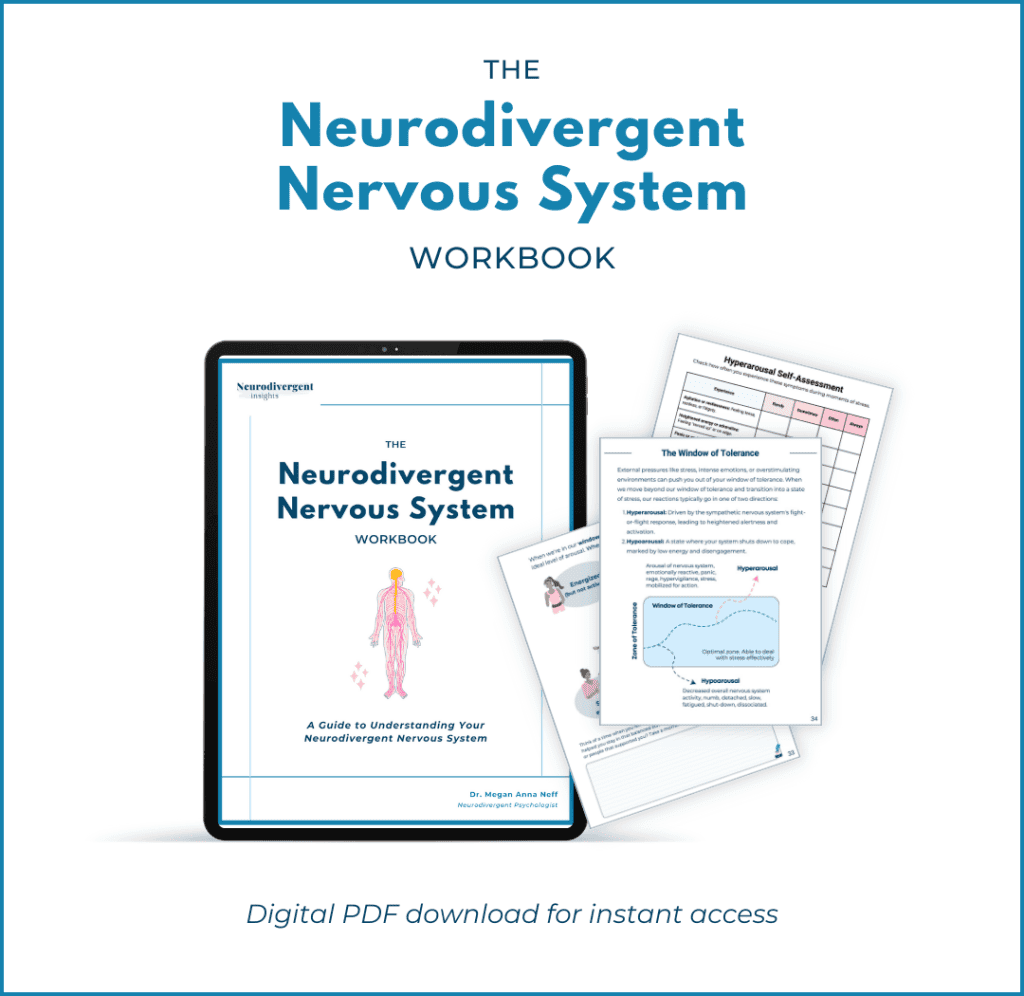
- For more on the nervous system in general, you can check out the Neurodivergent Nervous System workbook
Youtube Video
You can now catch the Neurodivergent Insights interview Dr. Neff and Brett recorded about this article!
NDI Visual Guide

Prefer to engage or share this information visually? Our Free NDI visual Guides are abbreviated, visual-forward highlights of our longer articles.
🗞️ Stay in the Neurodivergent Loop
For ongoing insights and updates, subscribe to the Neurodivergent Insights Newsletter. Each Sunday, I send out fresh thoughts and a roundup of the newest resources on topics related to neurodivergence, mental health, and wellness. My most personal writing is reserved for my newsletter, and subscribers also get access to the newsletter vault (12+ PDFs) when they join.
Footnote
This article was originally written in early January and published on January 19th. There are many very real stressors unfolding in the world right now, stressors that understandably activate fight-or-flight and other survival responses. At times, we need these responses for safety. And for many people, especially those living under systems of chronic threat, unsafety isn’t occasional—it’s ongoing.
This is where the idea of “present-moment safety” can matter. It doesn’t deny real or persistent danger. Rather, it encourages us to anchor into small pockets of safety when we have them — moments where the nervous system can release some of the stored stress, so there is more capacity, strength, and steadiness for what comes next.
References
Reznick, A. Z. (1989). The cycle of stress: A circular model for the psychobiological response to strain and stress. Medical Hypotheses, 30(3), 217-222. https://doi.org/10.1016/0306-9877(89)90064-9
Burnout: The Secret to Unlocking the Stress Cycle by Emily and Amelia Nagoski.